
The best windows for new construction are the ones specified to the house before the rough openings are framed: a whole-window U-factor that meets the energy model, an operable size that covers the largest opening, a frame depth and installation method that suit the wall, and an exterior finish with written terms. There is no single best window brand for a new build - the US clad-wood lines publish casements up to 47 x 108 in (Pella Reserve) and NFRC ranges that reach U-0.19 to 0.23 with triple glass, while the European systems I quote reach a best catalog value of U-0.11 (Uw 0.60 W/m2K, Aluprof MB-86 AERO) in frames 2.76 to 3.39 in (70 to 86 mm) deep. Pick a US line for traditional double-hung styles and a local-dealer schedule, and a European system when the energy target, tilt-turn operation or large operable glass drives the design.
I am an independent agent sourcing European windows and doors in aluminum, uPVC, wood, aluminum-clad wood and real steel for projects in the US and Canada, so I sell one side of this comparison. Every US number below comes from the brand's own design manuals, product guides and warranty documents, and every European number from the system provider's catalog, accessed 2026-10-30.
How new construction windows differ from replacement windows
New construction windows differ from replacement windows because nothing about the opening is fixed yet: the rough opening, the frame depth, the installation method and the glass are all choices. A replacement fits the old frame - JELD-WEN's Siteline pocket units are 3 1/4 in deep against 4 9/16 in for the standard clad casement. On a new build you size the rough opening to the window, pick a nailing fin or brackets, and specify the glass to the energy model.
That freedom has a deadline: the decision has to land before framing, while the drawings can still move. Imported units are built from approved shop drawings, with the lead time confirmed per order - the phases are in how long European windows take to arrive.
What makes a window the best for new construction: 5 criteria
Five criteria decide which window is best on a new build, and each one has a number you can ask any supplier for before you sign.
1. Whole-window U-factor that meets the energy model
The U-factor that counts is the whole-window value your energy model or prescriptive path requires, not a center-of-glass number. California's 2025 prescriptive path for new single-family homes, for example, sets U-0.27 in climate zones 1-5, 11-14 and 16 and U-0.30 in zones 6-10 and 15.
The US brands publish an NFRC range per line: for vent casements, 0.23-0.31 for Pella Reserve Traditional, 0.19-0.30 for Pella Lifestyle Series (the low end with its triple-pane hinged glass panel) and 0.20-0.29 for Andersen A-Series. Marvin Ultimate and Andersen E-Series publish their values only through each brand's online NFRC lookup, so I give no number for them here. The European systems I quote reach 0.11 to 0.16 at best, converted from Uw - a metric catalog value, not an NFRC rating. What U-factor to target by climate explains the difference.
2. Operable size for the largest opening
The largest operable unit a line makes should set your elevation. The biggest published casement runs from 36 x 72 in (Andersen E-Series) through 42 x 84 in (JELD-WEN Siteline) and 42 x 102 in (Marvin Ultimate) to 47 x 108 in (Pella Reserve). European catalogs state the limit per sash: Reynaers MasterLine 8 takes a sash up to 9 ft 2 in (2,800 mm) tall and 441 lb (200 kg), with the width confirmed per order. The measures differ, so compare drawn units, not catalog maxima.
3. Frame depth and position in the wall
Frame depth tells you how the window meets the wall. US clad-wood jambs are 4 9/16 in (116 mm) on Marvin Ultimate and JELD-WEN Siteline and 5 in (127 mm) on Pella Reserve Traditional; Siteline extends to 8 9/16 in with extenders. The European profiles I quote are 2.76 to 3.39 in (70 to 86 mm). Shallower is not worse: you choose where the frame sits in the wall and how the interior return is trimmed.
4. Installation method
The installation method has to match the wall and the crew: a nailing fin for a sheathed frame wall, brackets for masonry, deep walls or a frame set inboard. Most European systems are bracketed and some carry a fin - the installation section below covers the choice.
5. Exterior finish and written warranty
The coating spec decides how long the exterior finish is covered: JELD-WEN covers AAMA 2605 for 30 years and AAMA 2603/2604 for 10, and Marvin covers its standard AAMA 2605 cladding for 20 years (10 within 1 mile of salt water). Pella's standard EnduraClad is AAMA 2603, with 2605 as an option. On the product, Marvin and Andersen give 20 years on glass and 10 on non-glass parts, transferable; JELD-WEN gives 20 years with at most 10 after a sale; Pella's wood lines carry a Limited Lifetime for the original owner, 2 years on labor and 10 transferable years for later owners. What I supply in aluminum, uPVC, wood and aluminum-clad wood carries a 10-year written warranty from Windows Guy; steel terms are confirmed per project.
Best window materials for new construction
Each of the five material families wins a different kind of new build.
Aluminum
Thermally broken aluminum gives the slimmest sightlines, the largest operable and sliding units and any RAL color; its thermal value depends on the thermal-break tier (Aluprof MB-86 runs from Uf 1.60 W/m2K standard to 0.74 with aerogel). It suits modern homes with big glass - see the aluminum systems I quote.
Aluminum-clad wood
Aluminum-clad wood puts a timber interior behind an aluminum exterior, which is also what the premium US lines are: Pella Reserve, Marvin Ultimate, Andersen E-Series and JELD-WEN Siteline. My European lines are Clad Flush, Clad Hidden Sash and Clad Passive - see wood inside, aluminum outside and aluclad vs aluminum vs wood.
Wood
All-timber windows give wood character inside and out, at the price of exterior finish care. I quote them as Timber Classic and Timber Estate, laminated timber with the species chosen per project - see the timber windows I source.
uPVC
uPVC is the budget tier of the systems I quote and still a strong thermal performer: Aluplast Ideal Neo is a 6-chamber, 3.35 in (85 mm) profile at U-0.13 (Uw 0.74 W/m2K) with triple glass, in white, RAL colors or woodgrain - see uPVC windows.
Real steel
Real steel means thermally broken steel profiles - Jansen Janisol HI, with a 3.15 in (80 mm) door section and a 3.54 in (90 mm) window sash - for elevations where the steel section is the design. It is made to order and quoted from drawings, never priced online. See thermally broken steel doors and windows.
US window brands that fit new construction
The four big US brands all make clad-wood lines for custom new construction, and the table compares them from each brand's own documents, including Pella's architect design manual.
| Line | Interior | Exterior | Clad finish | Frame depth | Casement max (W x H) | Glazing | Published U-factor (NFRC) | Std colors | Tilt-turn |
|---|---|---|---|---|---|---|---|---|---|
| Pella Reserve | wood | aluminum clad or wood | AAMA 2603; 2605 option | 5" (127 mm) | 47" x 108" | dual, triple (option) | 0.23-0.31 (vent casement) | n/p | no |
| Marvin Ultimate | wood | aluminum clad (wood on select products) | AAMA 2605 | 4 9/16" (116 mm) | 42" x 102" | dual, triple (select products) | brand online lookup only | 19 | no |
| Andersen E-Series | wood | aluminum clad | AAMA 2604; 2605 option | n/p | 36" x 72" | dual, triple (option) | brand online lookup only | 50 | no |
| JELD-WEN Siteline | pine (AuraLast) | aluminum clad or wood | AAMA 2603/2604; 2605 option | 4 9/16" (116 mm) | 42" x 84" | dual (Low-E insulating) | as low as 0.16 (line-wide) | 27 | no |
Brand-published specifications, accessed 2026-10-30. n/p = not published. U-factors are NFRC whole-window values from the brand's own documents; the bracket says what they cover (a vent casement range or a line-wide "as low as"). The exact unit, glass and size set the rating on the label.
Pella Reserve has the largest published casement, 47 x 108 in, three interior species and CW30 to CW50 on clad casements. Marvin Ultimate lists six species, 19 standard colors and AAMA 2605 as standard. Andersen E-Series has the widest palette, 50 colors and 11 species, with CW-PG55 to CW-PG70 on tested casements. JELD-WEN Siteline offers 27 colors and PG50 at 36 x 72 in; its U-0.16 is "as low as" per JELD-WEN, line-wide, so it does not compare directly with a casement range. None of the four offers tilt-turn; all four offer double hung. More in Pella vs Marvin vs Andersen and top window brands and manufacturers.
European window systems that fit new construction
The European systems I quote for new construction start with the aluminum and uPVC platforms in this table, set beside the US jambs; two timber house lines and one real steel system follow.
| Window | Type | Frame depth | Best published U-factor |
|---|---|---|---|
| Pella Reserve | US clad wood | 5" (127 mm) | 0.23-0.31 (vent casement) |
| Marvin Ultimate | US clad wood | 4 9/16" (116 mm) | brand online lookup only |
| Andersen E-Series | US clad wood | n/p | brand online lookup only |
| JELD-WEN Siteline | US clad wood | 4 9/16" (116 mm) | as low as 0.16 (line-wide) |
| Reynaers MasterLine 8 | European aluminum | 3.03" (77 mm) | 0.16 (Uw 0.88) |
| Aluprof MB-86 | European aluminum | 3.39" (86 mm) | 0.11 (Uw 0.60) |
| Aliplast Genesis 75 | European aluminum | 2.95" (75 mm) | 0.15 (Uw 0.85) |
| Cortizo COR 70 Hidden Sash | European aluminum | 2.76" (70 mm) | 0.15 (Uw 0.84) |
| Aluplast Ideal Neo | European uPVC | 3.35" (85 mm) | 0.13 (Uw 0.74) |
US values: brand-published NFRC ranges (accessed 2026-10-30). European values: provider-published whole-window Uw in W/m2K converted with U-factor = Uw x 0.176 - a metric value for the catalog configuration, not an NFRC rating of a supplied unit.
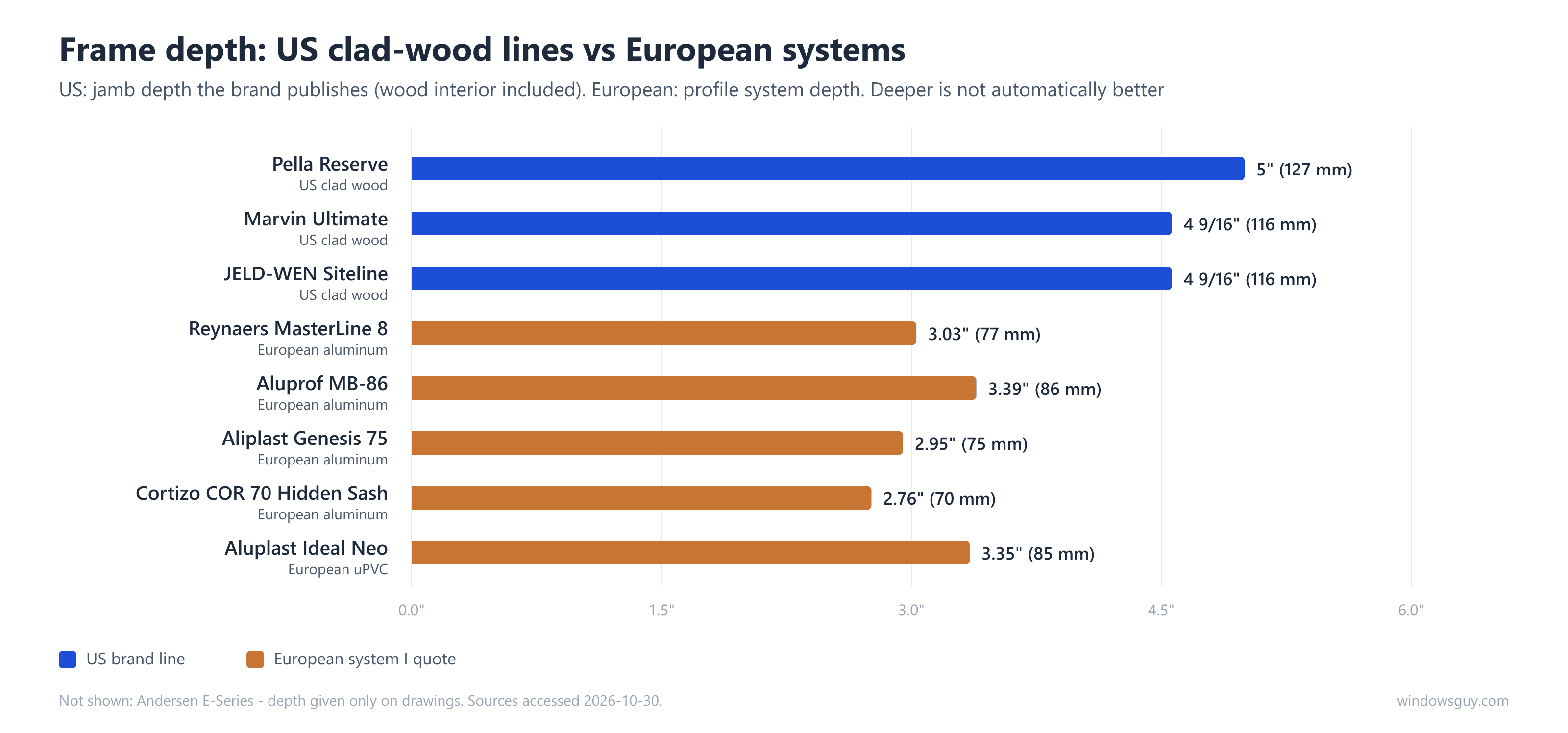
The chart compares two different measures: US jamb depth with the wood interior included, and European profile system depth. Here is what each system brings.
Reynaers MasterLine 8 is 3.03 in (77 mm) deep, at a best U-0.16 (Uw 0.88 W/m2K) in HI+, with glazing up to 2.83 in (72 mm) and wind class C5. Hidden Vent makes an opening sash look fixed.
Aluprof MB-86 is 3.39 in (86 mm) deep and reaches U-0.11 (Uw 0.60 W/m2K) in AERO, with 2.76 in (70 mm) glazing; MB-86US hides the sash.
Aliplast Genesis 75 is 2.95 in (75 mm) deep, at U-0.15 (Uw 0.85 W/m2K) triple-glazed, and the value pick; Cortizo COR 70 Hidden Sash (70 mm) suits elevations where the handle should disappear too.
Aluplast Ideal Neo is the uPVC tilt-turn platform; Ideal Neo OUT is the same 85 mm profile as an outswing casement with an integrated nailing fin, crank hardware and interior screens.
Clad Flush has a flush aluminum exterior, a 3.54 in (90 mm) reference depth, pine, meranti or oak inside, and about U-0.19 to 0.21 converted (Uw 1.1 to 1.2 W/m2K, not an NFRC rating). Timber Estate is all timber, with a substantial frame and drip-cap details.
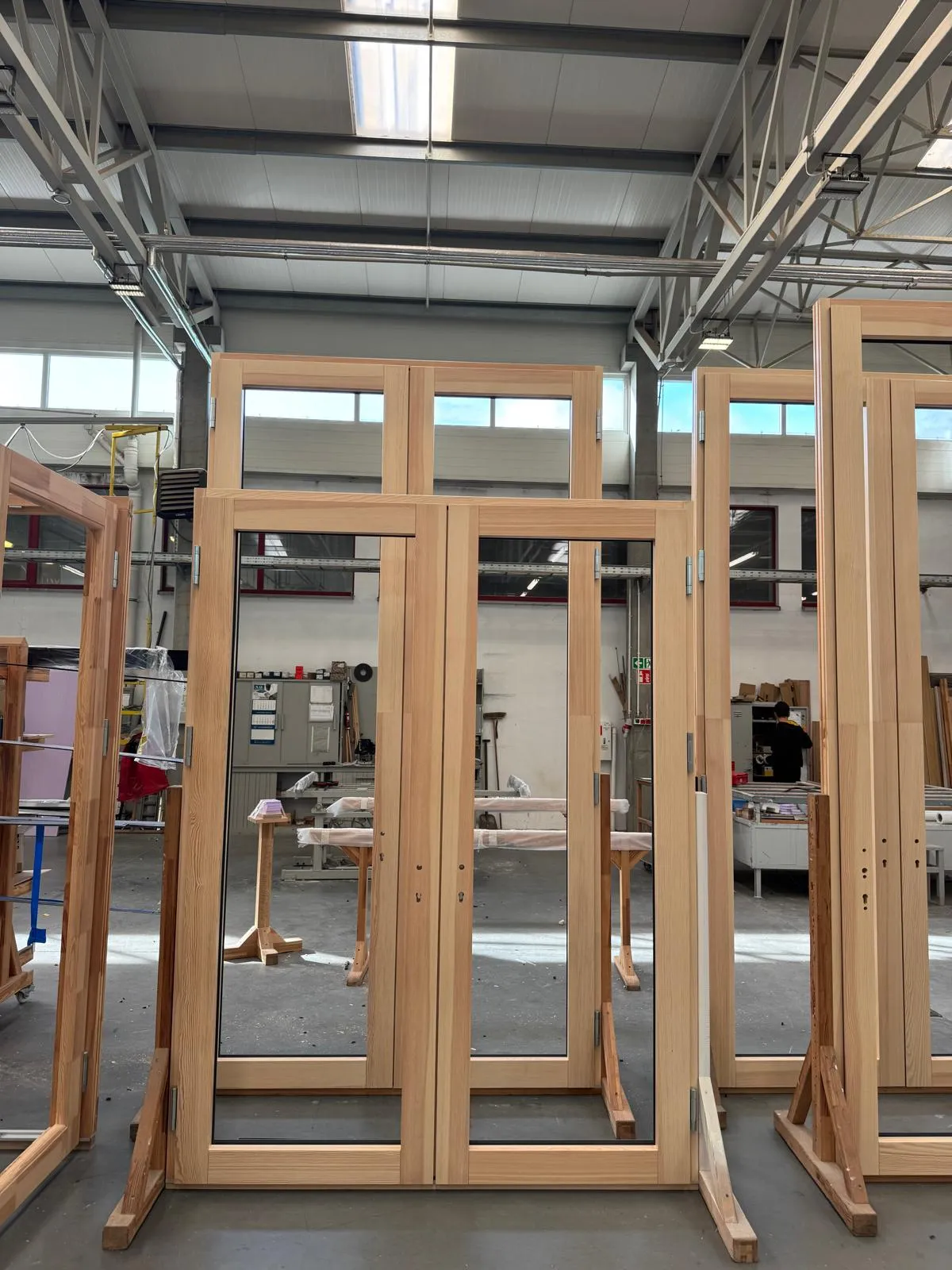
Jansen Janisol HI is the real steel option for French doors and casements, quoted from drawings.
Nailing fin or brackets: the installation question
Use a nailing fin when the wall is a sheathed wood or steel-stud frame with housewrap and the crew flashes to the fin; use brackets when the frame sits deeper in the wall, in masonry or behind exterior insulation. US lines are detailed for the fin: Marvin measures the Ultimate jamb from the nailing-fin plane, Andersen the A-Series jamb from the installation flange.
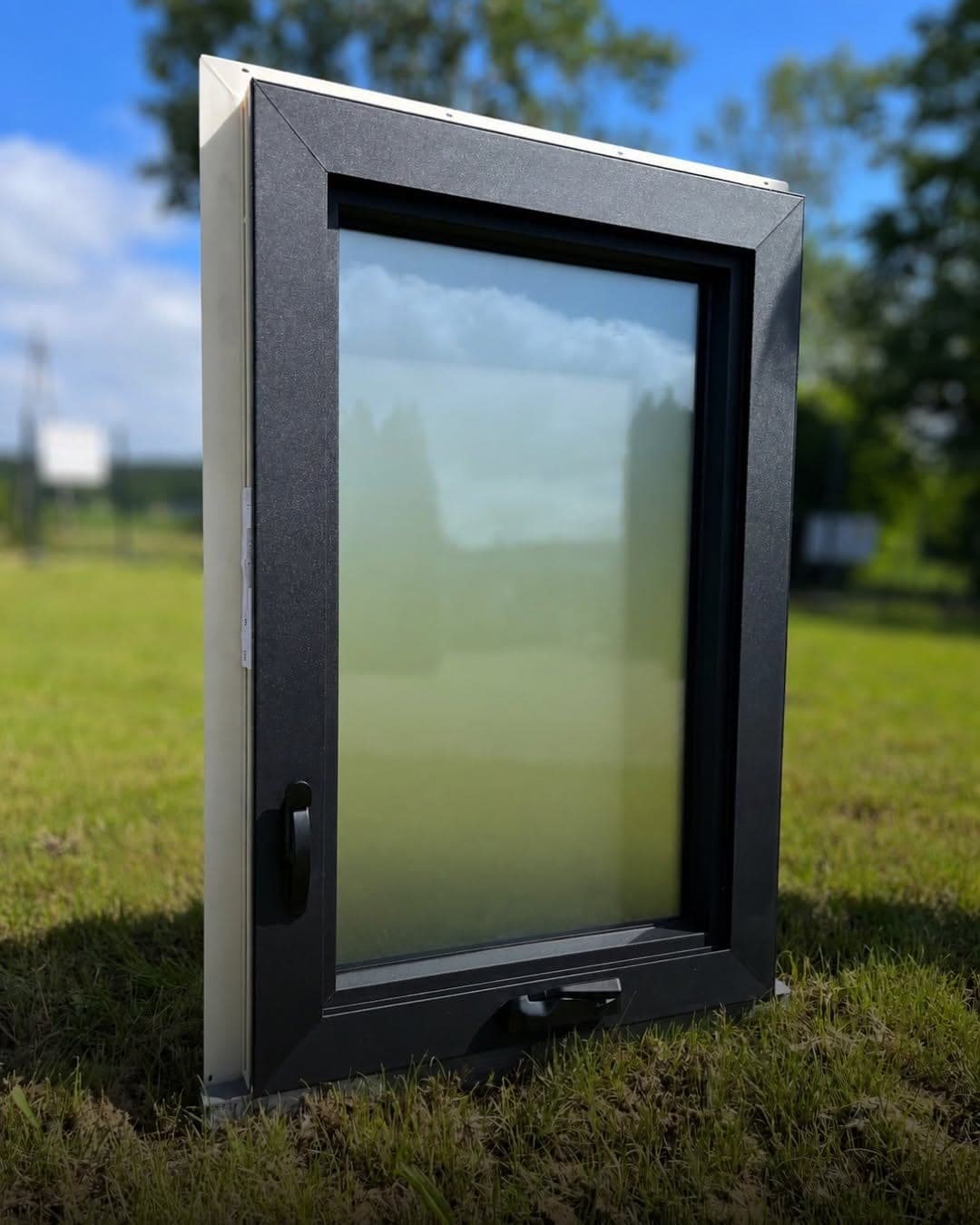
European frames are usually bracketed, so the window can sit anywhere in the wall depth - see installing bracket-mounted aluminum windows. Some carry a fin: Ideal Neo OUT has one integrated, set 1 1/8 in (29 mm) back, so it ties into the WRB and flashing like a domestic window. Which systems take a fin is in nailing flanges on European windows. Either way, put the fin setback or bracket position on the shop drawings before framing - it drives the trim, sill pan and head flashing.
What I would specify by house type
Here is what I would put on six common new builds, including the ones where I would send you to a US brand.
Traditional double-hung house
A US clad-wood line is the right call. None of the European systems I quote lists double-hung operation, while all four US lines in the table list it. Choose on species, colors and the dealer near the site.
Modern custom home with large glass
Aluminum: Reynaers MasterLine 8 or Aluprof MB-86, hidden-sash where the elevation should read as all glass. The 441 lb (200 kg) sash capacity and 2.76 to 2.83 in (70 to 72 mm) glazing pocket earn their place here, and I would price the schedule on both. Whether a European package suits a custom home at all is covered in European windows for custom homes.
Cold climate or a passive target
Triple glass on a well-insulated frame: MB-86 AERO at U-0.11, Ideal Neo at U-0.13, or Clad Passive (4.86 in, 123.5 mm deep, from about U-0.11 converted) for a wood interior. These are metric catalog values, so the energy model needs the final unit numbers. See triple vs double glazing.
Wood interior on a farmhouse or contemporary elevation
Clad Flush when pine, meranti or oak inside and a flush aluminum outside fit the design. For cherry, walnut, hickory or maple, Andersen E-Series lists all four - the US lines win on species range.
Budget-led build with a standard US crew
Ideal Neo OUT: outswing casement, integrated fin, crank hardware and interior screens, so nothing changes for the crew. NFRC-rated, labeled units are available on this system where the permit needs them.
Tight schedule or a late decision
If the windows are decided after framing, or the builder wants a showroom and local service, buy a US brand through a local dealer. All four sell through dealer or distributor networks, and Andersen and JELD-WEN also through home centers. A European order needs approved shop drawings first, so it rewards the project that decides early.
FAQ
What are the best windows for new construction? The best windows for new construction meet your energy model's U-factor, cover your largest opening, suit your wall and carry written warranties. For double-hung houses that is usually a US clad-wood line; for modern, cold-climate or large-glass builds, a European aluminum, uPVC or aluminum-clad wood system.
Which brand makes the best quality windows? No brand makes the best quality window for every house. Compare U-factor, largest operable size, performance grade, finish spec (AAMA 2605 carries the longest finish warranties here) and warranty terms. Pella Reserve publishes the largest US casement and Andersen E-Series the most species; of the systems I quote, MB-86 AERO (U-0.11) and Ideal Neo (U-0.13) post the lowest catalog values, which are metric values, not NFRC ratings.
Are new construction windows different from replacement windows? Yes. New construction windows fasten through a nailing fin or brackets into an opening framed for them; replacement units are pocket versions sized to the old frame, such as the 3 1/4 in Siteline pocket against the 4 9/16 in standard jamb.
Can European windows be installed with a nailing fin? Some can. Aluplast Ideal Neo OUT has an integrated fin set 1 1/8 in (29 mm) back, and selected aluminum systems support a fin; the rest are bracket-mounted, which works in any wall type.
Is triple glazing worth it on a new build? It is worth it when the energy model or climate needs a U-factor double glass cannot reach on your frame. On Ideal Neo, triple glass moves the catalog value from U-0.22 to U-0.13; on a US line, check the brand's NFRC table.
Send your drawings or window schedule through the quote page and I will price it on the systems that fit, or put your opening sizes into the window cost estimator for a budget range first.