
Most European aluminum windows are built to be bracket-mounted rather than fixed through a nailing flange; a fin is available only on selected systems. That is a deliberate design choice that gives you a clean exterior and the freedom to place the frame anywhere in the wall depth - but it does mean your install crew needs to understand a different method.
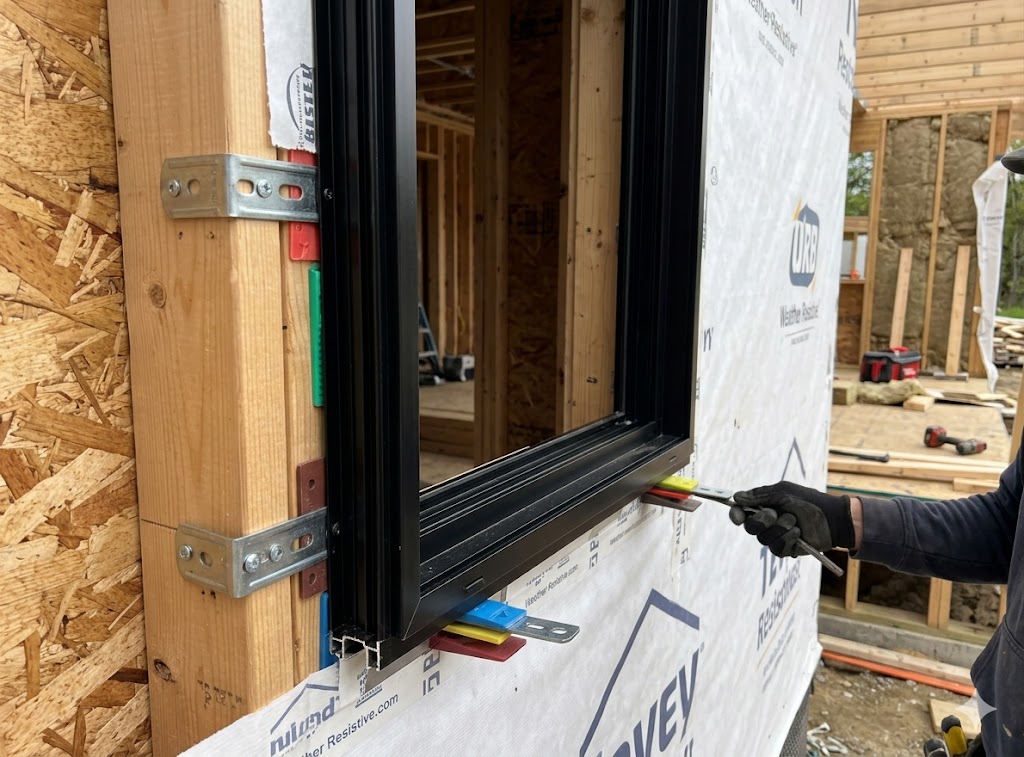
To install a window without a nailing flange, anchor the frame to the structure with steel mounting brackets or frame screws, set it on load-bearing blocks over a sloped sill pan, shim it level and plumb, fill the perimeter gap with low-expansion foam, and tape the frame into the water-resistive barrier outside and the air barrier inside. That is the standard European method, and it works in US wood-frame, steel-stud and masonry walls.
This guide covers what bracket mounting is, why it matters, and the key steps for getting it right in U.S. wood-frame and steel-stud construction, plus masonry and double brick walls. It's written for builders and GCs who may be setting European windows for the first time - whether that's new construction or a full-frame renovation replacement in an existing home.
For NAFS/NFRC documentation and compliance support, see the related guide.
Why Bracket Mounting?
In European construction - typically masonry or concrete - windows are anchored directly to the structure using brackets. No nailing fin, because there's no wood sheathing to nail into.
When these systems go into U.S. light wood-frame construction, the same bracket method applies. The result:
- Flexible positioning - place the frame anywhere within the wall depth (exterior plane, mid-wall, or interior-aligned)
- Clean exterior - no visible flange behind the cladding
- Precise leveling - controlled shimming process
- Strong load path - brackets transfer directly into the framing
European uPVC, wood and aluminum-clad wood frames go in on the same principle, and the method covers tilt-turn windows, casements, fixed units, entry doors, lift-and-slide systems, and bi-folds. If a unit has an integrated nailing flange (some European systems offer this for the U.S. market), follow the flanged instructions instead - Black Rock went in that way, with flanged windows fixed straight into the stud wall and curtain wall handled separately.
The Installation Sequence
The short version, in order:
- Verify the rough opening - level sill, plumb jambs, diagonals within 1/8".
- Install a continuous, sloped sill pan before the frame goes in.
- Remove operable sashes and attach the mounting brackets to the frame.
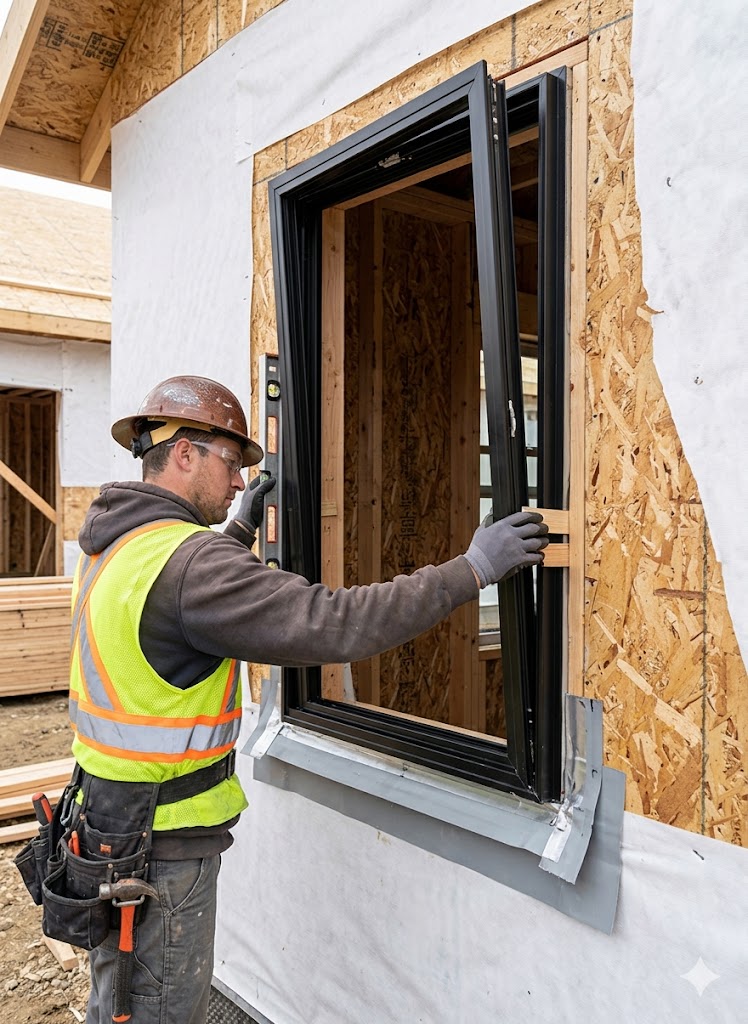
- Set the frame on load-bearing blocks and shim it level, plumb and square.
- Fasten the brackets from the corners toward the center.
- Fill the perimeter gap with low-expansion window and door foam.
- Seal the exterior into the WRB and the interior into the air barrier.
- Rehang the sashes and adjust the hardware.
Each step in detail:
1. Verify the Rough Opening
Allow approximately 1/2" to 3/4" clearance per side. If the opening was framed straight off a converted millimeter dimension rather than the confirmed shop drawing, that's the moment sizing errors surface - see European window rough opening sizes for the mm-to-inch conversion and gap convention before it gets to this stage. Before setting any unit, confirm:
- Sill is level (non-negotiable for doors and sliders)
- Jambs are plumb
- Opening is square (diagonals within 1/8")
Correct framing issues before proceeding. European precision hardware - multi-point locks, European hinges - is sensitive to out-of-square openings.
Also decide the frame depth position within the wall and keep it consistent across the project.
2. Install the Sill Pan
This is the most consequential detail. Bracket-mounted systems rely entirely on rough opening water control - there's no integral flange as a backup.
- Install a continuous sill pan before the frame goes in
- Extend pan up the jambs (minimum 6")
- Ensure positive slope toward the exterior
- Seal all corners and seams
A window installed without a proper sill pan will eventually leak - not because of the window, but because of the detail.
3. Prep the Frame
For tilt-turn windows and swing doors, remove operable sashes before setting - it reduces weight, improves visibility during fastening, and prevents sash damage during shimming. Store sashes on padded supports.
Attach the manufacturer-supplied mounting brackets to the frame perimeter: near each corner, at regular intervals (typically every 24"-30"), and near hinges, locks, and mullions.
4. Set and Shim
Place the frame on solid, load-bearing support blocks at the sill - under each jamb leg and at intermediate points for wide spans. These blocks are permanent and carry the dead load of the frame and glazing.
Shim to achieve:
- Level at sill and head
- Plumb at both jambs
- Square (diagonals equal)
- No twist or bow
Use opposing paired shims to center the frame without lateral force. Maintain 3/8" to 1/2" insulation gap around the perimeter after shimming.
5. Fasten the Brackets
Secure corner brackets lightly first, then work toward the center. Tighten progressively while checking level and plumb after each fastener.
Do not pull the frame into warped studs. If a stud is twisted, shim behind the bracket to fill the gap before fastening.
6. Insulate the Gap
Use low-expansion window and door foam only - standard high-expansion foam generates enough pressure to bow aluminum profiles. Fill to about 2/3 depth on the first pass, let it partially cure, then add more. For gaps over 3/4", use backer rod first.
7. Seal Exterior and Interior
Exterior (WRB integration):
- Jamb flashing first, lapping over the sill pan
- Head flashing last, lapping over the jambs
- Never tape over sill weep paths or block drainage
Interior (air seal):
- Continuous air-sealing tape or sealant at the frame-to-rough-opening interface
- A perfect window gasket with a broken interior air seal still fails a blower door test
8. Reinstall Sashes and Adjust
Rehang operable sashes. European tilt-turn hardware has 3-axis adjustment (height, lateral, compression) via hex key. Check:
- Smooth tilt and turn operation
- Multi-point lock engagement without forcing
- Uniform gasket compression around the full perimeter
For sliding systems, verify smooth panel travel and that the lift-and-slide mechanism raises and drops the panel evenly.
Doors and Sliding Systems: Extra Notes
- Plan crew size for weight - a 10-foot lift-and-slide panel with triple glazing can exceed 500 lbs
- Door frames need continuous sill support across the threshold, not just point supports at jambs
- Sliding systems require a perfectly level sill - even 1/8" over 10 feet causes drift and uneven gasket compression
- Keep threshold drainage clear - debris in the track is the most common cause of water infiltration at sliders
How Do You Install Aluminum Windows in a Timber Frame?
In a timber (wood-stud) frame, the bracket method above is the whole answer. The brackets screw into the king studs, jack studs and header, with solid blocking added wherever a bracket would land between studs. The sill pan goes in first, the frame sits on load-bearing blocks and is shimmed level, plumb and square, and the gap is filled with low-expansion foam. Outside, flashing tape laps the jambs over the sill pan and the head over the jambs, shingle-style into the housewrap; inside, a continuous air-seal tape closes the joint. Hill Road is a built example: steel-look aluminum units set into a timber-framed structure and sealed ahead of the cladding.
How Do You Install Aluminum Windows in Double Brick or Masonry?
In a double brick (cavity) wall, block or concrete opening, there is no sheathing and no housewrap, so the frame is anchored and sealed rather than flashed into a WRB:
- Anchor into the structural leaf - usually the inner leaf of a cavity wall, or the concrete - with brackets or frame anchors and masonry fasteners rated for that material.
- Manage water at the sill and head - a sill membrane or damp-proof course under the frame drains to the outside, and the lintel flashing or cavity tray over the head carries water out through the weep holes.
- Close the cavity at the reveal and insulate the gap around the frame.
- Seal in three layers - airtight tape on the warm inside, insulation in the middle, and a weather-tight but vapor-open tape or membrane outside. This is the standard European masonry detail, and it is what the brackets were designed for.
The leveling, shimming, foam and sash-adjustment steps are the same as in a timber frame. If you are deciding between brackets and a fin for a particular wall, the nailing fin guide covers when each one is the right call.
Common First-Project Mistakes
- Setting the frame before the sill pan is installed
- Not removing sashes before setting large frames
- Using high-expansion foam and bowing the frame
- Skipping the interior air seal
None of these are hard to avoid - they just require understanding the sequence and respecting each step. After the first installation, the process is consistent and repeatable. On modular and prefab projects, many of these steps happen in the factory under controlled conditions, reducing field errors significantly.
FAQ
How do you install a window without a nailing flange? Anchor the frame to the structure with steel mounting brackets or frame screws instead of nailing through a flange. Install a sloped sill pan first, set the frame on load-bearing blocks, shim it level, plumb and square, fasten the brackets from the corners inward, fill the gap with low-expansion foam, then tape the frame into the WRB outside and the air barrier inside.
How do you install aluminum windows in a timber frame? Screw the mounting brackets into the king studs, jack studs and header, adding blocking where a bracket falls between studs. Put the sill pan in first, set the aluminum frame on load-bearing blocks, shim and fasten it, foam the gap with low-expansion foam, and lap flashing tape jambs-then-head into the housewrap, with a continuous interior air seal.
How do you install aluminum windows in double brick? In a double brick cavity wall, anchor the aluminum frame with brackets or frame anchors into the structural leaf, usually the inner one, using masonry fasteners. A sill membrane drains water outward, the lintel flashing or cavity tray handles the head, and the joint is sealed airtight inside, insulated in the middle and weather-tight but vapor-open outside.
How far apart should window installation brackets be? Typically every 24 to 30 inches around the frame, plus a bracket near each corner and near hinges, locks and mullions, where the loads concentrate. The system provider's anchoring detail and the project's structural requirements govern the final spacing, so check the shop drawing for heavy sashes, tall units and doors.
What foam should you use around aluminum windows? Use low-expansion window and door foam only. Standard high-expansion foam builds enough pressure to bow an aluminum profile and bind the sash. Fill to about two-thirds of the gap depth on the first pass, let it partly cure, then top up, and use backer rod first where the gap is wider than 3/4 inch.
If you're preparing for a first European window installation and want project-specific guidance on bracket layouts, threshold details, or WRB integration for your wall assembly, Schedule a Call or Request a Quote. I typically provide technical support to the installation teams working on projects I've sourced.
Kai, your window guy!