
If you love the slim sightlines and thermal performance of European windows but worry an inspector will kick them back - you're not alone. It's a legitimate concern, and it has a clear solution.
European windows can be NFRC-rated and NAFS-tested, but it is configuration-specific - system by system and configuration by configuration: NFRC covers energy ratings (U-factor, SHGC, visible transmittance), NAFS covers structural, air and water performance, and neither comes automatically with a European CE mark. I quote NFRC-rated units on selected systems where the permit needs them; many other projects move forward on European performance data converted to US units. Here's how it works in practice.
The One-Minute Version
- NFRC proves energy performance (U-factor, SHGC, VT) for a complete window or door.
- NAFS proves structural, air, and water performance via tested ratings (e.g., PG-40, CW-PG50).
- Some AHJs may ask for one or both, though many projects move forward without formal NFRC/NAFS paperwork.
- A strong submittal package can include: NFRC documentation, NAFS references, shop drawings, and installation instructions - all matched to your actual units. On sleeping-room and basement openings, that package should also show the net clear opening dimensions a reviewer checks for egress - see my tilt-turn egress code guide for the exact math.
NFRC vs NAFS vs European CE Marking
| Item | NFRC | NAFS | CE marking (EN 14351-1) |
|---|---|---|---|
| What it covers | Energy: U-factor, SHGC, visible transmittance | Structural load, air leakage and water penetration resistance | European declaration of window performance |
| Standard behind it | NFRC 100 (U-factor), NFRC 200 (SHGC and VT) | AAMA/WDMA/CSA 101/I.S.2/A440 | EN 14351-1, with Uw calculated to EN ISO 10077 |
| How the result reads | Imperial U-factor, SHGC and VT on a 0-1 scale | Performance Class (R, LC, CW, AW) plus a Performance Grade (PG) | Metric Uw in W/m2K, European air, water and wind classes |
| Who asks for it | Energy code reviewers, California Title 24, some AHJs | Building departments and commercial specs, especially where wind load matters | Not a US label on its own - useful as supporting data |
| Where it shows up | Label on the unit or the NFRC directory listing for the specific product | Label or test report for the tested size | Declaration of performance and system datasheets |
If you are holding European paperwork, the metric values convert cleanly - the U-value to U-factor converter handles the energy numbers - but a conversion is not a US rating.
Are European Windows NFRC Certified? Only Per Specific Configuration
Some are, and it is always configuration-specific. NFRC certification attaches to a product line and the glazing options tested with it, not to a brand or a country of origin. On the US-oriented lines - for example the outswing European casement windows - NFRC-rated units are available for specific configurations; other systems document their numbers through simulation and European test reports. My estimator carries a 5% planning allowance when you tick the NFRC option, and the exact configuration is confirmed before ordering. If a reviewer will only accept a label, say so before the system is chosen - it narrows the list. California is where this comes up most, because Title 24 falls back to default values for unrated windows - see European windows in California for how I handle it.
What NFRC and NAFS Actually Mean
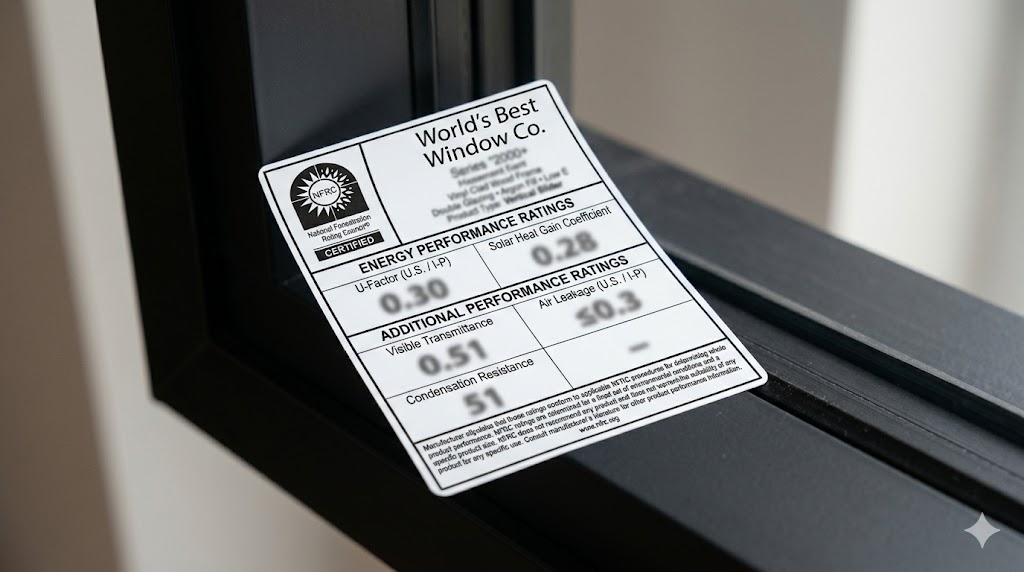
NFRC - Energy Performance
NFRC rates the whole product (frame + glass), not just the glass:
- U-factor: Thermal transmittance - lower is better (U-0.30 is the typical code maximum in most US climate zones; see what counts as a good U-factor)
- SHGC: Solar heat gain - lower means less heat gain (target depends on climate zone)
- VT: Visible transmittance - higher means more daylight
These values can help demonstrate compliance with IECC or Title 24 climate zone targets. For projects considering triple vs. double glazing, NFRC values differ significantly between the two. The thermally broken aluminum profiles used in European systems are a key factor in achieving strong whole-window U-factors.
NAFS - Structural, Air, and Water
NAFS assigns each product:
- A Performance Class (R, LC, CW, AW) - from residential to architectural
- A Performance Grade (PG-40, PG-60, etc.) - higher means more wind load resistance
- Verified air and water penetration resistance
| Class | Typical Application |
|---|---|
| R (Residential) | Single-family, low-rise |
| LC (Light Commercial) | Low-rise commercial, some multifamily |
| CW (Commercial) | Mid-rise commercial and multifamily |
| AW (Architectural) | High-rise, severe exposure |
How They Work Together
NAFS answers: "Will this window resist wind, water, and usage?" NFRC answers: "Will this window meet the energy model?" Some AHJs may ask for both, and having them ready strengthens your submittal. That said, many projects proceed with European performance data alone - it depends on the jurisdiction and the reviewer.
What Do Plan Reviewers Ask For?
At submittal:
- Cover sheet with unit schedule cross-referencing all documentation
- NAFS data with Performance Class, Grade, and air/water metrics (if requested by the AHJ)
- NFRC documentation for each unique configuration (frame + glass + spacer), where available
- Shop drawings with sizes and sections
- Installation instructions
At inspection:
- NFRC labels on installed units (or documentation set on file), if the jurisdiction requires them
- NAFS labeling or traceability documentation
- Warranty documentation
Pro tip: Create a mapping table in your cover sheet - something like: "Type W1 = Tilt-Turn, 48"x72", Low-E/argon, U-0.26, SHGC 0.23, NAFS LC-PG40." This single page prevents most RFIs.
Common Pitfalls
Config drift: A last-minute glass or spacer change can invalidate your NFRC values. Lock glass build-ups early and document any revisions.
Sizing outside the tested envelope: NAFS ratings are tested on specific maximum sizes. If your units are larger, the rating may not apply. Re-spec, split units, or discuss supplemental testing. For guidance on large glass and lift-slide door sizing, see the dedicated article. Proper bracket-mounted installation also affects how tested ratings translate to real-world performance.
Removed labels: NFRC labels get stripped during construction by crews who don't know they matter. Keep them on until after sign-off. Have a photo set and documentation package as backup.
Assuming "European" equals compliant: It doesn't, automatically. CE marking and EN 14351 cover different test standards than NAFS/NFRC, and some AHJs may prefer U.S.-format documentation. Some reviewers accept European test reports alongside converted values - the key is knowing your jurisdiction and having the right paperwork ready - and translating the metric values correctly, which is where a guide to reading a European window quote in US units helps. Learn how to evaluate a European window supplier properly.
A Note on European Windows and U.S. Compliance
European fenestration has a compliance reputation problem that isn't entirely deserved. Systems from providers like Reynaers, Aluprof and Aliplast are engineered to high standards - whether the frame is aluminum or uPVC, wood or aluminum-clad wood. The issue is usually documentation packaging, not the products themselves.
If you are earlier in the process and still deciding whether European windows fit the project at all, my complete US buyer's guide to European windows covers systems, cost, lead times, and compliance in one place. For the specific number a reviewer will look for, see what counts as a good U-factor.
When a supplier has done the work to prepare NAFS-aligned data, document NFRC values for their glazing configs, and format submittals for U.S. reviewers, the compliance process is straightforward.
The thing to watch for: a supplier who only has European CE certificates and has no plan for how to handle the compliance conversation if a U.S. reviewer asks for more.
Important caveat: NFRC documentation availability varies by system, configuration, and project scope. Not every combination will have documentation ready to go. This is something to discuss early in the project - I can advise on which configurations have documentation available and what alternative compliance pathways exist for others. For commercial projects specifically, see energy-efficient European windows for U.S. commercial use.
FAQs
Are European windows NFRC certified? Some European windows carry NFRC certification specific to a product line and its tested glazing options, not to a brand or country. Some US-oriented systems offer NFRC-rated units for specific configurations, such as the outswing uPVC casement line and a Reynaers bifold; others document performance through simulation and European test reports. If your jurisdiction requires a label, confirm it before the system is selected, because it narrows the options.
What is the difference between NFRC and NAFS? NFRC rates a window's energy performance - U-factor, SHGC and visible transmittance - for energy code compliance. NAFS (AAMA/WDMA/CSA 101/I.S.2/A440) rates structural, air and water performance and assigns a Performance Class such as R, LC, CW or AW with a Performance Grade. A reviewer may ask for one, both or neither, depending on jurisdiction.
What does NFRC 100 mean on a window spec? NFRC 100 is the NFRC procedure for determining a window's U-factor; NFRC 200 covers solar heat gain coefficient and visible transmittance. A spec that calls for NFRC 100 values wants a whole-window U-factor rated under that procedure, not a glass-only number and not a metric Uw converted from a European datasheet.
Are NFRC-documented European windows accepted nationwide? Generally yes, when the documentation matches the installed configuration. NFRC documentation helps energy code discussions, and California's Title 24 leans on NFRC ratings for the specific product, but many projects elsewhere move forward without a label being a hard requirement. When an AHJ does ask, having it ready speeds review considerably.
Can I use triple glazing to hit aggressive U-factor targets? Yes. On catalog values, triple-glazed European windows run about U-0.13 to U-0.19 whole-window, against U-0.22 to U-0.32 double glazed. Confirm the spacer specification, the documentation path for your configuration and the extra panel weight on the hardware before you lock the glass.
Do tilt-turn and lift-slide systems meet NAFS? They can. Many European tilt-turn and lift-slide profiles have NAFS test data or equivalent performance reports for specific sizes, so ask what documentation exists for your configurations and whether your largest units sit inside the tested size. The European window hardware guide covers the mechanics behind the airtightness numbers.
Need Help With Compliance Documentation?
Send me your elevations, window schedule, and performance targets. I'll let you know what NFRC and NAFS documentation is available for your project and help you navigate the compliance conversation for your specific jurisdiction. I handle the full DDP import and delivery process, including documentation.
Request a Quote | Schedule a Call
Kai, your window guy!