
A builder sent me a photo last winter: a black aluminum window in a new mountain house, interior face beaded with water at 7 a.m., the drywall return below it already stained. The window had been sold as "thermally broken." It was - technically. The break was a narrow poured strip, the glass was double with an aluminum spacer, and the house was running humid while the plaster dried. Every part of that was predictable from the spec sheet.
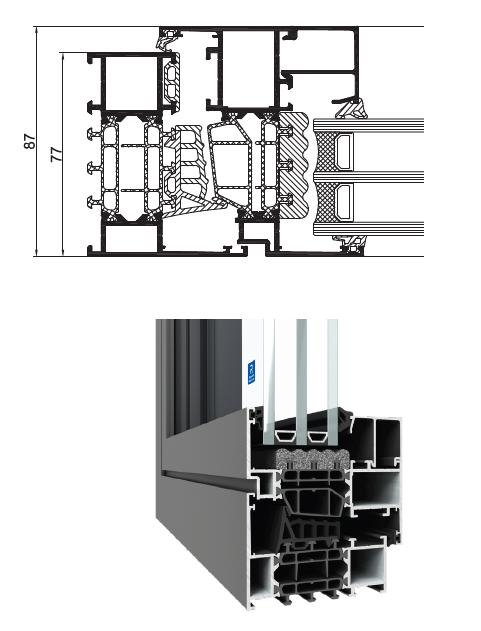
A thermally broken aluminum window (a thermal break window) has an outside and an inside aluminum frame joined by an insulating polyamide or polyurethane strip, so heat cannot conduct straight through the metal.
A solid aluminum frame is a thermal bridge: cold soaks through it in winter, conditioned air bleeds out year-round, and the interior face drops toward the dew point. A thermal break is the fix. But "thermally broken" covers everything from a quarter inch of poured polyurethane to nearly two inches of engineered polyamide, and the label alone says little about how the window will behave.
One thing up front: "thermal break windows" and "thermally broken windows" are the same product. Manufacturers, specs and search engines phrase it differently; there is no technical distinction. The frame either has an insulating barrier between the outside aluminum and the inside aluminum, or it does not.
This guide covers how the two mainstream thermal break methods work, how US and European thermally broken aluminum compare on real numbers, and what to write into a window schedule so you never get that 7 a.m. photo. It sits in my specs and compliance cluster because the break is where most aluminum spec problems start.
What "thermally broken" means
A thermally broken aluminum window frame is split into an exterior aluminum section and an interior aluminum section, connected by a low-conductivity material. Heat that wants to flow from the warm side to the cold side has to cross that material, and it mostly does not: glass-reinforced polyamide and cured polyurethane both conduct heat several hundred times less than aluminum.
Non-thermally broken aluminum is a single extrusion that runs straight through from outside to inside. It still shows up in storefront and mild-climate residential work, but for anything heated in winter the frame becomes the coldest surface in the room and the whole-window U-factor typically lands well above what current residential codes ask for.
The two ways to break an aluminum frame
This is the part many explainers get wrong: a polyamide strip is not the only way to make a thermal break. There are two mainstream methods, and both produce a legitimately thermally broken frame.
1. Polyamide strips - the European standard
The interior and exterior sections are extruded as two separate profiles. Two strips of PA66 polyamide with 25% glass fiber (PA66 GF25) are slid into knurled grooves on each profile, and the aluminum is rolled - crimped - onto the strips so the strip carries shear and the assembly behaves as one structural bar.
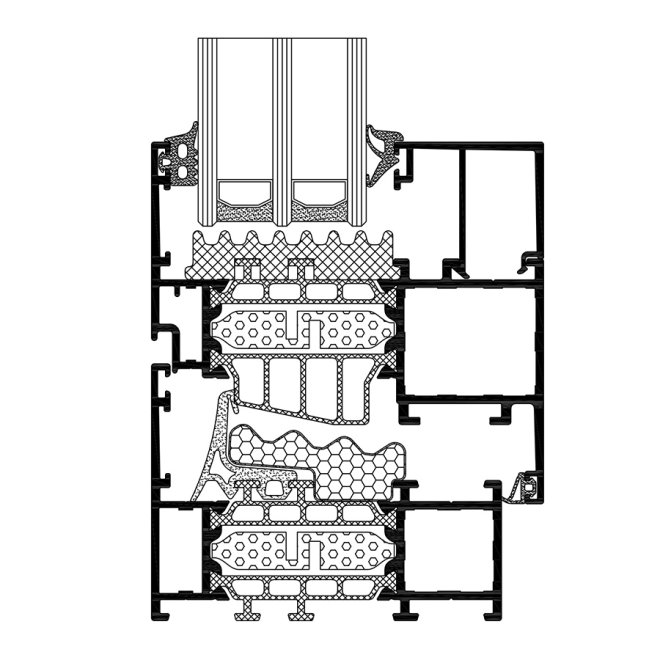
Strips run from 14 mm to about 45 mm wide (roughly 9/16 in. to 1-3/4 in.). The narrow end shows up in commercial curtain wall; the European residential systems I quote mostly sit in the mid-20s to mid-40s of millimeters. Because the strip is a manufactured part, the designer can give it a hollow section, fins or a foam insert, and can space the two strips apart to create a wide insulated cavity between the shells - which is what makes deep multi-chamber profiles possible.
What it does well: width. Break width is the single biggest frame-side driver of U-factor, and strips let you go wide without losing structure. Two separate shells also mean inside and outside can be finished in different colors before assembly. What it costs: two extrusion dies instead of one, more inventory, and a rolling step that has to be done precisely. It is the more expensive way to build a frame.
2. Pour-and-debridge - common on US frames
The frame is extruded as a single profile with a channel running along its length. A two-part polyurethane is poured into the channel and cures to a hard, well-bonded solid. Then the aluminum floor of the channel - the "bridge" that held the profile together during the pour - is machined away, leaving two aluminum halves held together by the polyurethane. This is the method behind a large share of US commercial and residential aluminum windows and storefront; it has been in use for decades, and it works.
What it does well: simplicity and cost. One die, one extrusion, no strip inventory, and the polyurethane itself is a good insulator - per unit of width it is actually less conductive than glass-filled polyamide. For a builder-grade or commercial frame it is the pragmatic choice.
What it gives up: width. The poured channel is typically about 1/4 in. to 3/8 in. (roughly 6-10 mm); wider pours exist but are less common because the pour has to stay dimensionally stable as it cures. After debridging the polyurethane is the only structural connection, so adhesion is everything, and there is no easy way to stack two breaks or build a deep insulated cavity the way strips allow.
The honest summary: pour-and-debridge is a proven way to get a modest thermal break at low cost; polyamide strips are the way to get a wide one. Neither is fake. The spec question that matters is not "which method" but "how wide, and what does the whole unit test at."
Why break width matters more than break type
A wider break makes the heat path through insulating material longer, so frame-side heat loss drops - the same reason a thicker wall insulates better. It is not the only variable: the aluminum shells on a good European profile are themselves multi-chamber, some systems fill the cavity between the strips with foam inserts, and the gasket lines have to keep air from short-circuiting the break. But if you can only ask one frame question, ask how wide the break is. It is also why modern tilt-turn windows and lift-and-slide doors from European systems perform so well: the frame stops fighting the glass. If any of these terms - polyamide strip, multi-chamber profile, U-factor - are new to your team, the window glossary has plain-English definitions for all of them.
US vs European thermally broken aluminum, side by side
The US ranges below are typical, not measured - US residential aluminum varies a lot by manufacturer and glazing package. The European numbers are the catalog U-factors for the aluminum systems in my estimator.
| Frame | Thermal break type | Typical break width | Typical whole-window U-factor | Glazing usually paired | Where it is common |
|---|---|---|---|---|---|
| US aluminum, thermally broken | Mostly pour-and-debridge polyurethane; polyamide strips on some commercial lines | About 1/4-3/8 in. (6-10 mm) poured; roughly 14-24 mm strips on commercial | Roughly U-0.40-0.60 with double glazing on pour-and-debridge residential frames (typical range, not measured) | Double, low-E | Sunbelt and West Coast residential, replacement, storefront and light commercial |
| European aluminum, thermally broken | Polyamide strips (PA66 GF25), two per profile | Roughly 1 to 1-3/4 in. (mid-20s to mid-40s mm) on residential systems | U-0.22-0.29 double glazed, U-0.15-0.19 triple glazed (catalog values) | Double or triple, low-E, warm-edge spacer | Europe throughout; imported for US custom homes, design-build and passive-level projects |
For the cost side of that comparison - what the wider break and the tilt-turn hardware add per square foot - see what aluminum windows cost and the American vs European aluminum benchmark.
What that means for US energy code
Residential code compliance depends on whole-window ratings and the adopted compliance path. Under the 2021 IECC residential prescriptive baseline, window U-factor is not tabulated in zone 1, is limited to 0.40 in zone 2 and generally to 0.30 in zones 3-8; SHGC limits and exceptions also apply. The climate-zone reference provides the sourced table. Confirm local adoption before locking the specification.
Use the required whole-window rating for the actual configuration to check the adopted code. A converted European catalog value provides a reference, not an NFRC certification or a guarantee that a frame type complies. Both polyamide and pour-and-debridge systems need assembly-specific evidence.
Two cautions. A glass-only U-factor excludes frame and edge effects; the schedule needs the whole-unit value. And NFRC labelling is configuration-specific - some European systems have NFRC-labelled configurations, others document through simulation - so confirm what your reviewer will accept early. My NFRC/NAFS guide covers both paths, and triple vs double glazing covers how glazing moves the whole-unit number.
Condensation: what a thermal break does and does not do
A thermal break raises the temperature of the interior frame surface. Whether that surface stays above the dew point depends on how wide the break is, the glazing (triple keeps the edge-of-glass warmer than double), the spacer (warm-edge versus aluminum), the indoor humidity, and whether room air can reach the frame at all - deep reveals, closed blinds and heavy drapes trap a cold pocket against the window. So a thermally broken window reduces condensation risk; it does not eliminate it. On a good frame the first place to sweat is usually the bottom edge of the glass, not the aluminum.
If a spec calls for a Condensation Resistance Factor (CRF), that is an AAMA 1503 test number on a 0-100 scale (higher is better) that most US aluminum manufacturers publish. European systems generally do not test to it; they document condensation risk through interior surface-temperature (isotherm) simulations. If your reviewer wants a CRF, ask the supplier early whether they can provide the AAMA number or an equivalent simulation, rather than assuming one exists. For cold-climate detailing beyond the frame, see the best windows for cold climates.
Finishes and durability
Both break methods leave the visible faces as aluminum, so the finish options are the same: powder coat in any RAL color, anodized, or dual-color inside and out - with polyamide-strip systems having the edge because the two shells can be finished separately before assembly. The break does not affect finish life, and aluminum's dimensional stability is part of why steel-look profiles in matte black hold their lines year after year.
What to write into the window schedule
If a supplier cannot or will not provide these, that tells you something about the system.
- Thermal break method and width - polyamide strip or pour-and-debridge, and the width in mm or inches. Rule of thumb, not code: for heated climates I look for strips in the mid-20s of millimeters or wider; for the coldest zones, mid-30s and up with triple glazing, because that is where the comfort margin comes from.
- Whole-window U-factor for the actual configuration - frame, glass and size, not center-of-glass. If you are not sure what number belongs there, see what counts as a good U-factor.
- Spacer type - warm-edge if condensation is a concern, which in a heated climate it usually is.
- Documentation path - NFRC label, simulation, or both, agreed before ordering.
- Hardware isolation - hardware and structural fasteners should not bridge the break.
- Air infiltration - tested per NAFS for the operable units.
The European systems I quote most often - built on Reynaers, Aluprof and Aliplast profiles - all use polyamide-strip breaks with multi-chamber shells, and submittal documentation can be provided for most configurations. I compared the major system providers separately, and brochures and technical drawings are available for download.
Still choosing the material?
PVC is cheaper and, on catalog values, still edges aluminum on pure U-factor with triple glazing; aluminum wins on sightlines, panel size and finish - the aluminum vs PVC guide covers when each is the right call, and aluclad vs aluminum vs wood covers the warmer-looking options - if the brief is a metal exterior with a real timber interior, the aluminum-clad wood windows page is the direct answer. If the real question is whether to import at all, start with Marvin vs Pella vs European windows or the complete US buyer's guide; for slim-frame work, see steel-look windows for design-build. To see the frame styles and systems built on these thermal breaks, start with European aluminum window frames for US projects.
FAQ
What are aluminum thermal break windows? Aluminum-framed windows whose frame is split into an exterior and an interior aluminum section, joined by an insulating material - glass-reinforced polyamide strips or poured polyurethane - so the frame does not conduct heat straight from outside to inside. "Thermal break windows," "thermally broken windows" and "aluminum windows with thermal break" all describe the same product.
What does thermally broken mean in windows? Thermally broken means the conductive path through a metal window frame has been interrupted by a low-conductivity barrier. In an aluminum window that barrier sits between the outside and inside faces of the frame, so the interior aluminum stays closer to room temperature and the whole-window U-factor drops compared to a solid extrusion.
What is the difference between a thermal break strip and pour-and-debridge? A thermal break strip is a pre-made polyamide bar (usually PA66 with 25% glass fiber) rolled into grooves between two separate aluminum extrusions; it can be wide - 14 to about 45 mm - and shaped with fins or foam inserts. Pour-and-debridge fills a channel in a single extrusion with two-part polyurethane, then machines out the aluminum bridge beneath it; simpler and cheaper, but typically narrower, around 1/4 to 3/8 in. Both are genuine thermal breaks: strips are the route to lower U-factors, pours to lower cost.
Are thermally broken aluminum windows worth it? In any climate where the house is heated in winter, yes - a solid aluminum frame is the coldest surface in the room and usually lands above current residential U-factor limits. Whether a basic poured break or a wide polyamide-strip break is the right buy depends on the zone: a narrow break with a good glazing package can pass code in mild zones; cold-zone comfort and condensation control generally call for the wider break, warm-edge spacers and often triple glazing. Premium European aluminum runs about $45 to $95 per square foot supplied - see what aluminum windows cost.
Do thermally broken windows stop condensation? They reduce it; they do not stop it. A thermal break keeps the interior frame warmer, but whether condensation forms depends on the glazing (triple or double), the spacer (warm-edge or aluminum), indoor humidity and airflow at the window. A thermally broken frame with double glazing and an aluminum spacer in a humid house can still sweat at the glass edge on a cold morning. Wider break, warm-edge spacer, triple glazing and controlled humidity together keep surfaces above the dew point most of the time.
How wide should the thermal break be in aluminum windows? Polyamide strips come in 14 to about 45 mm; European residential systems mostly use the mid-20s to mid-40s. Rule of thumb: mid-20s and up for heated climates, mid-30s and up with triple glazing where winters are severe. Pour-and-debridge breaks are typically 1/4 to 3/8 in. and lean more on the glazing package to reach a low whole-window number.
What is the U-factor of thermally broken aluminum windows? It depends on the break, the profile and the glazing. The European aluminum systems in my estimator catalog run about U-0.22 to U-0.29 with double glazing and U-0.15 to U-0.19 with triple. Typical US pour-and-debridge residential frames with double glazing sit roughly at U-0.40 to U-0.60 - typical, not measured. Specify the tested whole-window number for your exact configuration, not center-of-glass.
Does a thermal break weaken the frame? Not when it is done properly. Polyamide strips are rolled in to carry shear and the composite bar is tested as a structural member; a cured polyurethane pour is likewise bonded to carry frame loads after debridging. The wider European strip systems are routinely used for large tilt-turn sashes and lift-slide panels, within the tested size and weight limits of each system.
Specifying thermally broken aluminum and want to confirm the numbers before they reach your reviewer? Send me your window schedule - I'll match the right European system, run the whole-window U-factors and put together the documentation your submittal needs. Request a Quote | Schedule a Call
Kai, your window guy!