
If you're speccing a custom home or multifamily project and someone mentions "European windows," tilt-turn is usually what they mean. If you've been building in the U.S. your whole career, casement is what you know.
The difference between tilt and turn and casement windows: a casement is hinged on one side and swings open in a single mode - outward with a crank in U.S. practice - while a tilt and turn window opens inward in two modes, tilting in at the top for tilt ventilation or swinging in like a door, and locks at multiple points around the whole sash. Tilt-turn wins on large sashes, airtightness and cleaning from inside; casement wins where the room has no space for an inward swing or the client wants the familiar crank with an interior screen.
Here's a practical breakdown so you can pick the right one for your scope. (If you've already decided tilt-turn is the direction, here's how I source tilt and turn windows for US projects. And if casement operation is non-negotiable, you do not have to give up the European frame to get it - see European casement windows, the outward-opening systems built for US installation.)
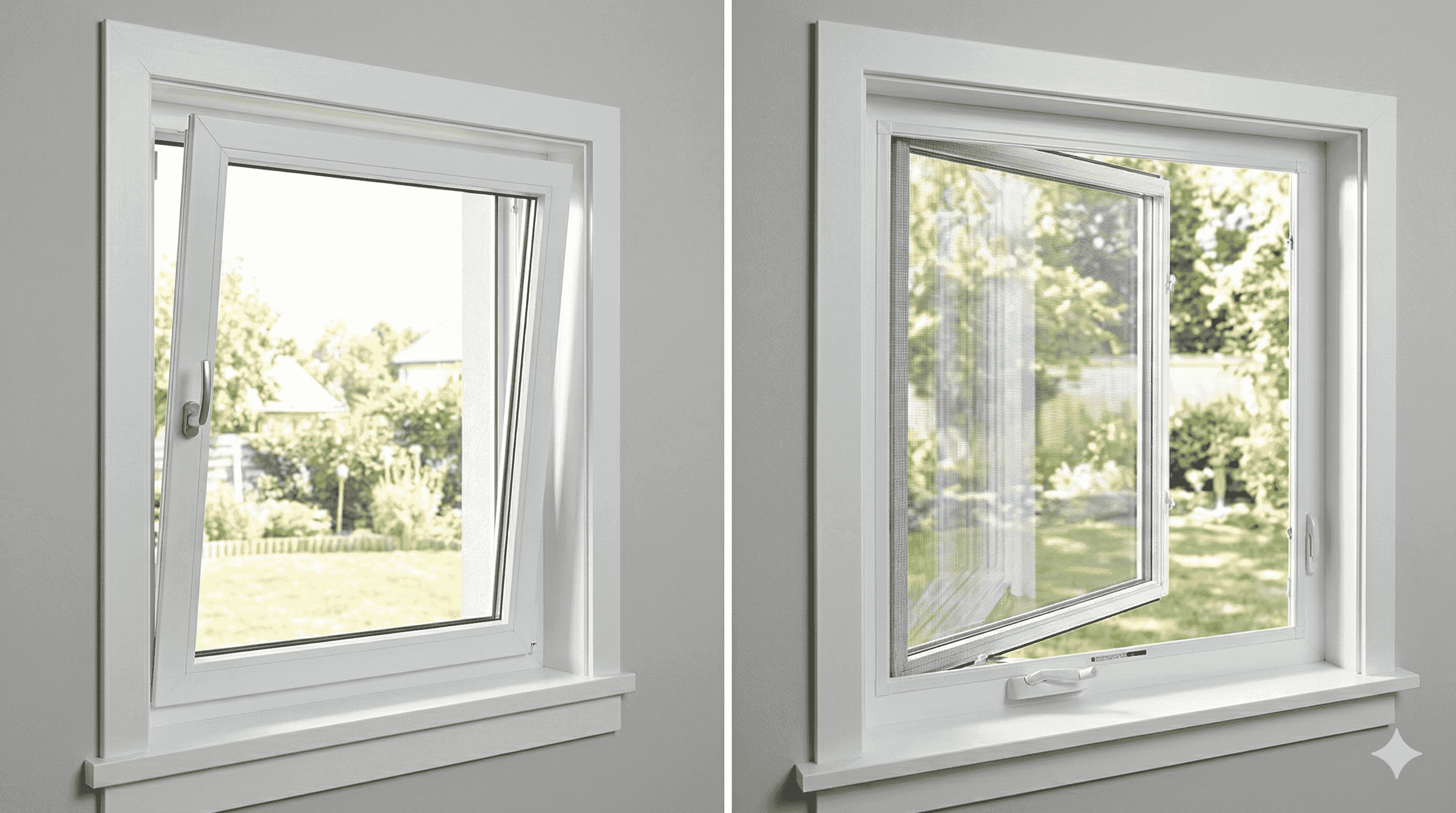
How Do Tilt and Turn and Casement Windows Work?
Casement - hinged on one side, swings outward via a crank handle or lever. One mode: open or closed. The sash pushes against weather stripping when closed.
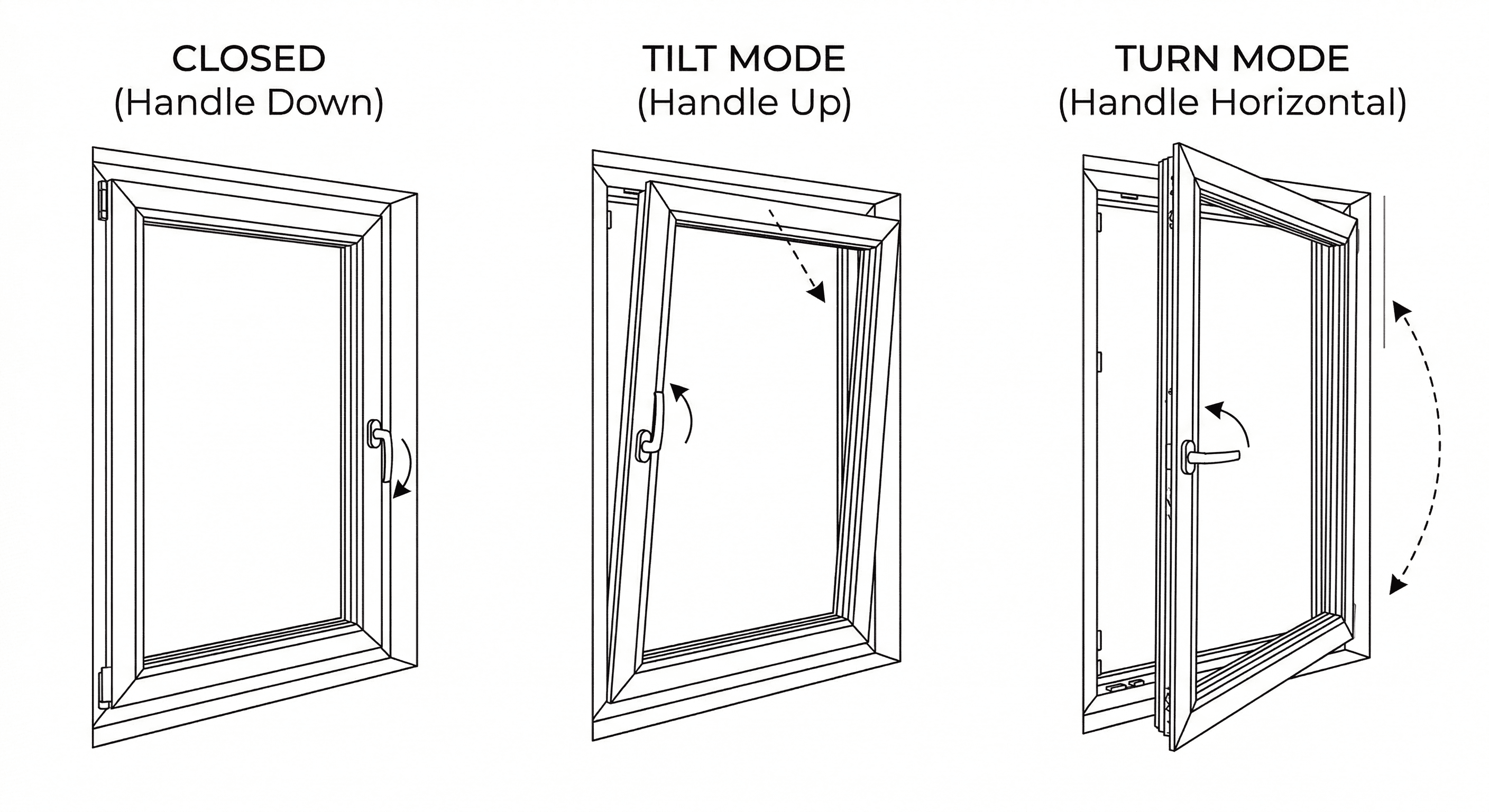
Tilt-turn - a single handle controls two modes. Turn the handle 90 degrees and the sash swings inward like a door (turn mode). Rotate it 180 degrees and the top tilts inward for ventilation (tilt mode). One handle, two functions, multi-point perimeter locking. Why the sash goes inward in the first place is covered in why European windows open inward.
The mechanical difference matters more than you'd think. The tilt-turn espagnolette system locks at 4-8+ points around the full sash perimeter. Many standard US casements lock at one or two points, although premium lines also offer multipoint locks. Check the hardware on the actual units you compare - it matters for wind, water and air infiltration.
Performance Comparison
| Feature | European Tilt-Turn | American Casement |
|---|---|---|
| Opening direction | Inward | Outward |
| Locking points | 4-8+ multi-point perimeter | 1-2 points on many units; multipoint on premium lines |
| Sealing method | Compression gasket (full perimeter) | Compression at hinge side, wiper/brush opposite |
| Ventilation modes | Tilt ventilation + full inward swing | Full outward swing only |
| Typical U-factor (whole window) | 0.18-0.30 | 0.25-0.35 |
| Max sash weight capacity | 330+ lbs (heavy-duty hardware) | ~100-150 lbs typical |
| Post-install adjustment | Yes - height, lateral, compression | Limited |
| Cleaning from inside | Yes - full inward swing | No - exterior access needed |
| Screen position | Exterior screen (fixed or roller) | Interior screen |
Which Is Better: Tilt and Turn or Casement?
Where Tilt-Turn Wins
Large openings. When sash sizes push past 30" x 60", casement hardware starts working hard. Weight at the crank, drag on the operator, seal inconsistency. Tilt-turn hardware is engineered for heavy sashes - European systems routinely handle units that would overwhelm a standard casement operator. For even wider openings beyond what any window can deliver, see my bi-fold vs lift-and-slide comparison.
Air and water tightness. Multipoint hardware compresses the seals when the sash is closed. The complete window still needs appropriate tested air, water and structural ratings for the site; gasket geometry alone does not establish performance in coastal or high-rise exposure.
Controlled ventilation. Tilt mode gives you airflow through a small opening at the head instead of a fully open sash. It is not a security setting on standard hardware - close and lock the window when the room is empty - but for everyday ventilation it is a mode a casement does not have.
Modern architecture. The slimmest European aluminum tilt-turn profiles deliver sightlines under 2 inches - that's thanks to high-performance thermal breaks that achieve great insulation with minimal frame width. Combined with concealed hardware and inward operation, you get the clean aesthetic that contemporary projects demand. If even the sash should disappear, hidden sash windows take it behind the frame.
Where Casement Still Makes Sense
Familiarity. US crews may be more familiar with crank-operated casements. Confirm installation experience, training and parts support for either choice; familiarity does not eliminate callbacks or servicing needs.
Outward swing = interior clearance. Casements don't swing into the room. In tight spaces - above kitchen counters, behind furniture, next to deep window seats - that can matter. Tilt-turn in turn mode requires interior clearance for the full sash swing.
Screen position. A casement keeps its screen on the inside and you crank the sash open through it, which is what most U.S. homeowners are used to. A tilt-turn puts the screen on the exterior face of the frame and the sash opens inward behind it - I cover the options in how insect screens work on tilt-turn windows, and in my estimator a screen adds about $110 per operable sash on uPVC and $145 on aluminum. Both work; it's a different look and routine.
Budget-first projects. If the spec is vinyl casement at the lowest possible price point and the project doesn't demand European performance, casement from a domestic supplier is the path of least resistance.
Worth noting that European casement is its own category - not the domestic product with a different badge. The European outswing systems I quote include the Aluprof MB-79N crank-out in aluminum and the Aluplast Ideal Neo OUT in uPVC with an integrated nailing fin, and NFRC-rated units are available on selected systems where the permit needs them - the full lineup is on the European casement windows page. The Lakehouse photos show a European casement system glazing a lake elevation close to wall-to-wall, with fixed units carrying the spans and operable sashes only where ventilation is actually needed.
Do Tilt and Turn Windows Cost More Than Casement Windows?
Within the same frame system, a tilt-turn unit costs more than a fixed window of the same size because it carries more hardware - in my estimator about 1.4 times in uPVC and about 1.8-2 times in aluminum - and it sits toward the upper end of the per-square-foot range for its material. For the supplied European window, that range is about $15-25 per square foot in uPVC and $45-95 per square foot in aluminum, before freight, duty and installation - with small operable sashes at the top of each range and steel-look aluminum above it.
Compare current quotes for the same units, glazing, finishes and documentation. Add installation, lifting, flashing and site work to the delivered price on both sides. Any saving must come from that matched installed-cost comparison, not a country-wide percentage.
The catch is lead time: roughly 9-16 weeks from approved shop drawings to delivery on site, against domestic availability. If your schedule can absorb that, compare the matched landed-plus-installed totals and decide on the numbers. See European window lead times and my DDP import guide for the logistics. For a direct brand-level comparison, see Marvin vs Pella vs European windows.
A few related questions come up constantly once people settle on tilt-turn: how egress works on an inward-opening sash, how it stacks up against the double-hung, and what people actually mean when they say German-style windows.
Common Objections
"My installer doesn't know tilt-turn." Valid concern. But tilt-turn windows can be produced with a nailing flange - same installation method your crews already know. Bracket mounting is also available when the detail calls for it. I provide installation documentation with every project. Most competent crews are comfortable after the first few units. See my bracket mounting guide.
"Parts and service won't be available." The hardware platforms I use (Sobinco, Roto, Siegenia) are global brands with parts availability that extends well beyond any single supplier, and every order carries a 10-year written warranty from Windows Guy sp. z o.o. - your claim comes to me, not to an overseas support desk.
"Tilt-turn is overkill for my project." Maybe. If you're building spec homes with modest openings and standard thermal requirements, casement does the job. But if you're pushing toward larger glass, slimmer frames, or better performance - tilt-turn isn't overkill, it's the right tool.
FAQ
Which is better, tilt and turn or casement windows? Tilt and turn windows offer two opening modes and inside cleaning access. Casement windows suit rooms where an inward swing would hit furniture or counters, or a client wants a crank and interior screen. Compare actual air leakage, water ratings, sizes and glazing; inward opening and lock-point count alone do not establish superiority.
What is the difference between tilt and turn and casement windows? A casement window is side-hinged and swings outward in one mode, usually by crank. A tilt and turn window opens inward in two modes from one handle: tilt, where the top leans in a few inches for ventilation, and turn, where the sash swings fully in like a door. Tilt-turn locks around the whole sash; a typical casement locks at one or two points.
Are tilt and turn windows more expensive than casement windows? Usually somewhat, because the tilt-and-turn hardware is more complex than a casement operator. A supplied European tilt-turn runs about $15-25 per square foot in uPVC and $45-95 in aluminum; compare it with a casement quote for the same size, glazing and finish, and add installation to both sides before deciding.
Can I mix tilt-turn and casement on the same project? Yes, and it works best inside one system family, so the frames, finishes and sightlines match. Aluprof MB-79N comes as a tilt-turn and as a crank-out casement, and Aluplast Ideal Neo has an outswing Ideal Neo OUT version. Mixing brands across one elevation is what to avoid - different hardware, install details and service parts.
Do tilt-turn windows need more maintenance than casement? No - just different maintenance. Quality tilt-turn hardware is designed to be adjusted rather than lived with: an occasional height, lateral or compression adjustment keeps the sash sealing at spec, and there is no crank operator to wear out. My hardware guide shows where the adjustment points are.
Are tilt-turn windows code-compliant for egress in the U.S.? They can be, in turn mode, when the net clear opening of the specific unit meets the adopted code's width, height, area and sill-height limits. Tilt mode does not count. I check each egress window against the unit drawing during specification. For the exact clear-opening math a plan reviewer checks, see my tilt-turn egress code guide; for broader code compliance, see my NFRC and NAFS guide.
Deciding between tilt-turn and casement for your project? Send me your window schedule and I'll spec the right approach for each opening. Request a Quote | Schedule a Call
Kai, your window guy!