
You want a wide opening to the patio, pool deck, or outdoor living space. The architect drew something big. Now someone has to decide: bi-fold or lift-and-slide?
Choose a bifold door when you want the whole wall to open - it clears 90-95% of the frame width - and a lift-and-slide door when you want bigger, heavier glass panels, one-handle daily operation and a tighter seal; in European aluminum the two usually price within about 10-15% of each other at the same opening size.
Both create dramatic openings. The bifolds I source are thermally broken aluminum; lift-and-slide comes in aluminum, uPVC, and wood or aluminum-clad wood (how that works in timber), so material is a second decision - see the aluminum vs. PVC/vinyl guide. But the two door types operate differently, cost differently, and fail differently. Here's what actually matters when choosing between them.
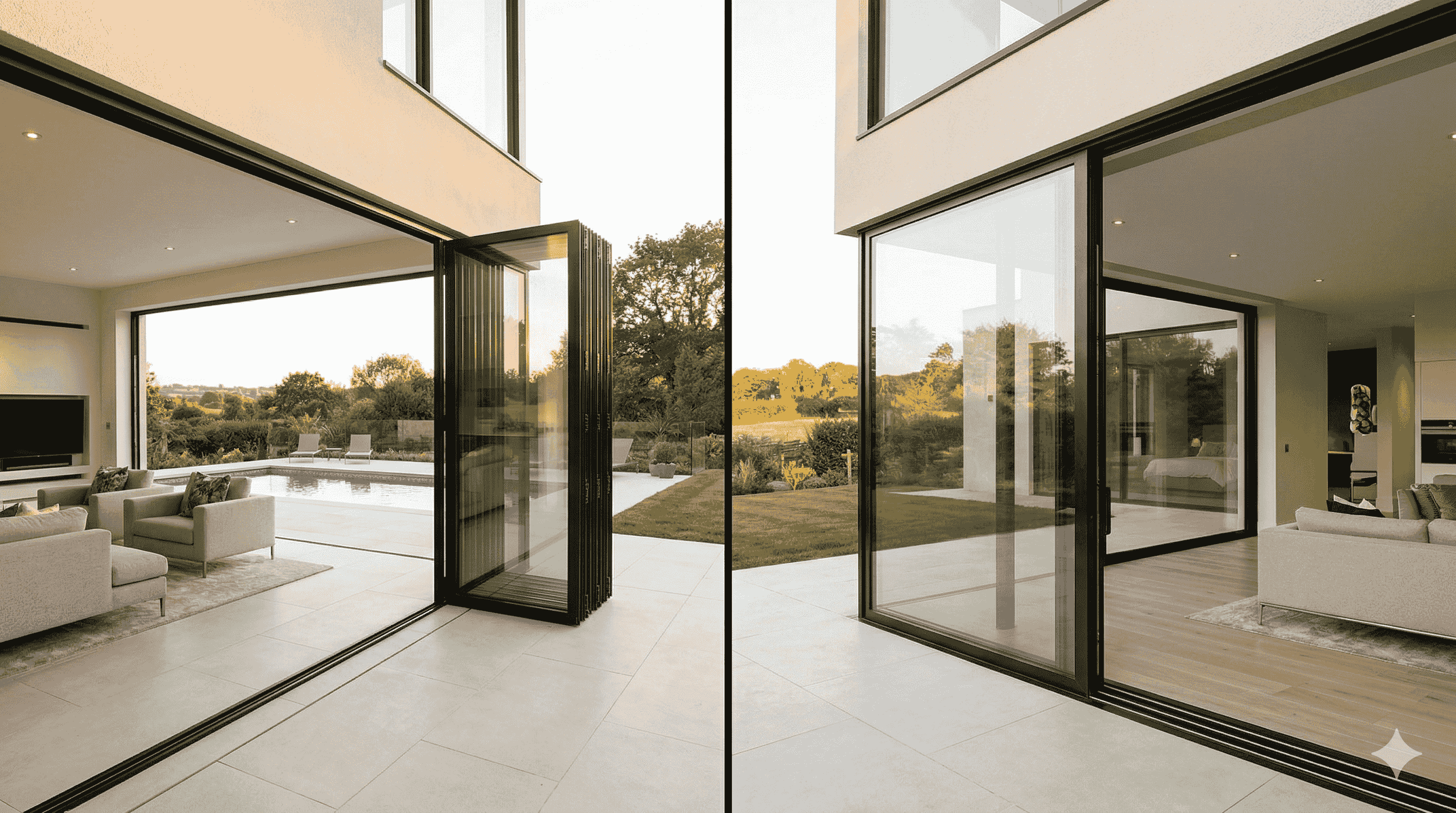
How Each One Works
Bi-fold - multiple panels hinged together, folding accordion-style to one or both sides. You get a nearly full clear opening - typically 90-95% of the frame width. Panels fold and stack at the jamb.
Lift-and-slide - panels ride on a bottom track. Rotate the handle to lift the sash off its compression seals, slide it laterally, then lower it back into sealed position. Panels slide behind each other or into a wall pocket.
The core trade-off: bi-fold gives you a bigger clear opening but more moving parts. Lift-and-slide gives you smoother daily operation with heavier panels but the fixed panel always takes up space.
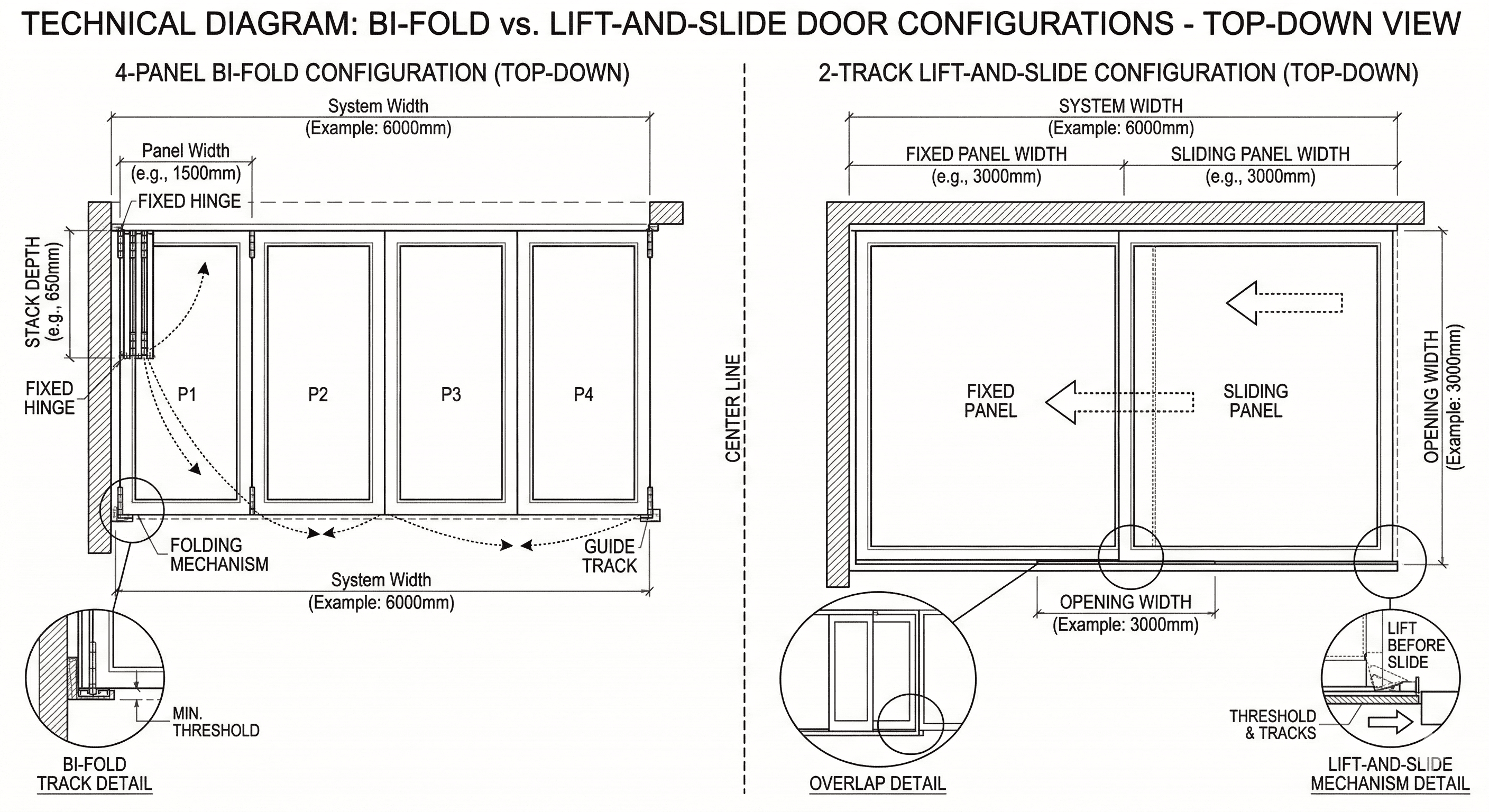
Side-by-Side Comparison
| Feature | Bi-Fold | Lift-and-Slide |
|---|---|---|
| Clear opening | 90-95% of frame width | 50% (2-panel) to 75% (pocket) |
| Max span | 20-40 ft typical | 20-50+ ft typical |
| Max panel weight | ~220 lbs per panel | 660+ lbs per panel |
| Max panel height | ~10 ft typical | 10-12 ft, some systems to 14 ft |
| Daily operation | Fold/unfold multiple panels | Single handle lift + slide |
| Sealing method | Compression gaskets between panels | Drop-down compression seal |
| Published U-factor, systems I quote | about 0.19 (triple) to 0.29 (double) | about 0.15 (triple) to 0.28 (double) |
| Floor track profile | Raised or flush threshold | Flush track possible |
| Wind resistance | Moderate - more joints = more exposure | Higher - fewer joints, heavier panels |
When Bi-Fold Is the Right Call
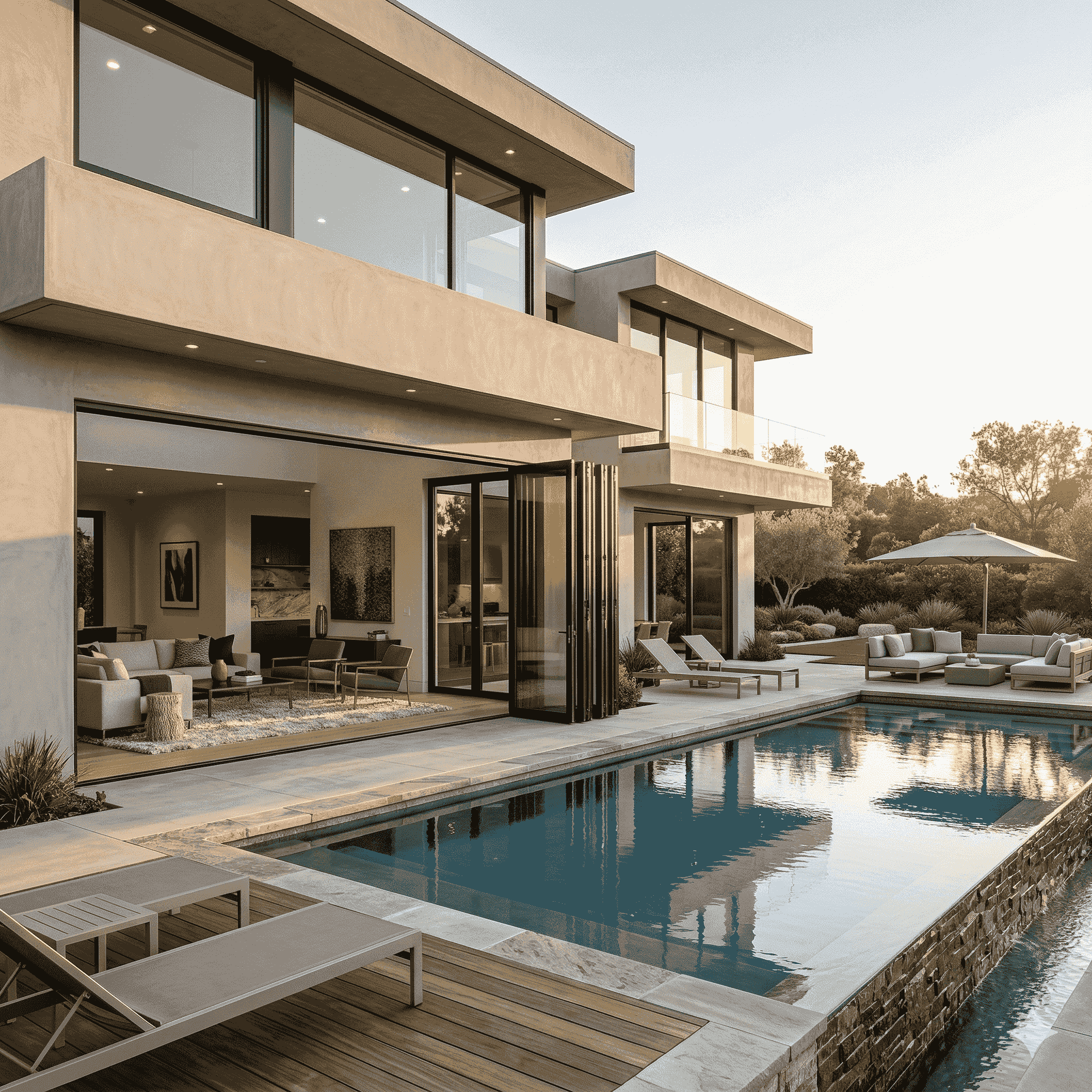
Maximum opening is the priority. If the brief is "I want the wall to disappear," bi-fold is the simplest way to a near-full clear opening without building a wall pocket. A 20-foot bi-fold opens to roughly 18+ feet of unobstructed space. A 20-foot lift-and-slide opens to 10 feet.
Indoor-outdoor living. For projects in warmer climates where the opening will be fully open regularly - sunrooms, California great rooms, covered patios - the full opening changes how the space feels.
Moderate panel sizes. Bi-fold works best with panels in the 24-36 inch width range. That keeps individual panel weight manageable and operation smooth.
When Lift-and-Slide Wins
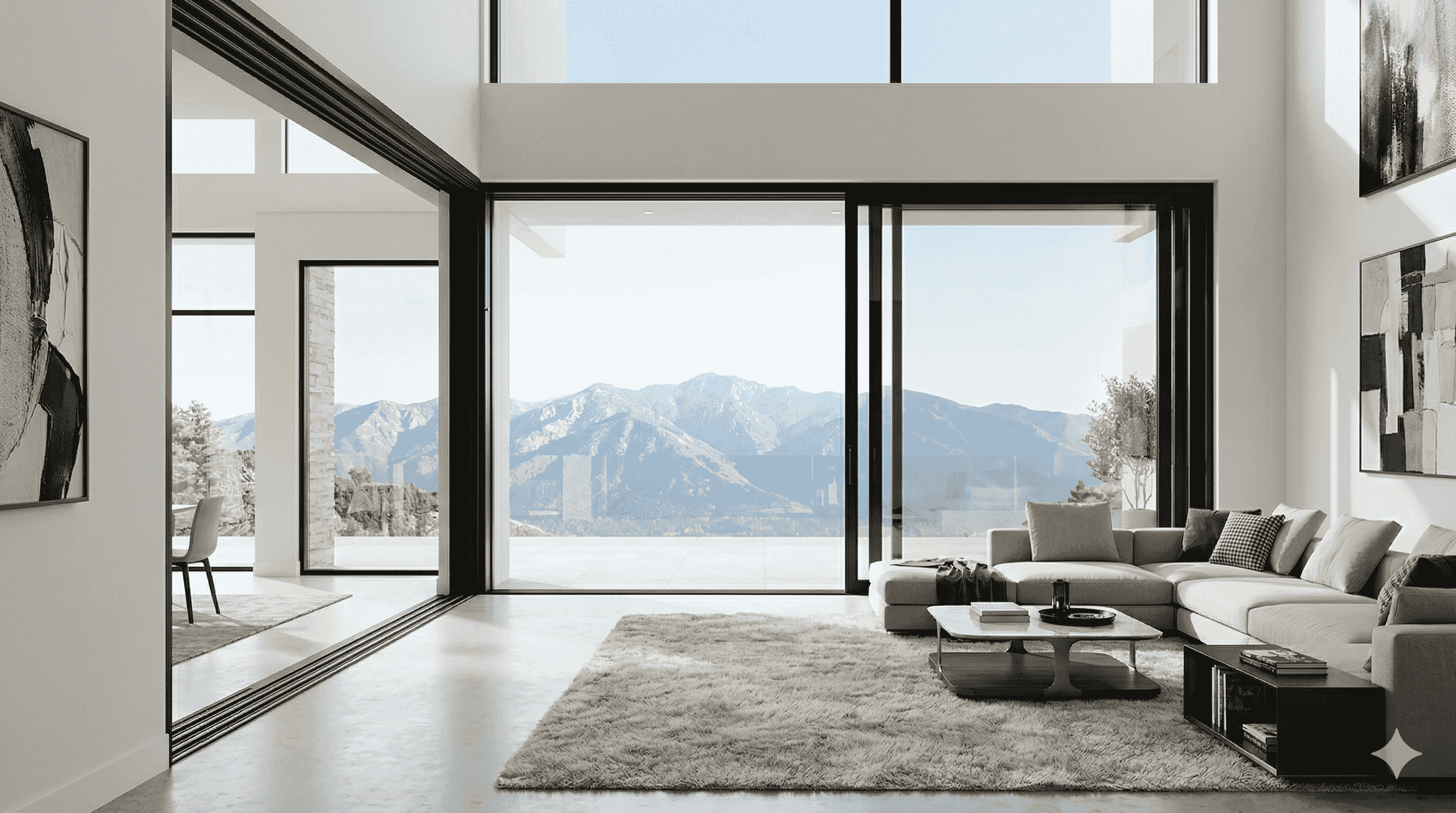
Floor-to-ceiling glass walls. When you want 10-12 foot tall panels with maximum glass area, lift-and-slide handles the weight. A single lift-and-slide panel can weigh 400-660+ lbs - impossible for a bi-fold configuration.
Everyday ease of use. One handle rotation, one smooth slide. That's it. Bi-fold requires unlatching, folding, guiding, and stacking multiple panels. For doors that open and close daily, the lift-and-slide experience is noticeably better.
Thermal performance. Fewer joints mean fewer potential infiltration paths. The drop-down seal mechanism creates a compression seal along the full perimeter when closed. For tight building envelopes and passive house projects, lift-and-slide typically delivers better numbers - especially with triple glazing and high-performance thermal breaks. For more on this, see my lift-and-slide guide.
Wind and weather. Fewer panel joints and heavier construction mean better DP ratings. For coastal projects or high wind exposure, lift-and-slide is often the stronger structural choice - confirm the tested design pressure for the exact size.
Which Is Cheaper, Bifold or Lift-and-Slide?
At the same opening size, a European aluminum bifold and an aluminum lift-and-slide land close together; uPVC lift-and-slide is the budget route, because there is no uPVC bifold in the range I source. Supplied prices from my estimator, 8 ft tall, double glazed, before freight, duty and installation:
| Opening (W x H) | Aluminum bifold | Aluminum lift-and-slide | uPVC lift-and-slide |
|---|---|---|---|
| 12 ft x 8 ft | $6,300 - $9,100 | $6,300 - $8,400 | $3,600 - $4,400 |
| 16 ft x 8 ft | $7,600 - $11,000 | $7,900 - $10,500 | $4,500 - $5,500 |
| 20 ft x 8 ft | $8,800 - $12,800 | $9,300 - $12,500 | $5,300 - $6,500 |
Each range runs from the lower-priced system at the bottom of my +/-10% estimate band to the higher-priced system at the top of it. Wood and aluminum-clad wood lift-and-slide doors are quoted per project from drawings. Where the money goes differs:
Bi-fold tends to cost more per linear foot of opening because of the additional hardware per panel - each panel needs hinges, locks, rollers, and a guide system. A 5-panel bi-fold has significantly more hardware than a 2-panel lift-and-slide covering similar width.
Lift-and-slide has higher cost per panel (larger glass, heavier frames, precision track), but fewer panels to cover the same span.
Net result: For the same rough opening width, they land in a similar price range, as the table shows. The bi-fold might edge higher on hardware cost; the lift-and-slide might edge higher on glass cost. I typically quote both when the project could go either way.
Whether either one undercuts a US brand depends on matched quotes: compare the landed European price plus installation against the domestic installed quote for the same opening, glass and finish. See my cost optimization guide for the levers and the DDP import guide for how landed pricing works.
For actual numbers rather than a framework, I have dedicated cost guides for both: what bifold doors cost in the US and sliding patio door cost ranges. If your opening is wide enough that multi-slide is also on the table, multi-slide vs lift-and-slide covers that decision. For all patio door types in one table, see the patio doors cost overview.
Installation Considerations
Bi-fold requires precise alignment across all panels. If the header deflects or the sill isn't perfectly level, panels bind. The more panels, the tighter the tolerance. The frame is assembled on-site, shimmed level, and screw-anchored directly to the structure. Good rough opening prep and experienced installers are essential.
Lift-and-slide is more forgiving on installation tolerance because you're dealing with fewer panels on a simpler track system. The critical detail is track levelness and proper drainage at the sill. Weight is the main challenge - staging and lifting 400+ lb panels requires equipment and planning.
Installation methods for doors and sliding systems differ from windows - these are typically screw-anchored directly into the structure, not bracket-mounted like tilt-turn windows.
What I See on Projects
Most of the luxury residential projects I quote use lift-and-slide as the primary large opening and reserve bi-fold for specific locations where the full opening matters - outdoor kitchens, entertainment areas, or where the architect specifically wants the wall-disappearing effect.
If budget allows only one, lift-and-slide is the more versatile choice for most projects. If the concept is built around indoor-outdoor flow and the opening will be fully open frequently, bi-fold is worth the premium.
Both approaches are visible in recent work. Black Rock uses a four-leaf bi-fold to fold the entire deck elevation open, while the Mississippi custom home runs a lift-and-slide onto a covered porch on a low threshold - same brief, two different answers.
FAQ
Which is better, a bifold or a lift-and-slide door? A bifold door is better when the priority is a fully open wall, because it clears 90-95% of the frame width. A lift-and-slide door is better for large heavy glass, daily one-handle use, airtightness and wind exposure, because fewer panels close into compression seals. Many custom homes use lift-and-slide for the main opening and a bifold for an outdoor kitchen.
Which is cheaper, a bifold or a lift-and-slide door? In European aluminum they usually price within about 10-15% of each other at the same size: a 12 ft x 8 ft opening runs about $6,300 to $9,100 supplied as a bifold and $6,300 to $8,400 as a lift-and-slide. A uPVC lift-and-slide is the cheapest route at about $3,600 to $4,400 for the same opening.
Can I combine bi-fold and lift-and-slide on the same project? Absolutely - and it's common. Lift-and-slide for the main great room opening, bi-fold for the outdoor kitchen or secondary patio. I'll match the profiles and finishes across both systems so the look is consistent.
What about multi-slide (stacking) doors? Multi-slide uses several sliding panels on parallel tracks - lift-and-slide or standard rolling hardware, depending on the system. They stack to one side or pocket into the wall. Clear opening is better than standard lift-and-slide but operation is heavier. It's a good middle ground if you need more clear opening than lift-and-slide but don't want bi-fold complexity.
Which one is better for hurricane zones? Neither standard configuration is hurricane-rated. For hurricane zones, you're looking at impact glass and reinforced framing regardless of door type. Lift-and-slide generally tests better for wind pressure due to heavier construction and fewer joints, but both require project-specific engineering. See my NFRC & NAFS guide for more on U.S. testing standards.
Not sure which door type fits your project? Run the opening through my estimator for a quick range, or send me your floor plans and elevations - I'll recommend the right configuration for each opening and quote both options if it could go either way. Request a Quote | Schedule a Call
Kai, your window guy!