
Window selection affects the commercial building envelope and its energy analysis. Establish the adopted code and documentation requirements early, then check the proposed assemblies in the project compliance model.
European windows can be used on US commercial projects when the actual assemblies and documentation satisfy the adopted energy code and compliance path. A low converted catalog U-value alone does not establish ASHRAE, IECC or California compliance. Confirm U-factor, SHGC, visible transmittance and the applicable rating method before ordering.
Do European Windows Meet ASHRAE 90.1-2022?
The answer is configuration-specific. Limits depend on the adopted edition, climate zone, assembly category and compliance path. Use the project code analysis rather than a combined table of limits from different standards.
| Confirm before selecting a system | Evidence needed |
|---|---|
| Code and climate zone | Adopted edition, amendments and project classification |
| Fixed, operable or entrance assembly | Correct category for each schedule mark |
| Thermal and solar performance | Required whole-product ratings for the quoted size and glass |
| Documentation | NFRC certification or the alternative expressly accepted by the authority |
| Compliance result | Design-team review of the complete envelope and chosen path |
DOE COMcheck guidance explains supported commercial and high-rise residential compliance options. Unit conversion is useful for comparison but does not turn an EN result into an NFRC rating.
COMcheck: What Better Windows Can and Cannot Do
COMcheck supports energy-code compliance analysis for the editions available in the tool. Confirm that the jurisdiction accepts the selected version. Its envelope trade-off calculation compares the proposed envelope with a code baseline; it does not waive mandatory requirements or automatically permit extra glazing area. See DOE methodology.
Better fenestration can improve the calculated result, but the design team must check the entire envelope, applicable area limits and compliance path. Do not assume that a window upgrade allows reduced insulation or eliminates a mechanical-system requirement.
I coordinate a project data sheet identifying the source and documentation status of each value. The design team confirms whether those values are accepted for the selected compliance path.
| Field on the data sheet | What you get |
|---|---|
| Unit type | Fixed, operable or entrance door, matched to your schedule marks |
| Frame | Aluminum with thermal break, system named |
| U-factor | Whole-window value in imperial units, per configuration - never center-of-glass |
| SHGC and VT | Whole-window values for each glass package |
| Documentation path | NFRC-rated units on selected systems where the permit needs them; simulation and European test reports otherwise |
For converting a European datasheet yourself, the U-value to U-factor converter does the arithmetic.
California Title 24: A Few Extra Hoops
California doesn't use COMcheck - it has its own compliance pathway through EnergyPro or CBECC. A few things to know:
- NFRC-rated values are what Title 24 expects - not manufacturer-claimed numbers. I can source systems with NFRC documentation available when the project calls for it.
- Relative SHGC (rSHGC) accounts for external shading. European windows with low SHGC glazing options (0.18-0.30) perform well here - the same coating logic drives residential specs in hot markets like Texas, see European windows in Texas for the SHGC-first breakdown by IECC zone.
- Fenestration area limits on the prescriptive path. A better U-factor does not raise the prescriptive area limit; a design that exceeds it moves to the performance path.
Under a performance method, model the complete building to establish the effect of the selected fenestration. No window package guarantees enough margin to avoid other design changes.
LEED and Green Building Credits
Windows may contribute to building-level energy, daylight and view goals. LEED credit availability and points depend on the selected rating-system version and the complete project; purchasing a European window earns no points by itself. Have the project LEED team evaluate the documented assembly and building model.
ENERGY STAR building performance also depends on the whole building and its operation, not the window origin.
Curtain Wall vs. Punched Openings
| Approach | Typical WWR | Best For |
|---|---|---|
| Full curtain wall | 60-90% | Office, lobby, retail |
| Punched openings | 25-45% | Multifamily, hotel rooms |
| Hybrid | Varies by zone | Mixed-use, podium + tower |
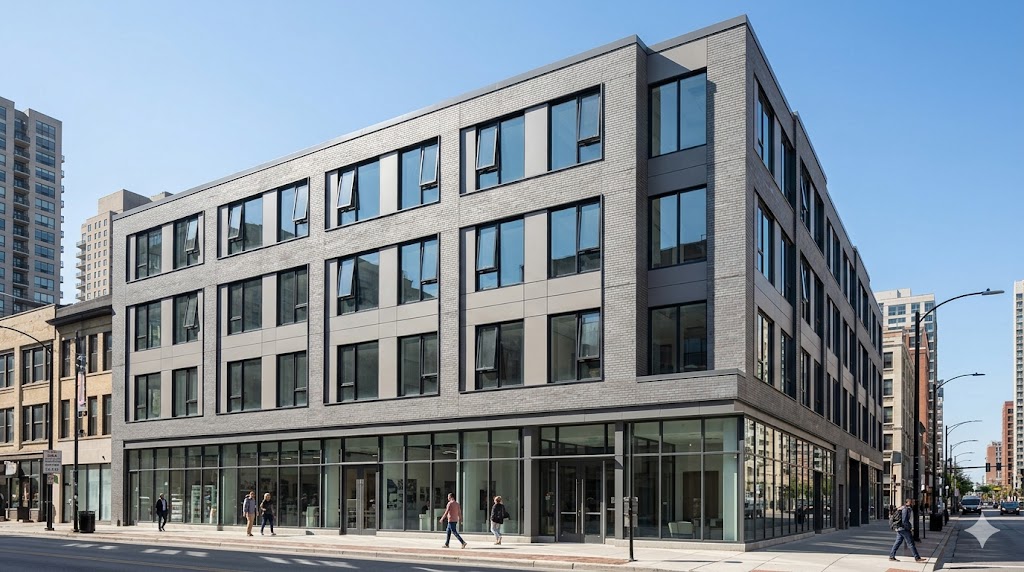
European system providers offer both product lines from the same profile family, so you get consistent sightlines and finishes across the facade. Punched openings install with bracket mounting, and for office-to-residential conversions, the flexibility is especially useful.
The same hybrid logic scales down to residential. On Black Rock the double-height living room runs as curtain wall while the bedroom wing uses punched windows - one profile family, one finish, two structural approaches on the same house.
FAQ
Can European windows pass ASHRAE 90.1-2022 prescriptive requirements? Yes, if the actual rated configuration satisfies the project requirements. Verify the applicable U-factor, SHGC, area limits and documentation for each assembly and compliance path. A catalog range or country of origin is not proof.
Do operable European windows meet the fixed-window U-factor limits? Some operable configurations have low U-factors, but compare the exact product rating against the applicable operable category and project path. Do not assume that every tilt-turn meets the fixed-window limits.
Do I need NFRC labels for COMcheck? COMcheck takes U-factor and SHGC inputs whose source the jurisdiction must accept; NFRC ratings are the standard source, and California's Title 24 path expects them. Whether a label is mandatory depends on the jurisdiction and the compliance path. I quote NFRC-rated units on selected systems where the permit needs them and provide the U-factor, SHGC and VT for each configuration in US units either way.
What do European aluminum windows cost for a commercial project? Premium thermally broken European aluminum runs about $45 to $95 per square foot supplied for operable units, before installation - large fixed lights lower at about $30 to $50, small operable sashes at the top, and steel-look profiles higher still. See what aluminum windows cost, or run your schedule through the estimator for a landed range.
Ready to Document Your Windows for Code Review?
Send me your window schedule and performance targets. I'll have a budget estimate back to you the same or next working day, with COMcheck input data, NFRC documentation on the selected systems that have it and NAFS test reports where available, alongside shop drawings within 2-3 working days after review.
Kai, your window guy!