Most builders who ask about European windows already know they want something different from the standard domestic package. What they are less clear on is what "European" actually means in practice - what the product is, how it performs, what it costs, and how the procurement process works in the US.
This guide covers all of that. It is meant as a starting point for anyone who is pricing their first European package or trying to explain the product to a client, GC, or plan reviewer.
What "European windows" actually means
The term does not refer to a brand or a single system. It describes a manufacturing tradition built around different standards than the US market uses.
A few things are almost always true of a European window:
Multi-point locking. Instead of a single latch, a European sash locks at three to seven points around its perimeter when you turn the handle. This is not a premium upgrade - it is the baseline. It seals better, distributes load evenly, and is much harder to force.
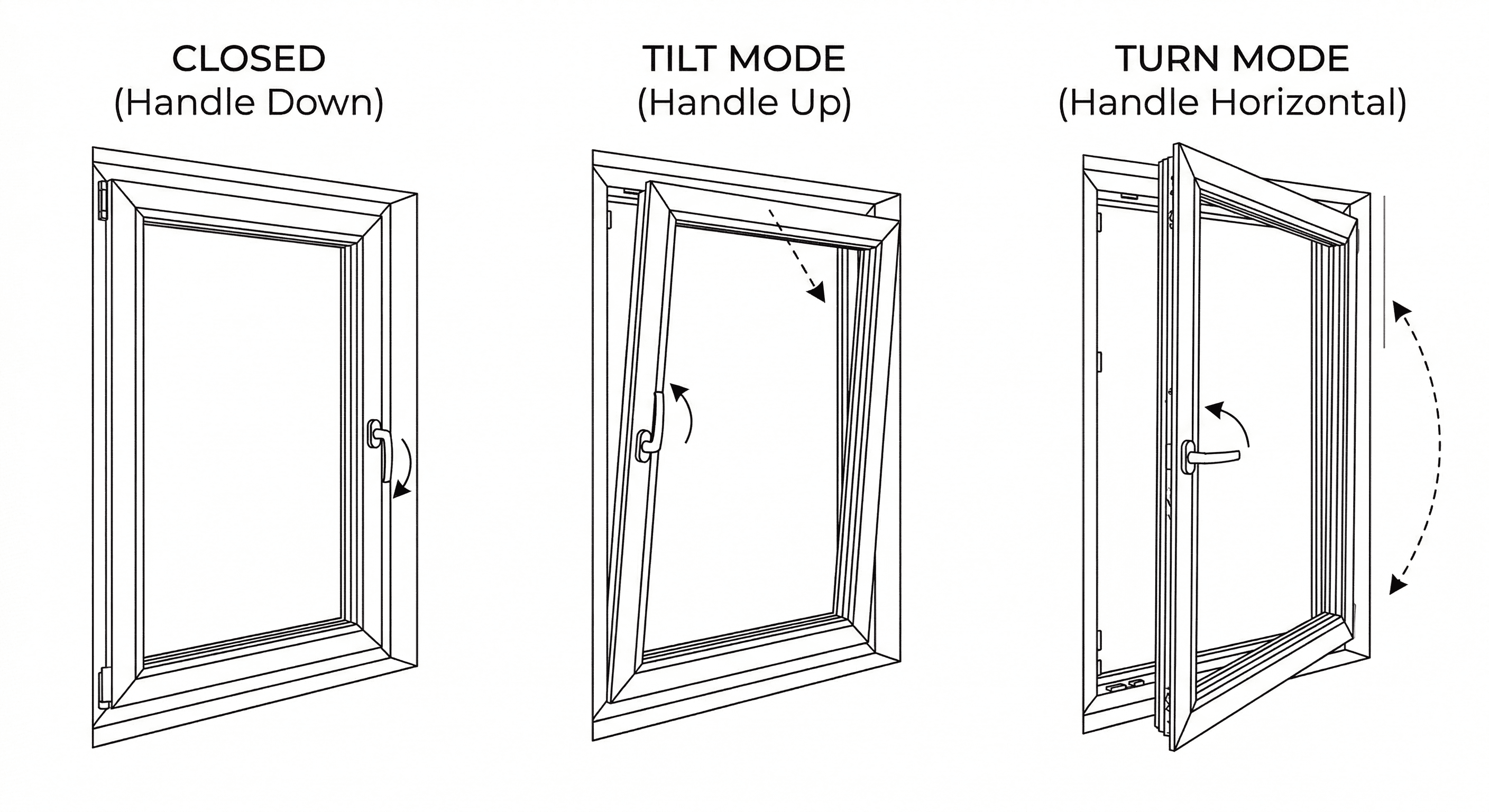
Tilt-turn hardware. The dominant operable type in European fenestration is the tilt-turn: one handle controls two opening modes - a bottom-hinged tilt (for ventilation) and a standard side-hinged swing. It is the default operable unit the way a double-hung is the US default. You can read a full comparison in tilt-turn vs casement windows, and the one most US homeowners actually need, tilt-turn vs double-hung. Outward-opening versions exist too, built for markets that expect a crank and an interior screen - those are covered on the European casement windows page.
Thermally broken frames. All premium European systems use a polyamide thermal break to separate the inner and outer frame shells. This stops cold bridging and is what produces the low U-factors these windows are specified for.
DIN/CE engineering. European systems are tested and certified to DIN/EN standards. That engineering rigor - tight tolerances, documented performance, consistent hardware - is a big part of what justifies the price difference.
Main window and door types
Tilt-turn windows
The most common European window type. Single-sash units come in very large sizes (up to around 9 ft tall in some systems), operate in two modes, and seal tightly in both. They work as picture windows when the handle is horizontal and ventilate in tilt mode without a screen. The /tilt-and-turn-windows landing page has full specs and system examples.
Lift-and-slide doors
The large-opening workhorse. The sash lifts off the sill when you turn the handle, then slides with almost no friction. Multi-rail systems handle openings to 30+ ft. They are the most common patio door type in European residential construction and the product I spec most often for custom homes with large glazing ratios. See sliding patio door cost for current US price ranges.
Bifold doors
Glass panels that fold back accordion-style, fully opening a wall. Good for connecting indoor-outdoor spaces. More complex mechanically than lift-and-slide, and the threshold is higher (not flush). I cover cost and tradeoffs in the upcoming bifold doors cost post.
Fixed and combination units
A large share of European glazing is fixed - picture windows, fixed transoms, structural glass. They are often paired with operable units in combination frames to achieve clean sight lines with minimal frame interruption.
Frame materials
uPVC (unplasticized PVC)
The dominant residential material in Europe. Comparable thermal performance to thermally broken aluminum, lower cost, no repainting required. Works well for residential projects where the client is not chasing a minimal frame profile. Not the right call for very large units, where aluminum handles deflection better.
Thermally broken aluminum
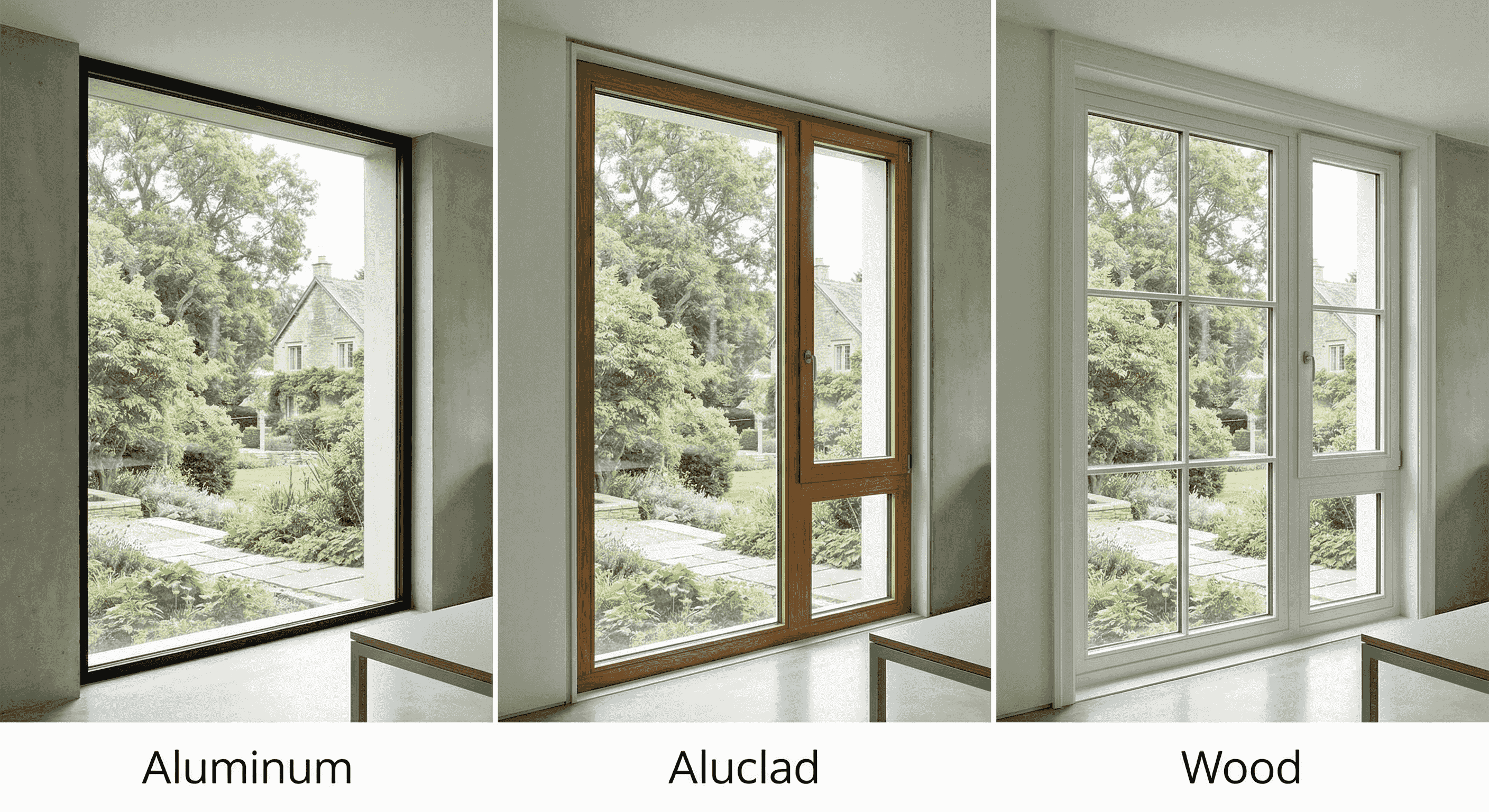
Slimmer sight lines, stronger sash (less frame for the same span), wider color palette, longer service life. The premium choice for high-end custom homes, commercial builds, and designs that want a modern or steel-look aesthetic. Also the material category where performance specs for passive house and high-performance certification tend to live. See thermally broken aluminum windows explained.
Aluclad
An aluminum exterior shell clipped over a laminated wood frame. Best of both materials - durability outside, warmth inside. A product for projects where the design requires exposed interior wood, with construction details worth comparing - the systems, depths and finishes are on the aluminum-clad wood windows page. Full comparison: aluclad vs aluminum vs wood windows.
Wood
Solid laminated timber inside and out, stained or lacquered at the factory. The choice for traditional and historic work, and for interiors where the frame is part of the joinery. Exposed exterior timber needs periodic finish care, which is why many clients end up on the clad version. What I offer in solid timber - species, profile depths, finishes - is on the wood windows page.
Performance: what the numbers mean
The key spec is U-factor. Standard double-hung US windows run U-0.27 to U-0.30 at best. A mid-range European tilt-turn aluminum window typically lands around U-0.20. Passive-house-grade triple-glazed units can reach U-0.14 or lower.
For most US projects in climate zones 4 and above, a triple-glazed European window will beat ENERGY STAR requirements by a meaningful margin. In zones 5-7 (northern tier, mountain states), the difference is large enough to affect annual heating load noticeably.
SHGC (solar heat gain coefficient) is the other number to track. Northern projects want higher SHGC to capture winter sun; southern projects want lower SHGC to limit cooling load. European systems offer the same range of low-E coatings as domestic products - this is a glazing spec, not a European/American distinction. The exact code target depends on where the project sits - see European windows by state for the climate zone and code numbers in the states I ship to most.
NFRC certification is available on many European systems but not universal. For projects where the spec sheet must show a certified label, confirm before ordering. I cover this in detail in NFRC and NAFS certified European windows. For passive house windows specifically, PHI-certified systems exist and are the ones worth specifying.
See triple vs double glazing for US projects to understand when the upgrade is worth the money.
What European windows cost in the US
The all-in cost - supply, shipping, duties, and installation - varies by material and system:
- uPVC systems: roughly $20-30 per square foot of window area
- Thermally broken aluminum: roughly $55-95 per square foot
- Wood and aluclad: quoted per project from the current specification; request a quote
These are landed, installed ranges for a US project. The import process adds duties - which vary by material and HTS classification, and can be substantially reduced through proper contract structuring - and ocean freight, which is why comparing a factory quote to a domestic window price in a catalog does not work directly.
For a full breakdown of the cost math - including what drives the spread - see how much do European windows cost. To get an estimate for a specific project, the online estimator covers supported PVC and aluminum systems. Wood and aluclad need a project quote.
Lead times and the procurement process
European windows are made to order. Standard lead times run 10-16 weeks from approved shop drawings to factory ship date, plus 3-6 weeks for ocean freight. On a normal US project timeline, this means:
- Place the order at frame stage, not at trim-out
- Approve shop drawings promptly - revisions restart the queue
- Coordinate rough opening tolerances early (European tolerances are tighter than US standard framing)
The process is different from ordering domestic windows through a distributor, but it is not complicated once you have done it once. I handle coordination end to end - factory communication, shipping logistics, documentation, and on-site delivery - so the GC does not need to manage the import directly.
Who European windows make sense for
Not every project. The right fit is usually:
- Custom homes where glazing is a design feature, not a commodity
- Passive house or high-performance builds where U-factor targets exceed what domestic products can hit economically
- Projects with large openings (lift-slide walls, floor-to-ceiling fixed units)
- Architects who want slim frames and a wider range of operable configurations than US suppliers offer
If the project is a standard renovation with 30 double-hungs replacing in kind, European windows will not deliver enough value to justify the lead time and process overhead.
For projects that do fit, see European windows for custom homes for a deeper look at the specification process.
FAQ
What is the main difference between European and American windows? The biggest differences are hardware and thermal performance. European windows use multi-point locking and tilt-turn hardware as standard. Frames are thermally broken with tighter tolerances. This produces lower U-factors and better airtightness than most comparable domestic products.
Are European windows worth the cost in the US? On the right project, yes. If you are targeting U-0.20 or better, wanting tilt-turn functionality, or specifying very large units, the European product range offers options domestic suppliers do not. The lead time and import process are the main tradeoffs.
What duties apply to European windows imported to the US? Duty rates vary by material and HTS classification. The headline rate on aluminum is significant, but through proper contract structuring the effective landed duty is substantially lower than the headline suggests. I walk through the current tariff picture and reduction strategies on every project call - book a slot here to discuss your specific scope.
Can European windows get NFRC certification? Many systems can. Some are pre-certified; others require project-level simulation and labeling. Not every system is certified, so confirm before specifying on a project where a certified label is required.
What is the lead time for European windows to arrive in the US? Typically 10-16 weeks manufacturing plus 3-6 weeks shipping, so 3-5 months total from signed order to site delivery. Plan for this at schematic design, not construction documents.
Do European windows meet US building codes? Yes, when specified correctly. NAFS performance classes, NFRC labeling (where required), and egress compliance are all achievable. It requires upfront attention in the specification phase - the product does not automatically come pre-mapped to US code language.