
Inward opening windows are common in Europe because tilt-and-turn hardware combines top-tilt ventilation with a full inward swing for cleaning and access, while leaving space outside for screens and shutters. The trade-off for a US project is interior clearance: furniture, faucets, blinds and deep returns need to stay out of the sash's path.
Not every European window opens inward. I also source outward-opening casements, and the right choice depends on the room and installation detail. This guide explains the practical reasons for an inward swing and the details to confirm before specifying it.
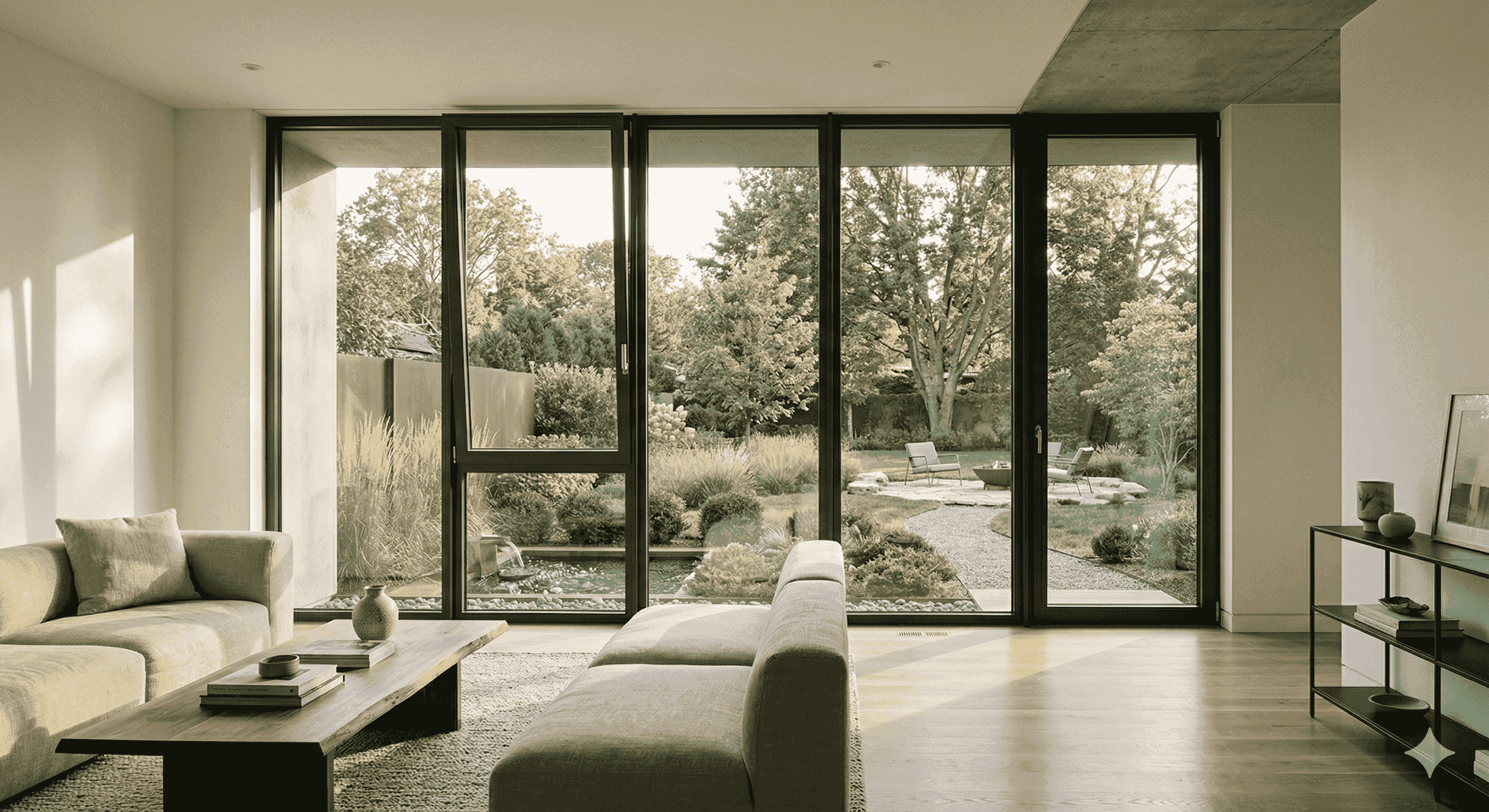
Why Do Windows Open Inward in Europe?
Inward-opening windows are the norm across continental Europe - Germany, Austria, Switzerland, Poland and France among them - while North America and the UK mostly open outward. In US spec language these are inswing windows. The European approach developed around a simple constraint: high-rise and multi-story buildings where you can't lean out to clean, adjust, or maintain an outswing sash. If the sash swings out on the fourth floor, cleaning it means hiring a crew or ignoring it. If it swings in, the occupant handles it from inside.
The second constraint sits on the outside of the wall. Continental European houses commonly carry exterior roller shutters or hinged shutters, and insect screens mount on the exterior face of the frame. An outswing sash would collide with all of them; an inswing sash never touches them.
Those constraints shaped hardware design, locking geometry, and the entire tilt-turn mechanism - all of which ended up delivering real performance advantages that persist even in single-story buildings.
What Are the Advantages of Inward Opening Windows?
Multi-point locking geometry
Tilt-turn hardware uses multiple locking points to pull the sash against its perimeter gaskets when closed. The number and position of those points depend on the hardware package and sash size; the complete window's tested ratings determine its air and water performance.
The locking pins engage with keepers in the frame as the handle rotates. The same handle selects tilt or turn mode, which is the practical benefit of this hardware arrangement.
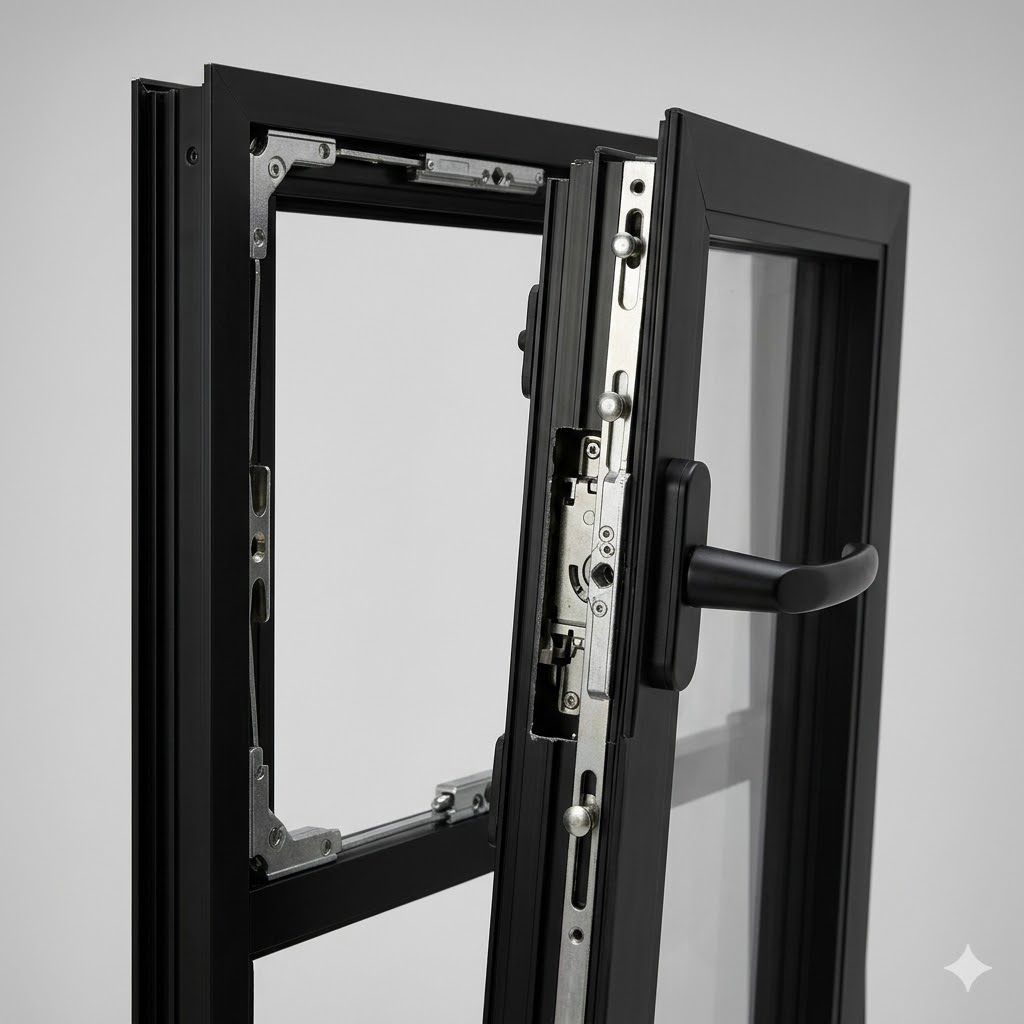
An inward swing alone does not guarantee a tighter seal than an outswing casement. US casements also use perimeter weatherstripping; Andersen's casement weatherstrip documentation illustrates that point. Compare the tested window configuration, not opening direction alone.
I cover the hardware in more detail in the European window hardware explained post if you want the full espagnolette breakdown.
Cleaning and access from inside
This one is practical and immediate. On a second-floor bedroom window, you clean both sides of the glass from inside the room. Open the sash inward, wipe the exterior face, close. No ladders, no scaffolding, no window cleaning service.
For high-end residential in the US, this is increasingly a selling point - especially for clients with floor-to-ceiling glazing on upper levels.
Safety on upper floors
An inward-opening window still presents a fall risk when fully open. Tilt mode gives a smaller ventilation opening, but ordinary tilt-turn hardware is not a child-safety device. Where access must be controlled, specify the appropriate restrictor or keyed tilt-before-turn hardware and coordinate it with the project's egress requirements. Roto's TiltFirst guidance explains how that hardware can restrict access to the full-turn position.
No exterior clearance required
An outswing casement needs clear space outside the building footprint - no shrubs, no decks, no furniture that would block the sash arc. An inward-opening sash clears into the interior, which you control. For tight urban setups or fenestration set close to exterior walkways, inswing is simply the cleaner solution.
Why Do European Windows Open From the Top?
When a European window opens from the top, you are seeing tilt mode: the sash stays supported at the bottom and leans inward at the top for ventilation without swinging the whole sash into the room. It is one of two modes on the same sash, and one handle controls both. The window is still open in tilt mode, so it should not be treated as weather-sealed or locked shut.
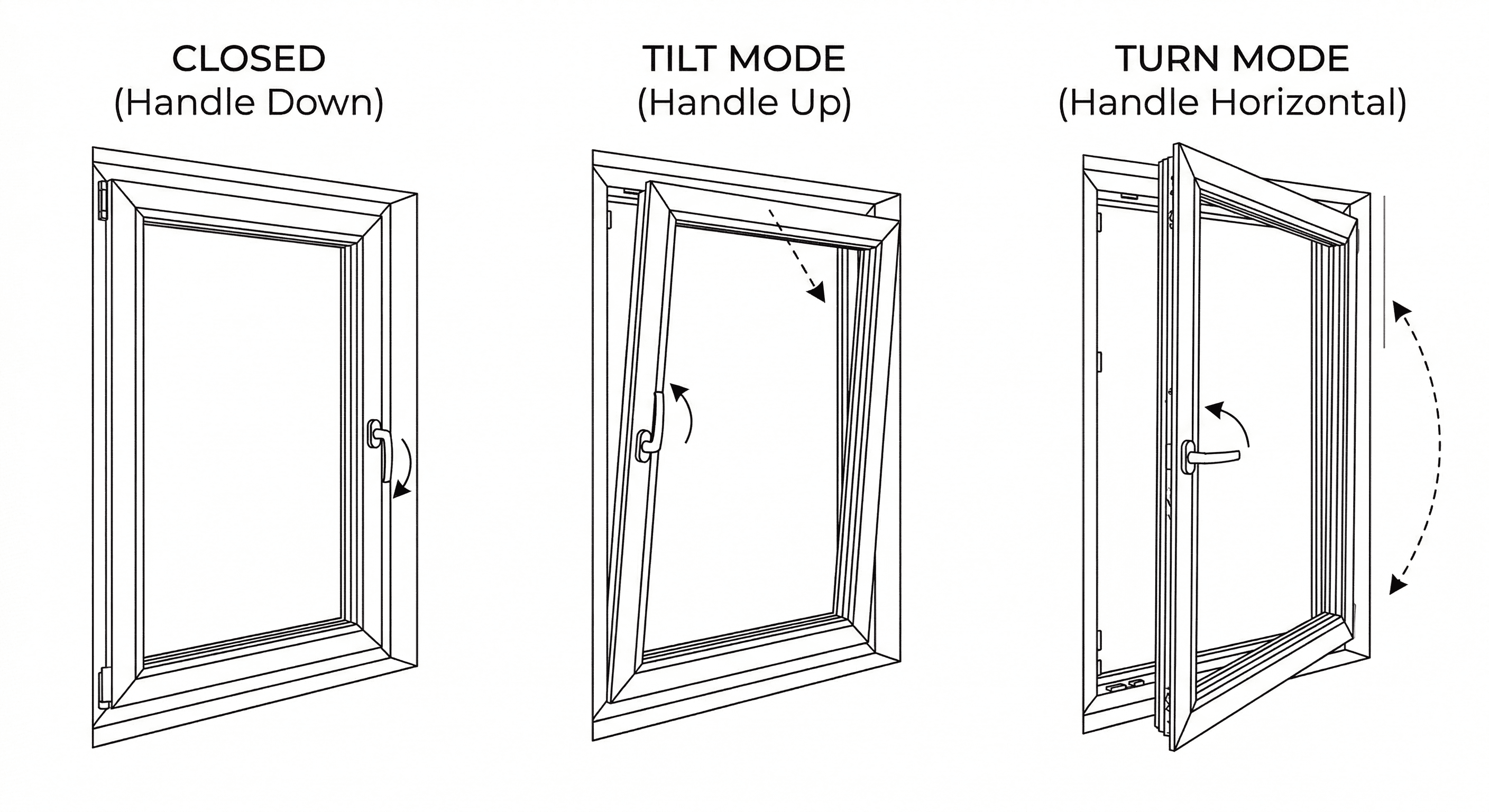
- Handle pointing down (closed): all locking points engaged, multi-point compression.
- Handle turned 90 degrees to horizontal (turn): sash swings fully inward like a door on side hinges - for cleaning, egress or full airflow.
- Handle turned 180 degrees, pointing up (tilt): top of sash pivots inward while the bottom remains supported. The tilt gap depends on the hardware and sash size.
Tilt-before-turn hardware swaps the last two, so the first quarter turn of the handle tilts the sash - a common choice for children's rooms, and one that works the same way on timber sashes, as covered in tilt and turn wood windows.
One handle selects both functions through the tilt-turn hardware built into the sash.
If you want the full comparison of this mechanism against American casement, I break it down in European tilt-turn vs American casement.
What About Rain?
The most common US objection: "if it opens inward, doesn't rain blow in?"
Yes, rain can enter an inward-opening window in either tilt or turn mode, especially when wind drives it toward the opening. The window's water-tightness rating applies to the closed and locked configuration. Close the sash when rain or strong wind is expected rather than relying on the tilt gap to keep the room dry.
Use tilt mode for controlled ventilation in suitable weather and full turn mode when you want a wider opening or access for cleaning. Reynaers' operating guidance explicitly distinguishes open windows from their closed-state weather and security performance.
What This Means for US Builders
A few practical notes for anyone speccing inward-opening windows on a US project:
Window stools and sills. The sash swings into the interior, so interior stools need to be kept clear of the swing arc. Check the frame position, finished sill, deep returns, blinds and nearby fixtures on the shop drawings before approving the opening detail.
Rough opening. Use the selected system's installation clearances and anchoring detail. Brackets, frame screws or a nailing flange may be appropriate depending on the frame and wall assembly; an inward swing does not dictate one installation method.
Screens. The insect screen mounts on the exterior face of the frame and the sash swings inward on the other side, so the two never meet - fixed frame screens or roller cassettes that integrate with the frame profile are standard. It's the reverse of a typical outswing casement arrangement, and I cover the mechanics in how screens work on tilt-turn windows.
Code and egress. Tilt-turn windows can meet US egress requirements on the turn mode. The open dimensions depend on the unit spec - always verify the clear opening height and width against local code for bedrooms. I provide the net clear opening drawing for each specific unit as part of the specification process, so the project team and plan reviewer can confirm compliance.
For pricing context: European windows cost about $15-25 per square foot in uPVC and $45-95 per square foot in aluminum for the supplied window, with tilt-turn sashes toward the upper end of each range because of their hardware. Freight, duty and installation come on top - the estimator gives a landed range for your schedule, and the layers are explained in how much European windows cost.
If you're evaluating tilt-turn windows for a project, my guide to European tilt and turn windows in the USA covers the systems I source, lead times, and how the import process works. And if the client simply will not accept an inward swing, you can keep the European frame and hardware in an outswing unit - see European casement windows.
FAQ
Why do European windows open inward? Many European windows open inward because tilt-and-turn hardware combines two useful opening modes: a top tilt for ventilation and a full inward swing for cleaning and access. The sash also stays clear of exterior screens and shutters. European outswing windows exist too, so the choice should follow the room layout and project requirements.
Why do European windows open from the top? A European window that opens from the top is in tilt mode. On standard tilt-turn hardware, turning the handle upward lets the top lean inward while the bottom remains supported; a horizontal handle selects the full inward swing. Tilt-before-turn hardware changes that sequence. Tilt mode provides ventilation but does not make an open window weather-tight.
Do inward-opening windows let rain in? Yes, rain can enter when an inward-opening window is tilted or fully open, particularly in wind-driven rain. Tilt mode leaves an opening at the top; it is not a weather-sealed position. Close and lock the window when rain or strong wind is expected, and follow the operating instructions for the specific system.
Are inward-opening windows safe for children? Inward opening alone does not make a window child-safe, and ordinary tilt mode is not a substitute for an appropriate safety device. Discuss restrictors or keyed tilt-before-turn hardware with the project team, including how the selected hardware controls full opening and how it affects required emergency escape operation.
Can European inward-opening windows meet US egress requirements? They can, in turn mode, if the specific unit meets the project's emergency escape requirements. Use the actual net clear opening with the sash open, not the frame dimensions: sash position, hardware and interior obstructions can reduce it. Confirm opening width, height, area, sill height and operation with the project team and local authority.
Why don't American windows open inward? American practice commonly uses double-hung windows, whose sashes slide vertically, and crank-operated outswing casements, whose sashes swing outside with screens inside. Both avoid an inward swing into curtains and furniture. Inward-opening tilt-turn windows offer a different combination of ventilation, cleaning access and exterior screen placement, which can suit US projects too.