Search "sliding patio door cost" and the numbers are all over the map: $800 at the big-box store, $2,500 for a replacement, $7,000 to $10,000 on a contractor quote, $14,000 at the high end. They're not wrong - they're answering different questions about different products.
A builder-grade replacement slider and a wall-sized European lift-and-slide are not the same buy, and lumping them into one range is how budgets blow up. So here's a straight answer for both, by opening width - your 6, 8, 10, 12, 16 or 20 foot number - plus 4-panel configurations, replacement openings, and the landed cost that decides what you write the check for.
Jump to the numbers: cost by opening width.
The Short Answer
Two products, two price classes:
- Standard sliding patio doors (the big-box and replacement category) typically run $800 to $5,000 supplied, and commonly $3,000 to $10,000 installed once you add labor and disposal. That's the bracket the retailers and replacement quotes are quoting.
- European lift-and-slide patio doors - the premium, large-format systems I source - run about $35 to $49 per square foot in uPVC and $67 to $91 per square foot in aluminum for the supplied unit. For a typical 8 to 12 ft 2-panel opening that's roughly $2,200 to $8,700 supplied; wall-sized multi-panel runs climb into five figures. Those are the ranges my own estimator is built on.
Cost by Opening Width: 8, 10, 12 and 16 Foot Sliding Doors
Most people arrive here with a width in mind, so here is the table first. These are 2-panel, single-track openings at a standard 8 ft (96 in) height - the most common configuration - priced as supplied product from the European systems I source, with no divided-light bars. The low end of each cell is a double-glazed unit at the bottom of my estimator's +/-10% band; the high end is triple-glazed at the top of it (triple adds about 15% on uPVC and 6% on aluminum). So the spread covers the glazing decision, not just estimator noise.
| Opening width | Approx. area (8 ft height) | uPVC supplied | Aluminum supplied |
|---|---|---|---|
| 6 ft | 48 sq ft | $1,700 - $2,400 | $3,200 - $4,400 |
| 8 ft | 64 sq ft | $2,200 - $3,200 | $4,300 - $5,800 |
| 10 ft | 80 sq ft | $2,800 - $3,900 | $5,300 - $7,300 |
| 12 ft | 96 sq ft | $3,400 - $4,700 | $6,400 - $8,700 |
| 16 ft | 128 sq ft | $4,500 - $6,300 | $8,500 - $11,600 |
| 20 ft | 160 sq ft | $5,600 - $7,900 | $10,700 - $14,600 |
Supplied is not landed: import duty (assessed on product value, noticeably higher on aluminum than uPVC) and a per-container freight share sit on top - the landed cost section below covers both.
4-Panel Sliding Door Cost: 16 ft and 20 ft
A 4-panel door (OXXO - two fixed outer panels and two sliders meeting in the middle, or a 4-track stack) is how most 16 and 20 ft openings get built once individual panels would otherwise run past 8 ft wide. My estimator prices it like everything else: per square foot of the opening, at the same rate as a 2-panel. What that cell doesn't show is the extra hardware - two more interlocks, two more sets of rollers, a longer track - which on a real quote nudges a 4-panel toward the upper half of the band below, and a pocketing version further still. Assumed heights: 6 ft 8 in (80 in) and 8 ft (96 in).
| 4-panel opening | Approx. area | uPVC supplied | Aluminum supplied |
|---|---|---|---|
| 16 ft x 6 ft 8 in | 107 sq ft | $3,700 - $5,300 | $7,100 - $9,700 |
| 16 ft x 8 ft | 128 sq ft | $4,500 - $6,300 | $8,500 - $11,600 |
| 20 ft x 6 ft 8 in | 133 sq ft | $4,700 - $6,600 | $8,900 - $12,100 |
| 20 ft x 8 ft | 160 sq ft | $5,600 - $7,900 | $10,700 - $14,600 |
Same width, two ways to build it: a 16 ft run as 2 giant panels needs heavier hardware and larger tempered or laminated glass; the same 16 ft as 4 panels spends that money on interlocks and track instead. The two can land 20% apart, so "4 panel sliding door cost" is a configuration question, not a width question. Either way, bigger is cheaper per square foot - the fixed cost of track, corner hardware and lock spreads across more glass - while the total still climbs, because there's more door.
Replacement vs New Construction
Replacing an existing slider does not change the supplied price. Sliding doors are screw-anchored through the frame and set on a leveled track whether the house is new or forty years old, so there is no nailing-fin uplift on a retrofit - my estimator applies that only to windows and entrance doors. What changes is the work around the opening, and it all lands on the install side:
- Removal and disposal of the old unit, and whatever it was hiding in the sill and jambs.
- Rough-opening rework. European frames are deeper than a stock slider's, the sill wants a solid, level substrate (recessed for a flush threshold), and a wider or taller panel means checking the header - see my rough opening guide.
- Trim and finish inside and out, because the new frame rarely lands exactly where the old one did.
Those are local-labor lines your installer prices, not something I estimate. The one cost-side difference: a single replacement door shipped on its own carries the whole freight allocation, so a one-off retrofit is best timed with a window order it can ride along with - see the retrofit guide.
The Affordable End: What the Cheapest Configuration Gives Up
The cheapest European sliding patio door in the table is a 6 ft, 2-panel uPVC lift-and-slide with double glazing and no bars: about $1,700 to $2,100 supplied. That is still a lift-and-slide with a steel-reinforced profile and full-perimeter compression seals, not the thin replacement product. What you give up is the aluminum sightline (a uPVC frame is visibly wider), the panel-weight capacity for wall-sized glass, the full RAL palette, and the per-square-foot economics - at 6 ft you're paying the fixed hardware cost on the least glass. Against an $800 stock slider it isn't the cheaper door; against a $3,000 to $10,000 installed replacement quote, it lands in the same bracket with a better mechanism.
Standard Slider vs European Lift-and-Slide: What You're Paying For
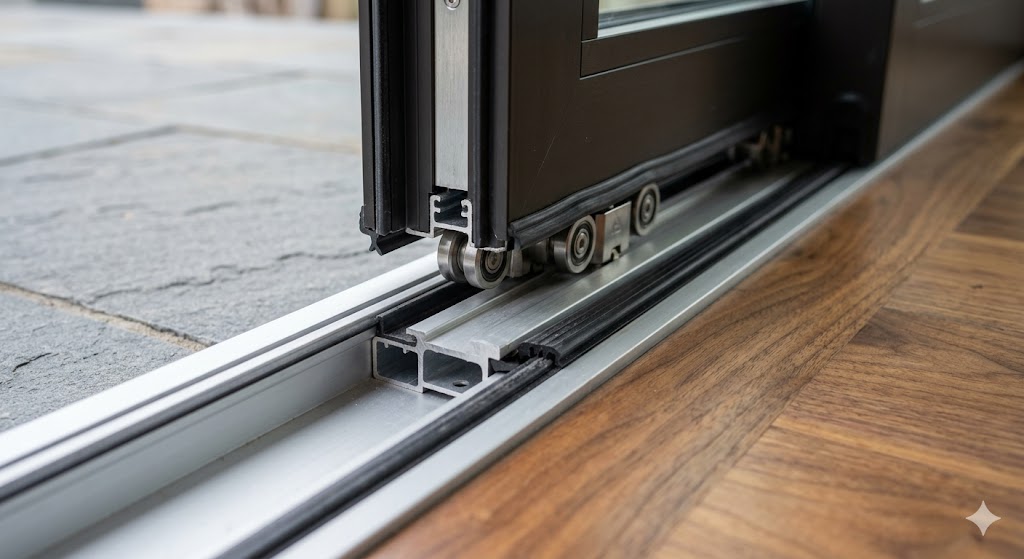
A standard sliding door rolls on a bottom track and seals against brushes or fins - fine for a modest opening and a modest budget. A lift-and-slide works differently: rotate the handle and the panel lifts off its seals to glide with almost no friction, then drops into a full-perimeter compression seal when you let go. That mechanism lets a single panel weigh 400 to 660+ lbs and still move with one hand, and it's the main reason the per-square-foot price is higher. The large-glass lift-and-slide guide covers the mechanism, sill and seals; for sliding versus folding, see bifold vs lift-and-slide.
Here's how the supplied cost per square foot compares across the European systems I source:
uPVC is the value tier. Aluminum is where most of my custom-home work lands: slim sightlines, big glass, any RAL color, and the panel weight capacity for wall-sized openings.
What Actually Drives the Price
Beyond width and panel count, roughly in order of impact:
- Configuration. A 2-panel, single-track opening is the cheapest per square foot. Pocketing, post-free corners and 3-rail stacks add hardware and cost.
- Material. Aluminum carries a real premium over uPVC - the single biggest swing on the chart above.
- Glazing. Triple-pane adds about 6% on aluminum but 15% on uPVC, because glass is a bigger share of a uPVC unit's cost. Whether you need it depends on your climate zone - see triple vs double glazing.
- Threshold, finish and hardware. A flush, zero-threshold sill costs more than a raised track and raises the stakes on drainage. Dual RAL colors, upgraded handles and motorization push toward the top of the range.
The Cost Most Quotes Hide: Landed and Installed
A clean per-door number is the unit leaving the factory in Europe. To get it sliding in your wall in the US, you also pay for:

- Ocean freight and inland trucking to the jobsite, allocated across the container - so the per-door share drops on bigger orders.
- Duties and tariffs. These move with trade policy and vary by material and HTS classification. The headline rate on aluminum is high, but with proper contract structuring the effective impact is substantially lower - background in my tariff impact breakdown, specifics on a project call.
- Customs, brokerage, and documentation. Predictable under a DDP (delivered duty paid) arrangement; handled badly, it's where projects bleed time and money.
- Installation. Budget for a crew that has staged and lifted 400+ lb panels before, and for getting the sill dead level.
That's how my estimator builds a number: supplied price, plus freight allocated across the container, plus current import duty, at a +/-10% accuracy band. Installation by your own crew sits on top. The systems themselves live under aluminum products.
Hold the spec constant and compare DDP-to-installed, and an imported lift-and-slide typically lands 30% to 50% below a premium American national brand, with the value deepest on triple-glazed, large-format and custom-color work. Compare a European factory price against an American installed price and you're not comparing the same thing - that's how people get surprised at the dock. Where European stops being cheaper is the bottom of the market: a builder-grade stock slider is a fight it isn't trying to win. More on protecting the margin in lowering window costs on high-end homes.
How to Get a Real Number for Your Project
Ranges are for budgeting, not bids - the price swings on your exact width, panel count, glazing and finish. Ballpark it with my online estimator in a couple of minutes, or send me your door schedule or elevations and I'll come back with a line-item, DDP, all-in number - the same format I'd hand a GC for a bid.
FAQ
How much does a sliding patio door cost? A standard sliding patio door usually runs $800 to $5,000 supplied and $3,000 to $10,000 installed. A European lift-and-slide is a different class: about $35 to $49 per square foot in uPVC and $67 to $91 in aluminum, supplied, before freight, duties and installation.
How much does a 6 foot sliding glass door cost? A 6 ft opening (about 48 sq ft at 8 ft height) is the smallest and cheapest in the table: about $1,700 to $2,400 supplied in uPVC, or $3,200 to $4,400 in aluminum. It also has the worst per-square-foot economics, because the hardware cost is spread over the least glass.
How much does an 8 foot sliding patio door cost? An 8 ft (about 64 sq ft) European lift-and-slide runs about $2,200 to $3,200 supplied in uPVC, or $4,300 to $5,800 in aluminum. Import duty (higher on aluminum), freight and installation come on top.
How much does a 12 foot sliding glass door cost? A 12 ft opening (about 96 sq ft at 8 ft height) runs about $3,400 to $4,700 supplied in uPVC, or $6,400 to $8,700 in aluminum. The estimator turns that into a landed number for your exact size.
What does a 16 foot sliding door cost? A 16 ft opening (about 128 sq ft) runs about $4,500 to $6,300 supplied in uPVC, or $8,500 to $11,600 in aluminum. Confirm the panel configuration first - a 2-panel run needs heavier hardware and larger glass than a 4-panel setup, and that shifts the price.
How much does a 4 panel sliding glass door cost? A 4-panel (OXXO) door is priced per square foot like any other slider: at 8 ft height, about $4,500 to $6,300 in uPVC or $8,500 to $11,600 in aluminum for 16 ft, and $5,600 to $7,900 in uPVC or $10,700 to $14,600 in aluminum for 20 ft, supplied. The extra interlocks and longer track push a real quote toward the top half of those ranges.
What is the average sliding glass door replacement cost? Standard replacement sliders commonly land between $3,000 and $10,000 installed. A European lift-and-slide replacement uses the same supplied price as new construction - about $2,200 to $3,200 for an 8 ft uPVC unit, or $4,300 to $5,800 in aluminum - plus removal, rough-opening rework and installation, which your installer prices locally.
What is the cheapest sliding patio door? In the European range I source, a 6 ft 2-panel uPVC lift-and-slide with double glazing: about $1,700 to $2,100 supplied. A builder-grade stock slider is cheaper still at around $800, but it is a different product - lighter frame, brush seals, no lift-and-slide mechanism.
Do European sliding door prices include shipping and duties? Usually not, unless the quote says DDP (delivered duty paid). A factory or "supply only" price excludes ocean freight, tariffs, customs and installation - confirm which one you're looking at before comparing it to a US installed price.
Working on a budget or a bid for a patio opening? Run it through my estimator for a quick range, or send me your drawings for a line-item DDP quote. Request a Quote | Schedule a Call
Kai, your window guy!