
The architect drew a 20-foot opening to the pool deck. Now someone has to specify it. Multi-slide or lift-and-slide?
Lift-and-slide beats multi-slide on sealing, airtightness and panel size - the panel drops into compression gaskets when it closes - while a multi-slide door wins when you need five or six moving panels or panels that pocket fully into the wall. The sealing method is the real difference, and it decides how the door performs in year ten.
Both systems create that wide, clean indoor-outdoor connection. Both come in thermally broken aluminum. But they work differently, seal differently, and fail differently - and those differences matter a lot once the door is in the wall and the homeowner is opening it every day for the next 30 years.
Here is what actually separates them.
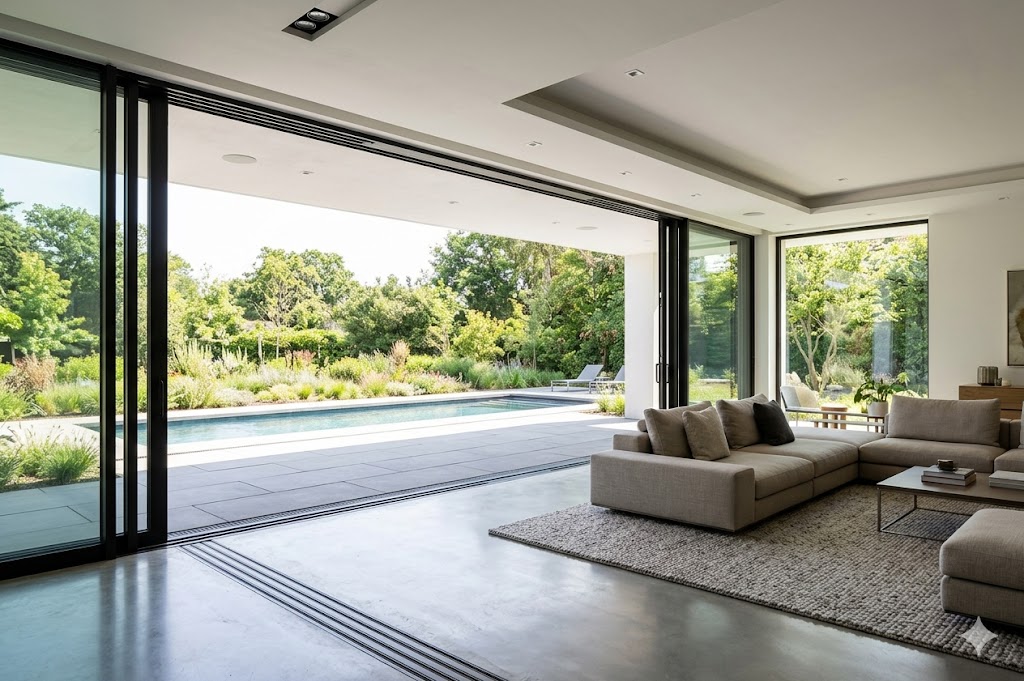
How Multi-Slide Doors Work
Multi-slide doors are exactly what they sound like: multiple panels that slide laterally on a track system. Two, three, four, or more panels can move independently or interlock and stack, giving you a very wide opening from a single doorway.
The key detail is that the panels ride on roller hardware throughout travel and stay in the same vertical plane when closed. Sealing happens through a combination of interlocking profiles between panels and compression or brush seals at the sill and head. The hardware does not change state between "sliding" and "closed" - there is no locking mechanism that moves the panel into a tighter seal position.
That simplicity has a real upside: multi-slide systems are generally easier to operate, especially with 4+ panels, and they are the go-to choice when you want a pocketing configuration where panels disappear entirely into a wall cavity. A quad sliding door - two panels stacking on each side - is a common multi-slide layout for wide openings that need a fully clear span.
The trade-off is sealing. Brush seals and interlock profiles do a reasonable job, but they are inherently dependent on tight tolerances and consistent install quality. Coastal exposure, wind-driven rain, and thermal cycling will find the gaps that a compression seal would not have.
How Lift-and-Slide Doors Work
Lift-and-slide (also written HS for Hebe-Schiebe, the German name) uses a different operating principle. When you turn the handle, a cam mechanism lifts the panel slightly off its compression seals. The panel now rides on rollers with minimal friction. When you reach closed position and turn the handle back, the panel drops into compression seals at the sill, head, and meeting stiles.
That compression seal is the defining feature. The panel's own weight helps seat it. You get the same airtightness approach as a well-fitted entry door - gaskets under compression, not brush contact. This is why European residential construction favors lift-and-slide for large glazed openings: the seal depends less on perfect installation than a brush seal does.
Most of the large sliding doors I quote are lift-and-slide or work on the same compression principle: the Aluprof MB-77HS and Aliplast Ultraglide in aluminum, the uPVC Smart-Slide NEO, and the Timber Lift & Slide in wood or aluminum-clad wood. That is not a product limitation; it is the dominant residential standard in Europe because it delivers the thermal and acoustic performance that architects specify, with only routine track cleaning and occasional adjustment. The minimal-frame sliders, such as the Cortizo COR Vision family, are a separate category built around the slimmest possible sightline. For the basics of the mechanism, see what a lift-and-slide door is.
One practical note: lift-and-slide panels can be heavier (thicker frames, larger glass units), so the handle feels stiffer when you engage the lift mechanism. A well-engineered system uses precision rollers so that once the panel is lifted, it glides smoothly. For a deeper technical look at what drives smooth operation, see the large glass lift-and-slide door guide.
Performance Head-to-Head
| Factor | Multi-Slide | Lift-and-Slide |
|---|---|---|
| Sealing mechanism | Brush seals + interlock profiles | Compression gaskets (panel lifts off when sliding) |
| Airtightness | Moderate - install-dependent | High - gasket compression by design |
| Operating feel | Light, no state change | Slightly heavier handle engagement, smooth slide |
| Panel count flexibility | 2 to 6+ panels | 2 to 4 panels typical |
| Pocketing into wall | Yes - panels disappear | Difficult - sash height + sill height usually block |
| Max panel size | Varies by system | About 10 ft wide or more on heavy-duty systems - check the published limits |
| Passive House compatibility | Unlikely | Yes, on certified systems |
| European availability | Less common | Standard residential system |
Cost Ranges in 2026
For European lift-and-slide systems on an 8 to 16 ft opening, the supplied price - the door itself, before freight, duty and installation - runs roughly:
| Lift-and-slide door, supplied | Per sq ft | 12 ft x 8 ft opening |
|---|---|---|
| uPVC | about $35 - $58 | $3,600 - $5,100 |
| Aluminum | about $61 - $110 | $6,300 - $9,600 |
| Wood or aluminum-clad wood | quoted per project | from drawings |
The low end of each range is double glazing at the bottom of my +/-10% estimate band; the high end is triple glazing at the top of it. Triple glazing adds about 11 to 14% on aluminum and about 15% on uPVC. Wider openings cost less per square foot, because the track and lock hardware cost about the same whatever the glass area.
Import duty, confirmed for the actual products and shipment, comes on top of these numbers together with freight and customs. Every quote I send is DDP, so they are already in the price you sign. Installation is a separate local line - get your installer's quote for the opening.
US-made multi-slide systems (Marvin, Sierra Pacific, Pella) have list prices that vary widely by panel count and glass package. Compare them against a European landed-plus-installed price for the same opening, panel count and glass, not on supplied price alone.
Use the European window and door estimator to get a project-specific supply figure based on your opening dimensions. For more context on overall sliding door cost ranges, see Sliding Patio Door Cost in the US (2026).
Which Configuration Wins Each Scenario
Go multi-slide when:
- You need panels to pocket fully into the wall (no visible stack when open)
- The opening requires 5 or 6 panels and a lift mechanism would be impractical
- It is a commercial or interior application where airtightness is less critical
- Budget favors a US-manufactured option where import lead time is a constraint
Go lift-and-slide when:
- Airtightness, acoustic performance, or passive house spec is on the drawings
- The opening is in a coastal or high-wind exposure zone
- You want consistent performance over a long service life without seal adjustment
- The project is specifying European aluminum throughout - consistent detail language matters
If the opening has both a wide span and a strict thermal spec, lift-and-slide with multiple sashes (2+2 or 3-panel) is almost always the right call. The pocketing trade-off is real but workable - and it is a much smaller concern than a compression seal vs brush seal in a beach house.
For how lift-and-slide compares to bi-fold (a completely different operating logic), see Bi-Fold vs Lift-and-Slide Doors. For the full doors and openings picture including pivot doors and bifold cost, that cluster has you covered.
FAQ
What is a multi-slide door? A multi-slide door has two or more panels that travel along a horizontal track. The panels stay in the same plane throughout travel and close with brush or interlock seals. They can stack at one side or pocket into a wall cavity, giving wide clear openings without a visible panel stack.
What is a quad sliding door? A quad sliding door is a four-panel multi-slide configuration where two panels stack on each side of the opening when fully open. This leaves the center span completely clear - useful on wide openings of 16 feet or more where a single-direction stack would create a large dead zone on one side.
How much do multi-slide patio doors cost? US-made multi-slide systems from major brands vary widely by panel count, glass spec, and finish - project pricing from a dealer is the only reliable number. For European lift-and-slide on an 8 to 16 ft opening, supplied prices run about $35-58/sqft in uPVC and $61-110/sqft in aluminum, before freight, duty and installation - about $6,300 to $9,600 for a 12 ft x 8 ft aluminum door. The estimator adds freight and duty and gives a project-specific range in a couple of minutes.
What is a ghost sliding door? Ghost sliding doors (also called frameless or all-glass sliders) minimize visible framing by using point-fixed or concealed hardware. They are a design choice rather than a mechanism category - the panel can use either a multi-slide or lift-and-slide operating principle underneath. The "ghost" effect comes from thin or hidden frame profiles, which some European aluminum systems achieve with narrow-profile sightlines.