
There is no single best window brand, because the brands lead in different places. In the US, Pella publishes the tallest clad-wood casement of the four big names (47 x 108 in, 1,194 x 2,743 mm on Reserve Traditional), Andersen the widest finish range (50 standard colors and 11 interior wood species on E-Series), Marvin a single fully transferable warranty across all its collections, and JELD-WEN 20 years on glass and non-glass parts of its wood and clad units; in Europe, 5 system providers I quote publish flagship windows 2.76 to 3.39 in (70 to 86 mm) deep with best catalog values from U-0.11 to U-0.16. So the useful question is not "who makes the best windows" or who are the best window manufacturers overall, but which brand or system leads for your project type, and the sections below sort them by tier and material, then by project.
I am an independent agent sourcing European windows and doors for projects in the US and Canada; I do not sell Pella, Marvin, Andersen or JELD-WEN, and every number here comes from the brands' and providers' own documents, accessed 2026-10-30.
Top US window brands
The four US brands most people mean by "top window brands" or "best window companies" are Pella, Marvin, Andersen and JELD-WEN, and they differ more in ownership and sales channel than most buyers expect. The company table shows where each is based, who owns it and how it sells.
| Brand | Headquarters | Founded | Ownership | How it sells | Publishes prices |
|---|---|---|---|---|---|
| Pella | Pella, Iowa | 1925 | privately held (Kuyper family) | Pella-branded distributors (showrooms) + authorized dealers | no |
| Marvin | Warroad, Minnesota | 1912 | family-owned | authorized dealers | no |
| Andersen | Bayport, Minnesota | 1903 | privately held (Andersen family majority, employee stock ownership) | dealers + retailers (home centers) | no |
| JELD-WEN | Charlotte, North Carolina | 1960 | public (NYSE: JELD) | dealers + distributors + retail home centers | no |
Company facts from each brand's own site, accessed 2026-10-30.
None of the four publishes prices, so a quote always runs through a dealer, distributor or retailer. Here is what each one is known for, on its own published data:
- Pella (Pella, Iowa, founded 1925, privately held by the Kuyper family) sells through Pella-branded showrooms and authorized dealers. Its Reserve Traditional casement runs to 47 x 108 in (1,194 x 2,743 mm) with a 5 in (127 mm) frame and an NFRC range of 0.23-0.31 for vent casements per Pella's architect design manual. Wood lines carry a Limited Lifetime warranty for the original owner of an owner-occupied single-family home, with 2 years of labor and 10 years for later owners.
- Marvin (Warroad, Minnesota, founded 1912, family-owned) sells through authorized dealers. Ultimate offers 19 standard exterior colors, 6 interior species and an AAMA 2605 clad finish, and one warranty document covers every collection: 20 years on insulating glass up to 60 sq ft (10 years above that), 10 years on non-glass parts, fully transferable.
- Andersen (Bayport, Minnesota, founded 1903, privately held with a family majority and employee stock ownership) sells through dealers and home-center retailers. E-Series has the broadest range in this set: 50 standard colors, AAMA 2605 available in all of them, and 11 interior species from pine to walnut. Glass is covered 20 years and non-glass parts 10, transferable and not prorated.
- JELD-WEN (Charlotte, North Carolina, founded 1960) is the only public company of the four (NYSE: JELD) and sells through dealers, distributors and retail home centers. Siteline has 27 standard clad colors, a 4 9/16 in (116 mm) jamb, casements to 42 x 84 in and PG50 at 36 x 72 in; wood and clad units carry 20 years on glass and non-glass parts, capped at 10 years after a sale.
Grouped by tier and material, the lines these brands publish fall into three bands. The table lists names only; the detail sits in the line-by-line comparisons.
| Tier | Clad wood (wood interior, aluminum outside) | Fiberglass or composite exterior |
|---|---|---|
| Premium | Pella Reserve, Marvin Ultimate, Andersen E-Series, JELD-WEN Custom Wood | - |
| Upper-mid | Pella Lifestyle Series, JELD-WEN Siteline, JELD-WEN EpicVue | Marvin Elevate, Andersen A-Series (both with a wood interior) |
| Mid | - | Pella Impervia, Marvin Essential, Andersen 100 Series |
For the three biggest names against each other on frame depth, sizes, U-factor and warranty, read Pella vs Marvin vs Andersen line by line. If JELD-WEN is on your shortlist, the JELD-WEN, Pella and Andersen spec comparison covers its Siteline, Custom Wood and EpicVue lines.
Top European window system providers
Among the top window manufacturers in Europe, the name on the brochure is usually a system provider, which designs and extrudes the profiles but does not build your window. An independent fabricator buys those profiles, cuts and assembles them, fits hardware and glass, and builds each unit to the schedule. So "Reynaers windows" or "Rehau windows" names the platform, while the company that sells you the finished unit is the one that holds the warranty.
The table lists 14 providers: the 5 I quote and 9 benchmarks I compare against but do not quote.
| System provider | Materials | Headquarters | Founded | Ownership | Do I quote it |
|---|---|---|---|---|---|
| Reynaers | aluminum | Duffel, Belgium | 1965 | Family-owned | yes |
| Aluprof | aluminum | Bielsko-Biala, Poland | 1951 | Grupa Kety (WSE-listed) | yes |
| Aliplast | aluminum | Lokeren, Belgium | 1984 | Corialis Group | yes |
| Cortizo | aluminum | Padron (A Coruna), Spain | 1972 | Family-owned | yes |
| Aluplast | uPVC | Karlsruhe, Germany | 1982 | Family-owned | yes |
| Schuco | aluminum, uPVC | Bielefeld, Germany | 1951 | Otto Fuchs group | no - benchmark |
| Wicona | aluminum | Ulm, Germany | 1948 | Hydro | no - benchmark |
| Heroal | aluminum | Verl, Germany | 1874 | Family-owned | no - benchmark |
| Rehau | uPVC | Muri, Switzerland | 1948 | Family-owned (REHAU Group) | no - benchmark |
| Veka | uPVC | Sendenhorst, Germany | 1969 | Family-owned (VEKA Group) | no - benchmark |
| Kommerling | uPVC | Pirmasens, Germany | 1897 | profine Group, owner-managed | no - benchmark |
| Gealan | uPVC | Oberkotzau, Germany | 1921 | VEKA Group | no - benchmark |
| Deceuninck | uPVC | Hooglede-Gits, Belgium | 1937 | Listed on Euronext Brussels | no - benchmark |
| Salamander | uPVC | Turkheim, Germany | 1917 | Family-owned | no - benchmark |
Company facts from each provider's own site, accessed 2026-10-30. A system provider designs and extrudes the profiles; independent fabricators build the windows.
By material, the European side groups like this, and the five material families I source cover more than the profile brands alone:
- Aluminum: Reynaers (Belgium, family-owned, founded 1965), Aluprof (Poland, part of the WSE-listed Grupa Kety), Aliplast (Belgium, Corialis Group) and Cortizo (Spain, family-owned) are the system providers I quote. Schuco, Wicona and Heroal are benchmarks.
- uPVC: Aluplast (Germany, family-owned, founded 1982) is the uPVC platform I quote. Rehau, Veka, Kommerling, Gealan, Deceuninck and Salamander are benchmarks.
- Wood and aluminum-clad wood: the timber lines I quote carry house names: Timber Classic, Timber Estate, Clad Flush, Clad Hidden Sash, Clad Passive and Timber Lift & Slide.
- Real steel: Jansen Janisol is the steel system I quote, from drawings only and never priced online; the Janisol steel page explains when it fits.
Each provider gets its own section, with flagship depth and Uw, in who makes what among European window system providers. For head-to-heads inside one material, see the Reynaers, Aluprof and Schuco aluminum comparison and Aluplast against Rehau, Veka and Kommerling.
How to compare a brand with a system
A US brand and a European system are compared on five points, and on each one the two publish different kinds of numbers. Read them side by side only after checking what each number measures.
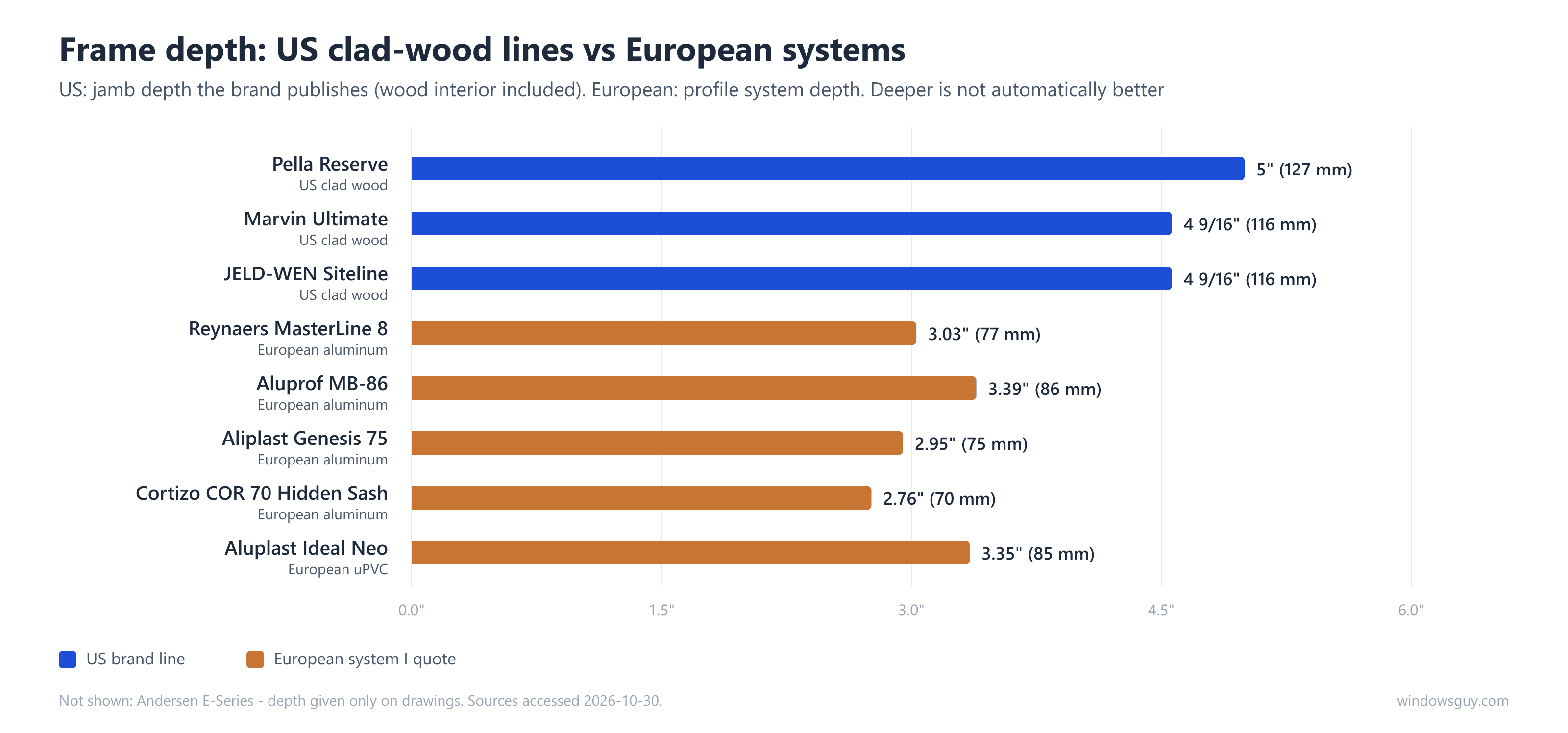
Frame depth. US clad-wood lines publish a jamb depth that includes the wood interior: 5 in (127 mm) on Pella Reserve Traditional and 4 9/16 in (116 mm) on Marvin Ultimate and JELD-WEN Siteline. European systems publish the profile depth: 2.76 to 3.39 in (70 to 86 mm) on the aluminum flagships I quote and 3.35 in (85 mm) on Aluplast Ideal Neo. Deeper is not automatically better; the number tells you how the window sits in your wall and how thick a glass pack it can carry.
Glazing. Pella, Marvin and Andersen list dual-pane glass with triple-pane as an option or on select products; JELD-WEN lists dual-pane Low-E for Siteline. The flagship aluminum windows I quote take glass packs from 1.57 in (40 mm, Cortizo COR 70 Hidden Sash) to 2.83 in (72 mm, Reynaers MasterLine 8), and Aluplast Ideal Neo up to 2.05 in (52 mm); the upper end leaves room for triple glazing.
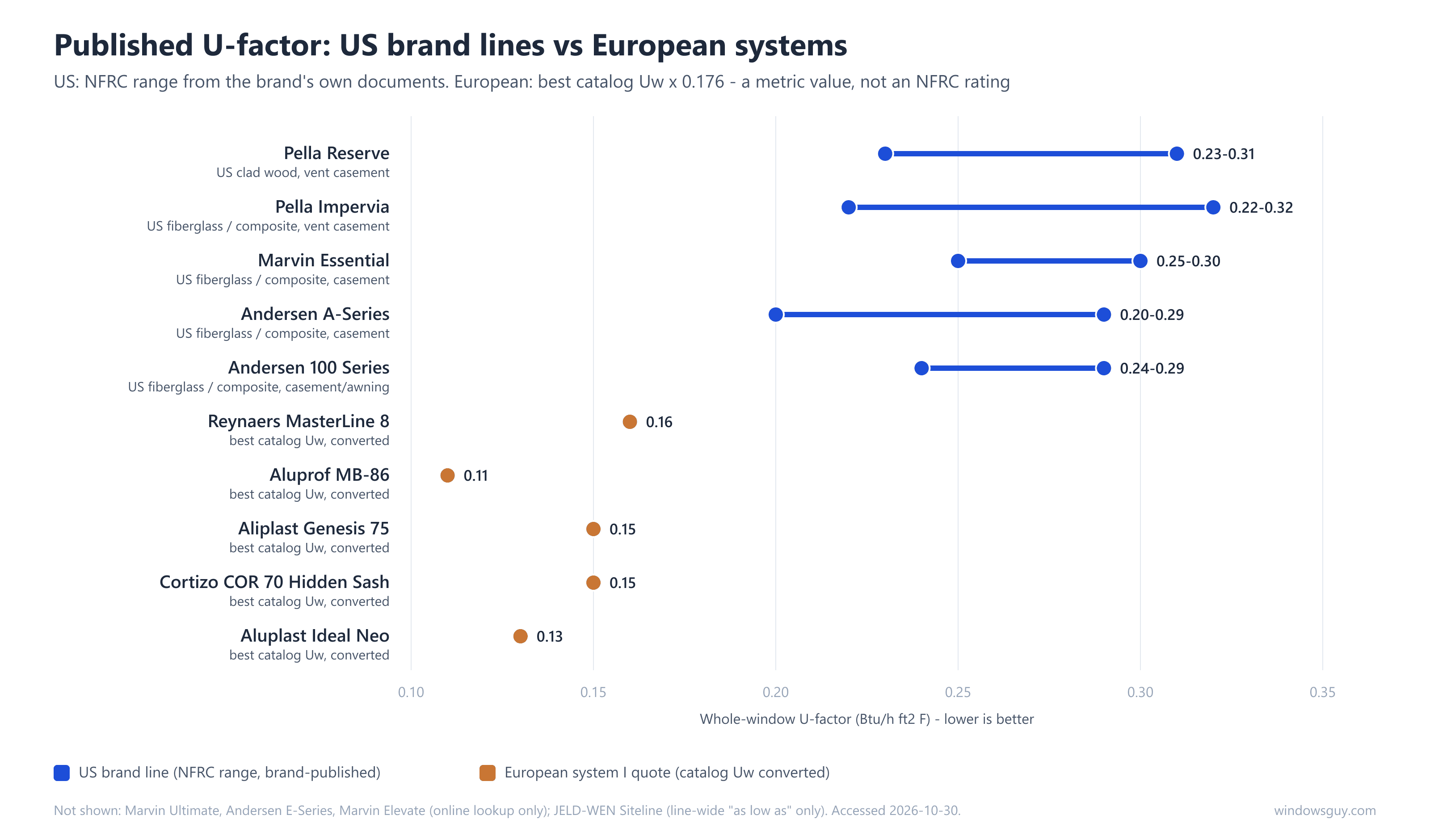
U-factor basis. A US brand's U-factor is the NFRC range the brand publishes for the line, for example 0.20-0.29 on Andersen A-Series casements and 0.22-0.32 on Pella Impervia. Marvin Ultimate, Marvin Elevate and Andersen E-Series publish unit values only through each brand's online NFRC lookup, so I give no number for them. JELD-WEN gives Siteline "as low as 0.16 per JELD-WEN", a line-wide figure and not a casement range. A European value is the provider's best catalog Uw multiplied by 0.176: a metric catalog value, not an NFRC rating.
Warranty holder. A US brand warrants the window it builds. A European system provider does not warrant your window; the seller of the finished unit does. For aluminum, wood, aluminum-clad wood and uPVC that I supply, Windows Guy issues a 10-year written warranty with no glass size cap; real steel terms are confirmed per project.
Lead time wording. None of the four US brands publishes a lead time in the documents behind this post, so ask the dealer for a date in writing. For what I source, the lead time is confirmed per order from approved shop drawings, never quoted as a week count up front.
The question of whether a European window is worth it against Marvin or Pella specifically is answered in Marvin vs Pella vs European windows.
Which to choose for which project
The right brand follows the project type, and on traditional replacement a US brand is the better call. Each verdict names the reason from the published data.
Traditional replacement in standard sizes
A US brand wins here. All four offer double-hung windows (Pella Reserve Traditional, Marvin Ultimate, Andersen E-Series, JELD-WEN Siteline), JELD-WEN publishes replacement pocket versions of Siteline casements and double hungs, and Andersen and JELD-WEN are sold through home centers as well as dealers. A local dealer who measures, installs and services is worth more on a like-for-like replacement than anything in a European catalog. None of the US lines in this set lists tilt-turn among its operations, which is where European windows start to matter.
Custom new build with a wood interior
If species range matters most, Andersen E-Series (11 species) and Marvin Ultimate (6 species) lead the US side. If you want wood inside with tilt-turn operation, Clad Hidden Sash fits: it conceals the sash behind the frame from outside. Clad Flush keeps frame and sash flush outside where that look matters more than the opening type. New-build specifics such as installation method and energy targets are in the best windows for new construction.
Tall casements and large openings
On tall casements, Pella Reserve Traditional publishes the largest US size in this set at 47 x 108 in (1,194 x 2,743 mm), then Marvin Ultimate at 42 x 102 in (1,067 x 2,591 mm) and Andersen A-Series at 47 1/4 x 95 1/4 in (1,200 x 2,419 mm). European platforms publish maximum sash dimensions instead: Reynaers MasterLine 8 lists sash heights to 110 in (2,800 mm) and sash weights to 441 lb (200 kg), a different measure from a published casement size. For walls of glass, European minimal-frame sliding systems run larger panels: Aluprof Skyline lists panels to 157 in (4,000 mm) high and 1,543 lb (700 kg), and Reynaers Hi-Finity to 157 in (4,000 mm) and 1,323 lb (600 kg). Large glass also tests the warranty: Marvin's 20-year glass term drops to 10 years at 60 sq ft and larger.
Passive house and cold climate
The lowest catalog values in this post are European: Aluprof MB-86 at U-0.11 (Uw 0.60 W/m2K) and Aluplast Ideal Neo at U-0.13 (Uw 0.74 W/m2K), both converted catalog values. The honest counterweight is that US triple-pane options carry NFRC ratings a permit reviewer can read directly, such as 0.19-0.26 on Pella Lifestyle Series and 0.20-0.25 on Andersen A-Series; a European unit needs its documentation confirmed for the exact assembly before you order.
Budget-conscious builds
On a tight budget, the US fiberglass and composite lines (Pella Impervia, Marvin Essential, Andersen 100 Series) are the realistic US choice, sold through dealers and, for Andersen, home centers. On the European side, Aluplast Ideal Neo in uPVC is the platform I price for the same brief. No brand here publishes prices, so for a European budget range run your openings through the estimator.
For projects in Canada
On a Canadian project the brands and systems above stay the same, but the reference standards and the units change. Canada has its own window manufacturers, which this guide does not rank or name; it covers what changes when a US brand or a European system goes to a Canadian site.
Canadian code reads whole-window U in W/m2K or as an Energy Rating, with Calgary in NBC zone 7A and Toronto in zone 5. The Canadian reference standards are NAFS / CSA A440 and Energy Star Canada; I mention them as information only, and code documentation is confirmed per project with your building official. Read every value in both units: Aluplast Ideal Neo's U-0.13 is a catalog Uw of 0.74 W/m2K, Aluprof MB-86's U-0.11 is 0.60 W/m2K, and Pella Lifestyle Series' triple-pane NFRC range of 0.19-0.26 equals 1.08-1.48 W/m2K.
EU-origin aluminum, wood, aluminum-clad wood and uPVC windows enter Canada duty-free under CETA with an origin declaration on the invoice. GST of 5% is paid at import and is recoverable for businesses registered for GST, and Canadian orders ship DAP with the Canadian buyer as importer of record; real steel import terms are confirmed per project. The Canadian import checklist walks through the paperwork, and the Canada page covers how a quote works.
FAQ
What are the top window brands? In the US, the four best-known window brands are Pella, Marvin, Andersen and JELD-WEN. In Europe, windows are sold under system providers such as Reynaers, Aluprof, Aliplast, Cortizo and Aluplast (which I quote) and Schuco, Rehau and Veka (benchmarks). Choose by tier, material and project type, not by a ranking.
Who makes the best windows? No brand is best for every project. Pella publishes the tallest clad-wood casement of the four US brands, Andersen the widest color and species range, Marvin one fully transferable warranty across its collections, and the European systems I quote the lowest catalog U-values in this guide (U-0.11 to U-0.16, converted, not NFRC ratings).
Is a window system provider the same as a window manufacturer? No. A system provider designs and extrudes the profiles; an independent fabricator builds the window, and the seller of the finished unit holds the warranty. US brands like Pella and Marvin build and warrant their own windows.
What are the best window manufacturers in Canada? I do not rank Canadian manufacturers. For European windows on a Canadian project, compare whole-window values in W/m2K, confirm code documentation with your building official, and check the CETA origin declaration and DAP terms before ordering.
Which window brand has the best warranty? It depends on who owns the house later. Marvin's 20/10-year warranty transfers in full, Pella's wood-line Limited Lifetime applies to the original owner (10 years for later owners), JELD-WEN's 20 years is capped at 10 after a sale, and Andersen's 20/10 years transfers Owner-2-Owner.
Send me your drawings or window schedule through the quote page and I will price them on the European systems that fit, or start with a budget range in the estimator.