
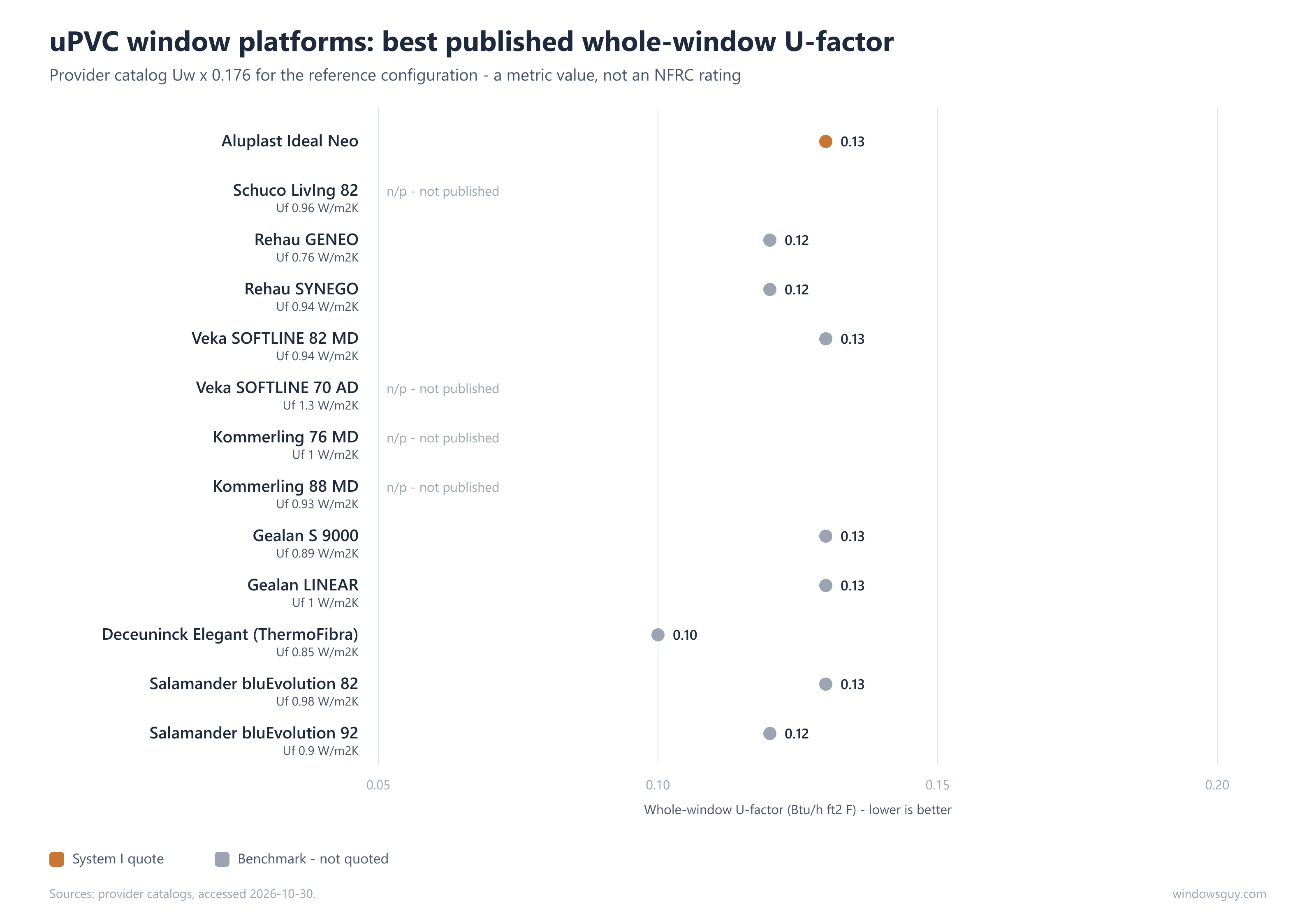
The leading European uPVC platforms sit within 22 mm (0.87 in) of frame depth and about 0.03 Btu/h ft2 F of best published U-factor of each other, so the provider name matters less than the configuration you actually order. Aluplast Ideal Neo, the platform I quote, is 3.35 in (85 mm) deep with 6 chambers and a best published Uw of 0.74 W/m2K (U-factor 0.13). Rehau GENEO (Uw 0.66, U 0.12) and Deceuninck Elegant with ThermoFibra (Uw 0.59, U 0.10) publish lower numbers, while Veka SOFTLINE 82 MD, Gealan S 9000 and Salamander bluEvolution 82 land at the same U 0.13 as Ideal Neo.
I source windows for projects in the US and Canada across five material families - aluminum, wood, aluminum-clad wood, uPVC and real steel - and in uPVC the one system I quote is Aluplast; every number below comes from the providers' own published pages and data sheets, accessed October 30, 2026, and the other providers are benchmarks, not systems I sell.
What is a uPVC window system provider?
A uPVC system provider designs and extrudes the frame profiles, gaskets and reinforcement layout, then sells them to independent fabricators who cut, weld, glaze and hardware the finished windows. uPVC is the European term for the rigid PVC frame material (what the "u" means). Aluplast, Rehau, Veka, Kommerling, Gealan, Deceuninck, Salamander and Schuco are all system providers in this sense: none of them builds your window. The profile name on a quote tells you the platform; the fabricator decides the weld quality, glazing, hardware fitting and testing of the unit you receive.
That split matters when you compare quotes. Two windows on the same Rehau profile from two fabricators can differ more than a Rehau and a Veka window from one good fabricator. A provider's best catalog value is the ceiling of what the platform can do, not a promise about a supplied unit.
The uPVC platforms side by side
The table below lists the uPVC window platforms in this comparison, with the one I quote first and the benchmarks after it. Values are provider-published; "n/p" means the provider does not publish that value on the pages I used.
| Platform | Status | Frame depth | Chambers | Reinforcement | Uf (W/m2K) | Best Uw (W/m2K) | Max glazing |
|---|---|---|---|---|---|---|---|
| Aluplast Ideal Neo | I quote it | 85 mm (3.35") | 6 | n/p | n/p | 0.74 (U 0.13) | 52 mm (2.05") |
| Schuco LivIng 82 | benchmark | 82 mm (3.23") | 7 | steel | 0.96 | n/p | 52 mm (2.05") |
| Rehau GENEO | benchmark | 86 mm (3.39") | 6 | glass fibre | 0.76 | 0.66 (U 0.12) | 53 mm (2.09") |
| Rehau SYNEGO | benchmark | 80 mm (3.15") | 7 | steel | 0.94 | 0.71 (U 0.12) | 51 mm (2.01") |
| Veka SOFTLINE 82 MD | benchmark | 82 mm (3.23") | 7 | steel | 0.94 | 0.74 (U 0.13) | 54 mm (2.13") |
| Veka SOFTLINE 70 AD | benchmark | 70 mm (2.76") | n/p | n/p | 1.30 | n/p | 42 mm (1.65") |
| Kommerling 76 MD | benchmark | 76 mm (2.99") | n/p | n/p | 1.00 | n/p | 60 mm (2.36") |
| Kommerling 88 MD | benchmark | 88 mm (3.46") | 7 | n/p | 0.93 | n/p | 60 mm (2.36") |
| Gealan S 9000 | benchmark | 82.5 mm (3.25") | 6 | steel | 0.89 | 0.72 (U 0.13) | 58 mm (2.28") |
| Gealan LINEAR | benchmark | 74 mm (2.91") | n/p | n/p | 1.00 | 0.73 (U 0.13) | 50 mm (1.97") |
| Deceuninck Elegant (ThermoFibra) | benchmark | 76 mm (2.99") | 6 | glass fibre | 0.85 | 0.59 (U 0.10) | 70 mm (2.76") |
| Salamander bluEvolution 82 | benchmark | 82 mm (3.23") | n/p | steel | 0.98 | 0.73 (U 0.13) | 60 mm (2.36") |
| Salamander bluEvolution 92 | benchmark | 92 mm (3.62") | 6 | n/p | 0.90 | 0.70 (U 0.12) | 60 mm (2.36") |
Provider-published catalog values, accessed 2026-10-30. Uw converted in brackets with U = Uw x 0.176 - a metric catalog value, not an NFRC rating of a supplied unit. n/p = not published.
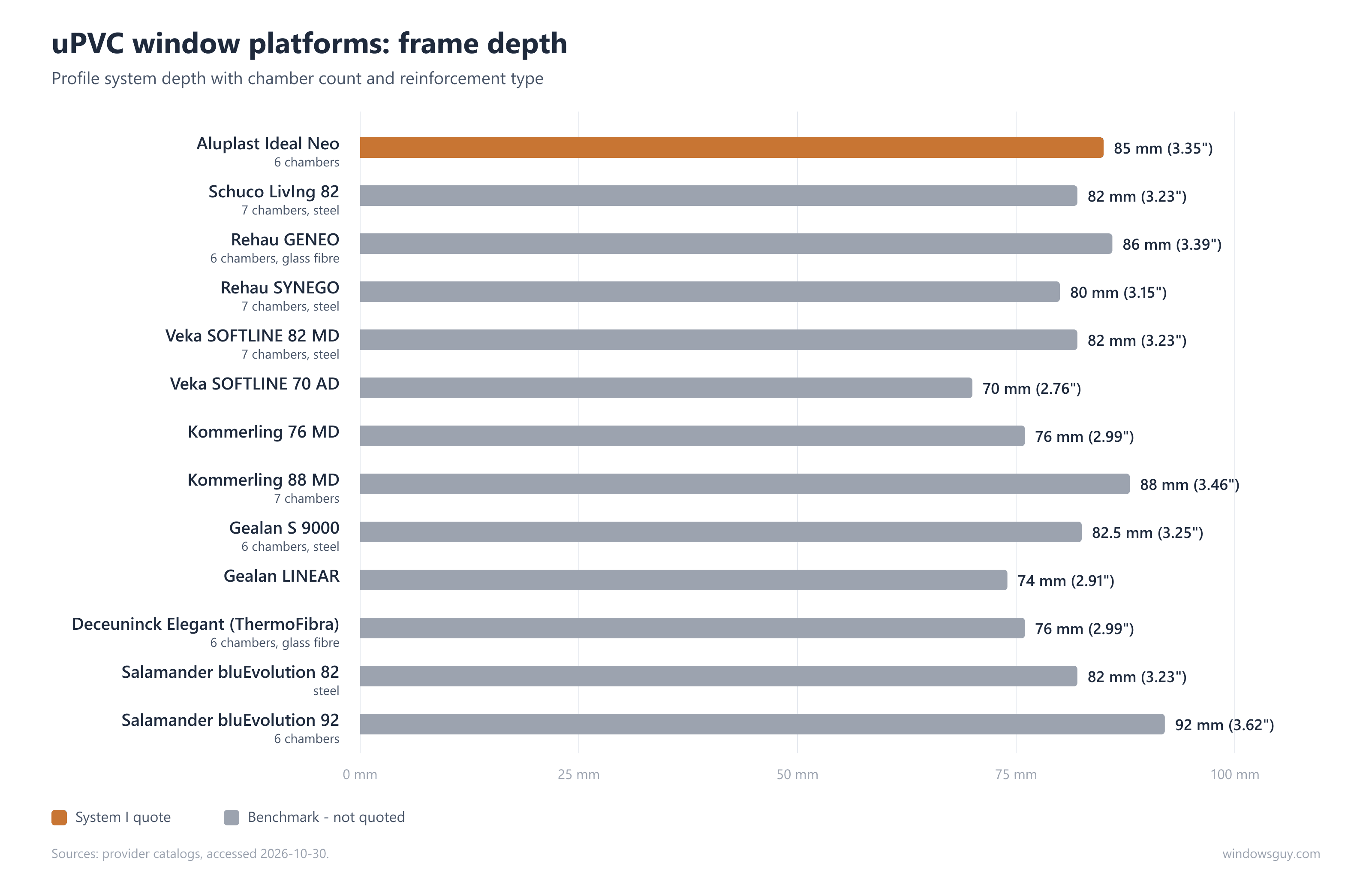
Frame depth is the first thing to compare, because it sets the room for chambers, gaskets and glass. The 13 platforms run from 70 mm (2.76 in) on Veka SOFTLINE 70 AD to 92 mm (3.62 in) on Salamander bluEvolution 92, and 10 of the 13 sit between 76 mm (2.99 in) and 88 mm (3.46 in).
The second chart converts each best published Uw to a U-factor (Uw x 0.176). It is a metric catalog value for the provider's reference configuration, not an NFRC rating of a supplied window. Four platforms - Schuco LivIng 82, Veka SOFTLINE 70 AD, Kommerling 76 MD and Kommerling 88 MD - publish a frame Uf but no whole-window Uw on the pages I used, so they have no dot.
What the numbers mean on a US or Canadian project
A spec sheet number only helps if you know which part of the window it describes and which configuration produced it. These five checks turn the table into a decision.
Frame depth versus your wall
A deeper frame does not make a window better by itself; it changes where the window sits in the wall and how much room the profile has for insulation. Ideal Neo at 3.35 in (85 mm) fits the same rough-opening logic as the other 82-88 mm platforms. On US wood-frame walls the bigger question is the fixing method, which is why the outward-opening Ideal Neo OUT carries an integrated nailing fin on the same 85 mm profile.
Chambers and reinforcement
Chamber count describes how many hollow cells the profile has; every platform that states a count has 6 or 7. Reinforcement is what stiffens the sash for size and wind load. Of the 7 platforms that state their reinforcement, 5 use steel, but Rehau GENEO uses a glass-fibre reinforced profile (metal reinforcement optional) and Deceuninck Elegant uses ThermoFibra continuous glass fibre in the sash. Glass fibre conducts less heat than steel, which is part of why those two publish the lowest numbers. Ideal Neo OUT has steel in frame and sash; the table shows reinforcement only where the source states it.
Uf versus Uw
Uf is the frame alone; Uw is the whole window, frame plus glass plus spacer, for one reference size and one glass. Providers state Uw for a reference window - Rehau's GENEO data sheet uses a 1230 x 1480 mm (48.4 x 58.3 in) window with Ug 0.5 glass. A 24 x 36 in sash has a larger share of frame and usually rates worse; a big fixed light usually rates better. Compare Uw values only when the size and glass behind them match.
Glazing thickness for triple glass
The glazing rebate decides how thick a triple unit fits. Ideal Neo takes 52 mm (2.05 in) and Ideal Neo OUT 46 mm (1.81 in); Kommerling 76 MD, 88 MD and both Salamander platforms take 60 mm (2.36 in), and Deceuninck Elegant 70 mm (2.76 in). A deeper rebate leaves room for wider gas spaces or laminated safety panes inside a triple unit, so check the rebate before you specify heavy security or acoustic glass.
Foils and colors
Every provider here offers white plus colors, but the route differs. Aluplast lists white, RAL colors and woodgrain; Rehau SYNEGO covers its KALEIDO COLOR range; Deceuninck lists 40 foil colors and anthracite base bodies; Kommerling and Gealan add acrylic colors and aluminum cladding. If you want an aluminum outside face on a PVC core, read the hybrid PVC-core, aluminum-shell guide before you settle on a foil.
Who the providers are
Ownership tells you who stands behind a platform. The next table shows headquarters, founding year and ownership for every provider in this comparison, aluminum ones included.
| System provider | Materials | Headquarters | Founded | Ownership | Do I quote it |
|---|---|---|---|---|---|
| Reynaers | aluminum | Duffel, Belgium | 1965 | Family-owned | yes |
| Aluprof | aluminum | Bielsko-Biala, Poland | 1951 | Grupa Kety (WSE-listed) | yes |
| Aliplast | aluminum | Lokeren, Belgium | 1984 | Corialis Group | yes |
| Cortizo | aluminum | Padron (A Coruna), Spain | 1972 | Family-owned | yes |
| Aluplast | uPVC | Karlsruhe, Germany | 1982 | Family-owned | yes |
| Schuco | aluminum, uPVC | Bielefeld, Germany | 1951 | Otto Fuchs group | no - benchmark |
| Wicona | aluminum | Ulm, Germany | 1948 | Hydro | no - benchmark |
| Heroal | aluminum | Verl, Germany | 1874 | Family-owned | no - benchmark |
| Rehau | uPVC | Muri, Switzerland | 1948 | Family-owned (REHAU Group) | no - benchmark |
| Veka | uPVC | Sendenhorst, Germany | 1969 | Family-owned (VEKA Group) | no - benchmark |
| Kommerling | uPVC | Pirmasens, Germany | 1897 | profine Group, owner-managed | no - benchmark |
| Gealan | uPVC | Oberkotzau, Germany | 1921 | VEKA Group | no - benchmark |
| Deceuninck | uPVC | Hooglede-Gits, Belgium | 1937 | Listed on Euronext Brussels | no - benchmark |
| Salamander | uPVC | Turkheim, Germany | 1917 | Family-owned | no - benchmark |
Company facts from each provider's own site, accessed 2026-10-30. A system provider designs and extrudes the profiles; independent fabricators build the windows.
Two relationships are worth knowing. Gealan has been part of the VEKA Group since 2014, so Veka and Gealan are sister companies rather than rivals in the corporate sense. Kommerling belongs to profine, whose other brands are KBE and TROCAL. Aluplast is family-owned, founded in 1982 in Ettlingen near Karlsruhe and now headquartered in Karlsruhe, with production sites including Karlsruhe and Poznan (Poland) and a company in the USA. The full uPVC range I source is built on its platforms.
Where each provider tends to fit
Each provider has a platform that leads its range, and the data shows where each one is strongest. This is how I read the published values.
- Aluplast Ideal Neo: 85 mm, 6 chambers, Uw 0.74 (U 0.13) triple glazed and Uw 1.25 (U 0.22) double glazed, available inward-opening (tilt and turn, casement, fixed), outward-opening with a nailing fin (Ideal Neo OUT) and as the Smart-Slide NEO sliding door. The fit is residential schedules where budget, thermal value and US-style installation all count.
- Rehau: GENEO has the lowest Uw of the 80-90 mm platforms at 0.66 (U 0.12) with a Passive House certified PHZ variant; SYNEGO is the 80 mm, 7-chamber, steel-reinforced workhorse at Uw 0.71.
- Veka: SOFTLINE 82 MD matches Ideal Neo at Uw 0.74 with 7 chambers and steel; SOFTLINE 70 AD is the slimmer 70 mm entry platform with Uf 1.3 and no published Uw.
- Kommerling: 88 MD is its deepest platform at 88 mm with 7 chambers and Uf 0.93, stated as suitable for passive houses under ift guideline WA-15/2; no Uw on the pages I used.
- Deceuninck: Elegant with ThermoFibra publishes the lowest Uw in the set, 0.59 (U 0.10), on a 76 mm frame with a 109 mm (4.29 in) frame-plus-sash sightline.
- Gealan, Salamander, Schuco: covered in the head-to-heads below.
Common head-to-heads: quick answers
These are the pairings people search for. Each answer uses the same published values as the table.
Aluplast vs Rehau: which is better?
On published numbers Rehau GENEO wins on thermal value: Uw 0.66 against Ideal Neo's 0.74, or U 0.12 against 0.13. GENEO is also 1 mm deeper (86 mm vs 85 mm) and takes 53 mm glass against 52 mm. Ideal Neo wins on what I can actually deliver: it is the platform I quote, it comes as an outward-opening, nailing-fin version for US walls, and the same schedule is priced on it from your drawings. On a real project the 0.08 W/m2K gap moves with window size and glass; a schedule of small operable sashes can widen or narrow it, so compare the Uw of your actual units in the quote, not the catalog best.
Rehau vs Veka
Rehau SYNEGO and Veka SOFTLINE 82 MD are close: 80 mm vs 82 mm, both 7 chambers, both steel-reinforced, both Uf 0.94. SYNEGO publishes Uw 0.71 (U 0.12) and SOFTLINE 82 MD Uw 0.74 (U 0.13). If thermal value is the deciding line, Rehau GENEO at Uw 0.66 is the stronger Rehau choice; Veka's Uf 0.94 needs thermally separated reinforcement and is otherwise stated up to 1.0.
Rehau vs Kommerling
Kommerling 88 MD is deeper (88 mm vs 86 mm for GENEO) and takes thicker glass (60 mm vs 53 mm), with 7 chambers and Uf 0.93. Rehau GENEO has the better frame (Uf 0.76) and publishes a whole-window Uw of 0.66; Kommerling does not publish a Uw on the pages I used. Without a matched Uw, Rehau is the one you can compare on paper.
Deceuninck vs Rehau
Deceuninck Elegant with ThermoFibra publishes Uw 0.59 (U 0.10) against GENEO's 0.66 (U 0.12), and both rely on glass fibre instead of steel for stiffness. Elegant is shallower (76 mm vs 86 mm) but takes much thicker glass (70 mm vs 53 mm), which leaves room for a heavier triple unit. GENEO has the better frame alone (Uf 0.76 vs 0.85) and a certified Passive House variant. Both beat Ideal Neo's published Uw; ask what reference size and glass each figure used before you treat the difference as a project saving.
Where do Gealan, Salamander and Schuco uPVC fit?
Gealan S 9000 (82.5 mm, 6 chambers, steel, Uw 0.72) and LINEAR (74 mm, Uw 0.73 at Ug 0.5) sit right beside Ideal Neo at U 0.13, inside the VEKA Group. Salamander bluEvolution 92 is the deepest platform here at 92 mm with Uw 0.70 (U 0.12); bluEvolution 82 publishes Uw 0.73. Schuco, best known for aluminum, makes LivIng 82: 82 mm, 7 chambers, steel, Uf 0.96, with no Uw published on the page I used and a stated minimum face width of 120 mm (4.72 in).
What I would specify
The right uPVC platform depends on the building more than on the logo. Here is how I would choose by project type.
- Budget-first new build or rental: Aluplast Ideal Neo, double glazed at U 0.22 (Uw 1.25), tilt and turn or fixed. The uPVC tilt and turn price list gives model budget ranges by size.
- US wood-frame custom home: Ideal Neo OUT, outswing with an integrated nailing fin, interior screens and triple glazing up to 46 mm. NFRC-rated units are available on selected configurations; I confirm the exact assembly and document per quote.
- Passive or cold-climate project: Ideal Neo triple glazed at Uw 0.74 (U 0.13) is the starting point, checked against the energy model for your actual sizes. If the model needs a certified Passive House window, a Rehau GENEO PHZ unit or a passive-grade aluminum system is the comparison; Clad Passive is the wood-interior direction, with its component certificate confirmed per project.
- Large sliding opening: Smart-Slide NEO, up to 19.7 x 8.2 ft (6000 x 2500 mm) at Uw 0.95 (U 0.17). Beyond that, an aluminum lift and slide carries heavier panels.
- Traditional replacement with double-hung sashes: none of these. European uPVC platforms are built around tilt and turn and casement; a US double-hung line is the right call there, and JELD-WEN vinyl windows vs European uPVC compares one such line with Aluplast uPVC.
uPVC windows for Canadian projects
Canadian code reads whole-window U in W/m2K, so the Uw values in the table are already in the unit your energy compliance path uses, though they are catalog values at a reference size, not a rating of the supplied unit; Calgary is NBC climate zone 7A and Toronto zone 5. Qualifying EU-origin uPVC windows enter Canada duty-free under CETA with an origin declaration on the invoice, and Canadian orders ship DAP with the buyer as importer of record. Code documentation is confirmed per project with your building official. The PVC windows in Canada page covers the import route.
FAQ
What are the best uPVC window brands? On published whole-window values the lowest numbers come from Deceuninck Elegant with ThermoFibra (Uw 0.59) and Rehau GENEO (Uw 0.66). Aluplast Ideal Neo, Veka SOFTLINE 82 MD, Gealan and Salamander bluEvolution 82 sit at Uw 0.72-0.74. All of them are system providers; the fabricator and the configuration decide the window you receive.
Do you offer Rehau or Veka windows? No. Aluplast Ideal Neo is the uPVC platform I quote, and Rehau, Veka, Kommerling, Gealan, Deceuninck, Salamander and Schuco are benchmarks in this comparison. If your drawings call for Rehau or Veka, I price the same schedule on Ideal Neo with matched opening types and glass, so you can compare like for like.
Is Rehau better than Veka? On thermal value, yes on paper: Rehau GENEO publishes Uw 0.66 and SYNEGO 0.71, against 0.74 for Veka SOFTLINE 82 MD. The build is otherwise similar - 80-86 mm frames and steel or glass-fibre reinforcement. Compare the Uw of your actual window sizes, not the catalog best.
Is Aluplast a good uPVC brand? Aluplast is a family-owned German system provider founded in 1982. Ideal Neo publishes Uw 0.74 (U 0.13) triple glazed on an 85 mm, 6-chamber profile - the same best value as Veka SOFTLINE 82 MD and within 0.08 W/m2K of Rehau GENEO.
Send your schedule through the quote form and I will price it on Ideal Neo, or start with the project estimator if the first question is budget.