
JELD-WEN wins on reach and the longest fixed-year warranty (20 years on glass and non-glass parts), Pella wins on unit size and frame depth, and Andersen wins on interior species and exterior colors. JELD-WEN sells Siteline through dealers, distributors and retail home centers and covers its wood and clad windows for 20 years on glass and 20 years on non-glass parts, while Pella Reserve offers the largest aluminum-clad casement in this comparison at 47 x 108 in (1,194 x 2,743 mm) and a 5 in (127 mm) frame, and Andersen E-Series lists 11 interior species and 50 standard exterior colors against Siteline's AuraLast pine and 27 colors. None of the three publishes prices or lists tilt-turn operation on these clad lines, so the right pick depends on the project - the verdicts by project type are near the end.
I source European windows for projects in the US and Canada, so I do not sell any of these three brands; every US number below comes from the brands' own warranties, design manuals and product guides plus public company records, accessed October 30, 2026, and where a brand does not publish a value I say so instead of guessing.
JELD-WEN, Pella and Andersen at a glance
JELD-WEN is the only public company of the three, and it is the one with the widest set of sales channels. Pella is privately held by the Kuyper family and sells through Pella-branded showrooms and authorized dealers; Andersen is privately held with a family majority and employee stock ownership, and sells through dealers and home-center retailers. JELD-WEN trades on the New York Stock Exchange as JELD, is headquartered in Charlotte, North Carolina, and sells through dealers, distributors and retail home centers. The table adds Marvin as the usual fourth name.
| Brand | Headquarters | Founded | Ownership | How it sells | Publishes prices |
|---|---|---|---|---|---|
| Pella | Pella, Iowa | 1925 | privately held (Kuyper family) | Pella-branded distributors (showrooms) + authorized dealers | no |
| Marvin | Warroad, Minnesota | 1912 | family-owned | authorized dealers | no |
| Andersen | Bayport, Minnesota | 1903 | privately held (Andersen family majority, employee stock ownership) | dealers + retailers (home centers) | no |
| JELD-WEN | Charlotte, North Carolina | 1960 | public (NYSE: JELD) | dealers + distributors + retail home centers | no |
Company facts from each brand's own site, accessed 2026-10-30.
Ownership matters less than the channel: home-center distribution means more places to order, while a showroom-and-dealer model gives you one contact who measures, orders and services the job.
The clad-wood lines compared on specs
The fair comparison is clad wood against clad wood: JELD-WEN Siteline, Pella Reserve, Andersen E-Series and Marvin Ultimate all pair a wood interior with an extruded aluminum exterior. The table pulls each line's published frame depth, largest casement, glazing, finish standard, colors and U-factor basis from the brand's own documents.
| Line | Interior | Exterior | Clad finish | Frame depth | Casement max (W x H) | Glazing | Published U-factor (NFRC) | Std colors | Tilt-turn |
|---|---|---|---|---|---|---|---|---|---|
| Pella Reserve | wood | aluminum clad or wood | AAMA 2603; 2605 option | 5" (127 mm) | 47" x 108" | dual, triple (option) | 0.23-0.31 (vent casement) | n/p | no |
| Marvin Ultimate | wood | aluminum clad (wood on select products) | AAMA 2605 | 4 9/16" (116 mm) | 42" x 102" | dual, triple (select products) | brand online lookup only | 19 | no |
| Andersen E-Series | wood | aluminum clad | AAMA 2604; 2605 option | n/p | 36" x 72" | dual, triple (option) | brand online lookup only | 50 | no |
| JELD-WEN Siteline | pine (AuraLast) | aluminum clad or wood | AAMA 2603/2604; 2605 option | 4 9/16" (116 mm) | 42" x 84" | dual (Low-E insulating) | as low as 0.16 (line-wide) | 27 | no |
Brand-published specifications, accessed 2026-10-30. n/p = not published. U-factors are NFRC whole-window values from the brand's own documents; the bracket says what they cover (a vent casement range or a line-wide "as low as"). The exact unit, glass and size set the rating on the label.
Two cautions about the JELD-WEN row before you read across. First, JELD-WEN's U-factor for Siteline is as low as 0.16, per JELD-WEN, a line-wide best case from a JELD-WEN post dated 2020. It is not a casement range, so it should not be read against Pella's 0.23-0.31 vent casement range as if the two were the same measure. Second, the Siteline sizes and the PG50 rating come from the January 2025 Siteline casement design manual, which is newer and more specific than the 2020 post. For Andersen E-Series and Marvin Ultimate, NFRC U-factors are published only through each brand's online NFRC lookup, so this post gives no number for them.
JELD-WEN also sells two other clad-wood lines. Custom Wood sits in the premium tier with an AAMA 2605 clad finish, 27 standard colors and an "as low as" U-factor of 0.19; EpicVue uses AuraLast pine inside with an "as low as" of 0.18. JELD-WEN gives both lines a performance grade of up to CW-PG65 line-wide in the same 2020 post, and I could not find a readable design manual with frame depth or maximum sizes for either, so Siteline carries the comparison.
JELD-WEN vs Pella
JELD-WEN vs Pella comes down to reach and fixed-year warranty terms against size, depth and species. In this comparison Siteline sits in the upper-mid tier next to Pella Lifestyle Series, while Pella Reserve sits in the premium tier with JELD-WEN Custom Wood - so the like-for-like pairs are Siteline against Lifestyle and Custom Wood against Reserve.
Where JELD-WEN wins over Pella
JELD-WEN wins on availability, finish warranty and standard sizes in the mid tier. Siteline is sold through dealers, distributors and retail home centers; Pella sells through its own branded distributors and authorized dealers only. Siteline's largest casement is 42 x 84 in (1,067 x 2,134 mm) against 35 x 73 in (889 x 1,854 mm) for Pella Lifestyle Series, and Siteline offers 27 standard clad colors plus custom colors against 4 standard colors on Lifestyle.
The finish warranty is the other clear JELD-WEN win. An AAMA 2605 clad finish on JELD-WEN wood windows carries 30 years of finish coverage, and the standard AAMA 2603 and 2604 finishes carry 10 years; Pella's EnduraClad paint is covered for 10 years against chalking and fading. Siteline also lists replacement versions in its product matrix - casement pocket units and double-hung pocket and sash-pack units - which suit a retrofit that keeps the existing frame.
Where Pella wins over JELD-WEN
Pella wins on unit size, frame depth, glazing and published performance data in the premium tier. Pella Reserve Traditional's casement goes to 47 x 108 in (1,194 x 2,743 mm), 24 in (610 mm) taller than Siteline's tallest casement, and its overall frame depth is 5 in (127 mm) against Siteline's 4 9/16 in (116 mm) standard jamb. Reserve offers triple glazing as an option; the Siteline documents I could read list only dual-pane Low-E insulating glass for Siteline.
Reserve also gives you more wood choice - pine, mahogany and Douglas fir inside, against AuraLast pine on Siteline - and an in-swing French casement. Pella's architect design manual publishes NFRC total-unit ranges for the vent casement: 0.25-0.31 dual-pane and 0.23 triple-pane on Reserve Traditional. And for the original owner of an owner-occupied single-family home, Pella's wood-window warranty is Limited Lifetime rather than a year count.
JELD-WEN vs Andersen
JELD-WEN vs Andersen is closer on channel - both sell through dealers and home centers - so it turns on warranty structure, sizes and the range of finishes. Siteline and Andersen E-Series are both wood inside and extruded aluminum outside; Andersen adds a Fibrex thermal barrier at the frame perimeter.
Where JELD-WEN wins over Andersen
JELD-WEN wins on non-glass warranty years, casement size and finish warranty. JELD-WEN covers non-glass parts for 20 years on wood and clad windows; Andersen covers them for 10. Siteline's largest casement, 42 x 84 in (1,067 x 2,134 mm), is 6 in (152 mm) wider and 12 in (305 mm) taller than the E-Series maximum of 36 x 72 in (914 x 1,829 mm). Siteline's 4 9/16 in (116 mm) jamb is published in text, with jamb widths to 8 9/16 in (217 mm) using extenders; the E-Series product guide shows its jamb depth on drawings only.
The clad finish warranty also favors JELD-WEN when you order AAMA 2605: 30 years, against Andersen's 10 years on chalking and color change and 20 years on cracking, peeling and loss of adhesion for E-Series painted exteriors.
Where Andersen wins over JELD-WEN
Andersen wins on species, colors, tested structural performance and how its warranty transfers. E-Series lists 11 interior species - pine, two Douglas fir grades, oak, white oak, maple, hickory, mahogany, cherry, walnut and alder - against AuraLast pine on Siteline. It offers 50 standard exterior colors with AAMA 2605 available in all 50, against Siteline's 27. Andersen reports CW-PG55 to CW-PG70 for venting E-Series casements at tested sizes (data dated October 2018), against PG50 at 36 x 72 in for a Siteline casement and PG35 at Siteline's largest operator sizes.
The warranty transfer is the subtle one. Andersen's Owner-2-Owner warranty moves to the next owner without being prorated, so a buyer gets what is left of the 20 years on glass and 10 on non-glass parts. JELD-WEN's 20 years drop to a maximum of 10 years of coverage once the home is sold or occupied by someone other than the original owner. If you plan to sell within a decade, the two end up closer than the headline years suggest.
Where Marvin fits
Marvin is the brand to add when the project is premium clad wood and you want a family-owned company that sells only through authorized dealers. It belongs on the shortlist next to Pella Reserve and Andersen E-Series rather than next to Siteline.
JELD-WEN vs Marvin
Marvin Ultimate and JELD-WEN Siteline share a 4 9/16 in (116 mm) jamb depth and a 42 in (1,067 mm) casement width, but Ultimate goes to 102 in (2,591 mm) tall against Siteline's 84 in (2,134 mm). Ultimate offers 6 interior species and 19 standard colors with an AAMA 2605 finish; Siteline offers AuraLast pine and 27 standard colors with AAMA 2605 as an option. Marvin warrants glass for 20 years up to 60 sq ft and non-glass parts for 10 years, fully transferable; JELD-WEN covers both for 20 years, capped at 10 after a sale. For the Marvin line-by-line detail against Pella and Andersen, read the three-brand Pella, Marvin and Andersen spec comparison.
Warranty: JELD-WEN vs Pella vs Andersen
JELD-WEN has the longest fixed non-glass term, Pella has the only lifetime term, and Andersen and Marvin have the cleanest transfer. The table shows the headline terms each brand publishes; every one has exclusions, and Pella's wood-window lifetime applies to the original purchaser in an owner-occupied single-family home, with 2 years of labor and 10 transferable years for later owners.
| Brand | Insulating glass (years) | Non-glass parts (years) | Transferable |
|---|---|---|---|
| Pella | Lifetime (original owner, wood lines); 20 (Impervia) | Lifetime (original owner, wood lines); 10 (Impervia) | Partly - later owners get 10 years (wood lines) |
| Marvin | 20 | 10 | Yes, fully transferable |
| Andersen | 20 | 10 | Yes (Owner-2-Owner), not prorated |
| JELD-WEN | 20 | 20 | Yes, up to 10 years after a sale |
Each brand's published limited warranty, accessed 2026-10-30. Years are the headline terms; every warranty has exclusions and product-specific terms - read the document for the line you buy.
Labor is short across the board: JELD-WEN and Pella both cover skilled labor for 2 years on their wood windows. JELD-WEN also gives AuraLast pine a separate limited lifetime coverage for decay and termite damage. Check first the term for the part most exposed on your site - the clad finish on a coastal elevation, the glass seal on a large fixed unit.
Where a European window changes the comparison
A European clad window changes the comparison on opening type and frame depth, not on brand reputation. None of Siteline, Pella Reserve, Pella Lifestyle or Andersen E-Series lists tilt-turn operation, which is the standard sash on European clad and timber windows.
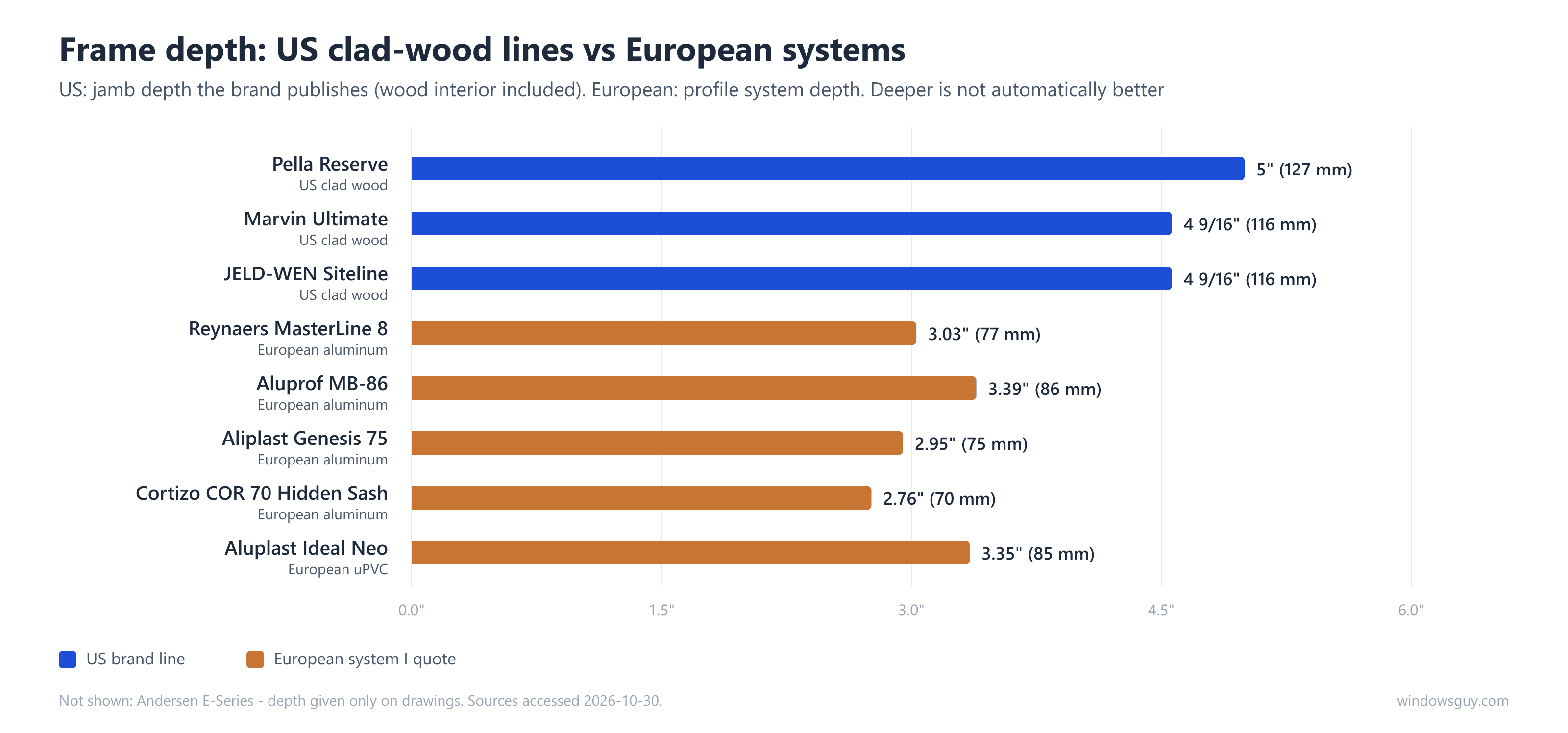
The European clad line closest to these US windows is Clad Flush: a laminated timber interior in pine, meranti or oak, a flush aluminum exterior, 3 sealing lines and a published reference depth of 3.54 in (90 mm). Its converted European reference is about U-factor 0.19-0.21 - a metric catalog value, not an NFRC rating. If you want wood outside as well, Timber Classic is the all-timber version with softly rounded profiles. The Andersen E-Series vs European aluminum-clad comparison goes through cladding, species and finish line by line, and the aluminum-clad wood windows guide explains how the European clip-on shell differs from US cladding. I quote across five material families - aluminum, wood, aluminum-clad wood, uPVC and real steel - and the windows I supply carry my own 10-year warranty in writing.
What I would specify
The right window depends on the project type, and in most of the cases below a US brand is the honest answer.
Traditional replacement in standard sizes. JELD-WEN Siteline. The pocket and sash-pack replacement versions keep the existing frame, the casement goes to 42 x 84 in (1,067 x 2,134 mm), and it is sold through more channel types than Pella or Andersen.
Custom new build with a wood interior. Andersen E-Series if the interior millwork calls for walnut, alder or hickory, because no other clad line here lists them. Pella Reserve if the design needs tall casements or in-swing French casements. If the architect wants tilt-turn sashes, I would quote Clad Hidden Sash, or Clad Flush where a flush exterior matters more than the opening type.
Passive house or cold climate. For a US brand, ask for the NFRC values on the exact units: Pella Reserve and Lifestyle publish triple-pane options in the architect design manual, and Andersen and Marvin publish through their online lookups. A JELD-WEN "as low as" figure is not enough for an energy model. On the European side, Clad Flush and Ideal Neo both take triple glazing, and I give converted catalog values with the basis stated rather than a US rating.
Large openings. Pella Reserve, with a 47 x 108 in (1,194 x 2,743 mm) casement - the tallest in this group. Marvin Ultimate at 42 x 102 in (1,067 x 2,591 mm) is next, and Andersen A-Series (wood inside, Fibrex composite outside) reaches 47 1/4 x 95 1/4 in (1,200 x 2,419 mm).
Long ownership and resale. Andersen if the house may be sold, because its warranty transfers without proration. Pella if you are the original owner staying put, because its wood-window coverage is lifetime for you. JELD-WEN if the clad finish is the worry: 30 years on AAMA 2605.
Budget-led project. Among these brands the mid-tier lines are Pella Impervia and Andersen 100 Series; Siteline sits a tier above them, in the upper-mid band. If the budget points to uPVC rather than clad wood, the platform I quote is Aluplast Ideal Neo: 3.35 in (85 mm) deep, 6 chambers, triple-glazed U-factor 0.13 (Uw 0.74) as a converted catalog value, not an NFRC rating. If the alternative on your list is JELD-WEN's own vinyl, the V-2500 and V-4500 against European uPVC goes through jambs, glass and warranty.
FAQ
Is JELD-WEN as good as Pella? For mid-tier clad wood, yes on several published measures: Siteline's casement is larger than Pella Lifestyle Series' (42 x 84 in against 35 x 73 in), it has 27 standard colors against 4, and its non-glass warranty runs 20 years. Pella Reserve beats Siteline on maximum size (47 x 108 in), frame depth (5 in), triple glazing and species, and Pella publishes NFRC ranges per casement where JELD-WEN gives a line-wide "as low as" value.
Is JELD-WEN better than Andersen? JELD-WEN is better on non-glass warranty years (20 against 10), clad finish warranty with AAMA 2605 (30 years) and casement size against E-Series (42 x 84 in against 36 x 72 in). Andersen is better on interior species (11 against 1), standard colors (50 against 27), tested structural ratings (up to CW-PG70) and warranty transfer without proration.
Who owns JELD-WEN? JELD-WEN is a public company, listed on the New York Stock Exchange as JELD, and owned by its shareholders. It was founded in 1960 in Klamath Falls, Oregon, and is headquartered in Charlotte, North Carolina.
Does JELD-WEN, Pella or Andersen make a tilt-turn window? Not in the clad-wood lines compared here: Siteline, Pella Reserve, Pella Lifestyle Series and Andersen E-Series list casement, awning, double-hung and other operations but no tilt-turn. Tilt-turn is the standard opening on European timber and aluminum-clad windows.
Next step
If your schedule names Siteline, Reserve or E-Series "or equal", send it through the quote form and I will price the European equivalent for each opening and tell you where a US line is the better fit; for a first budget range, try the estimator.