
If an Andersen dealer quoted you "clad windows", the first question is which cladding. Andersen sells wood windows with three different exterior shells, and only one of them - the E-Series - is extruded aluminum. That is the line to hold next to a European aluminum-clad timber window, and on paper the two are closer than most comparisons suggest: real wood inside, a metal shell outside, any color you want.
I source European aluminum-clad wood windows, so read this knowing which side I am on. Everything I say about Andersen comes from andersenwindows.com and the E-Series brochure published there. Where Andersen is the stronger choice, I say so - on species, colors and hung windows, it is.
What "Clad" Means at Andersen
Andersen's window comparison page pairs a wood interior with three different exteriors:
- 400 Series - wood inside, Perma-Shield cladding outside. Andersen describes Perma-Shield as a high-grade vinyl that it vacuum forms or extrudes around the wood. Dual-pane glass is standard, triple-pane is an option.
- A-Series - wood inside, fiberglass and Fibrex composite outside. Andersen lists triple-pane glass and PHIUS certification on its casement and picture windows.
- E-Series - wood inside, aluminum outside. This is Andersen's aluminum-clad wood window, and the one this post compares.
If your quote is for the 400 Series, the comparison you want is shell against shell, and the vinyl-clad vs aluminum-clad guide covers it without brand names.
What Andersen Publishes About the E-Series
From the E-Series brochure and product pages:
- Cladding. Andersen says the sash and frames are clad in heavy-gauge extruded aluminum, and contrasts it with thinner roll-formed aluminum. The exterior frame, sash and trim components are extruded.
- Exterior finish. A baked-on silicone polyester enamel, warranted for 10 years against chalking and color change and 20 years against cracking, checking, peeling, flaking, blistering and loss of adhesion.
- Colors. 50 standard exterior colors, custom color matching from a paint chip or photo, and 2-, 3- and 4-tone combinations.
- Interior species. Eleven: pine, maple, vertical-grain and mixed-grain Douglas fir, mahogany (Andersen notes it is sapele or sipo), oak, cherry, walnut, alder, white oak and hickory - plus custom species on request.
- Window types. Awning, bay and bow, casement, double-hung, gliding and picture. Custom sizes in 1/8 in increments.
- Glass. A range of Low-E options, with triple-pane listed in the brochure.
- Warranty. 20 years on glass and 10 years on non-glass parts, transferable to the next owner.
Andersen does not publish an E-Series U-factor range on these pages; it publishes NFRC total-unit performance data on its own energy and performance pages, which is the right place to look because the value changes with size and glass. E-Series pricing is "request a quote" through a dealer, and I do not guess it here.
The European Side: Laminated Timber Under a Clipped Shell
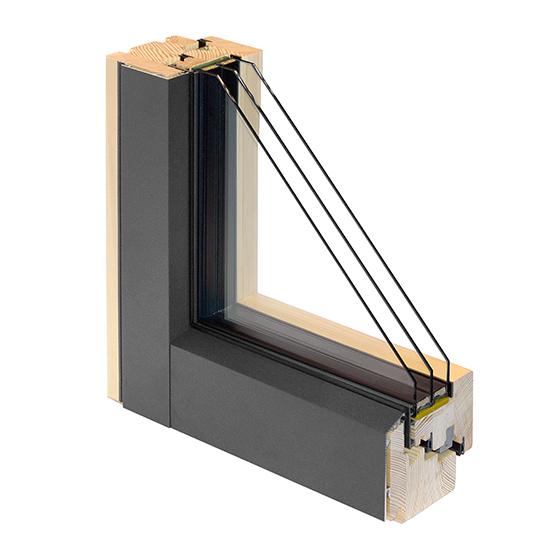
The aluminum-clad lines I quote share one construction: a laminated, finger-jointed timber frame and sash, with an extruded aluminum shell clipped to the outside over a ventilated gap. The shell is not glued to the wood, so moisture behind it has somewhere to go.
- Clad Flush - frame and sash sit flush outside. Published reference depth 3.54 in (90 mm), three sealing lines, pine, meranti or oak inside. About U-factor 0.19-0.21, converted from the European value, not an NFRC rating.
- Clad Hidden Sash - the opening sash hides behind the frame outside, so operable and fixed units read the same on the elevation. 3.21 or 3.60 in (81.5 or 91.5 mm) deep, concealed hinges with a published sash capacity up to 331 lb, tilt and turn heights up to 9 ft 2 in on selected configurations, pine, oak, meranti, larch or spruce. US catalogue reference from U-factor 0.16.
- Clad Passive - 4.86 in (123.5 mm) deep, foamed insulation in the frame, triple glass with a warm-edge spacer. From about U-factor 0.11, converted from the European reference, again not a US rating for your sizes.
- Timber Lift & Slide - the matching patio door in timber or clad timber.
Exterior color is any RAL shade, with wood-effect aluminum finishes on Clad Flush, chosen independently of the interior, which can be a transparent finish showing the grain or an opaque RAL or NCS color. The colors page shows the range.
Side by Side, on Published Facts
| Item | Andersen E-Series | European aluminum-clad (what I source) |
|---|---|---|
| Exterior shell | Heavy-gauge extruded aluminum, baked-on enamel | Extruded aluminum, clipped over a ventilated gap |
| Exterior colors | 50 standard, custom match, 2- to 4-tone | Any RAL color; wood-effect finishes on Clad Flush |
| Interior species | 11 listed plus custom | Pine, meranti, oak; larch and spruce on Clad Hidden Sash |
| Window types | Awning, casement, double-hung, gliding, picture, bay and bow | Tilt and turn, fixed, combined units, corner glazing |
| Frame depth | Not stated on the pages I read | 3.21-4.86 in (81.5-123.5 mm) by line |
| Seals | Not stated on the pages I read | 3 sealing lines |
| Concealed sash | Not listed | Clad Hidden Sash |
| Thermal data | NFRC total-unit data, published by Andersen | Published references; confirmed for your sizes in the quote |
| Warranty | 20 yrs glass, 10 yrs non-glass, transferable; finish 10 / 20 yrs | 10 yrs on frames, glass seal at any size, hardware and standard finishes |
| Sold through | Andersen dealers | Me, quoted DDP to the job site |
Where Andersen Wins
Species range. Cherry, walnut, alder, maple, hickory and Douglas fir are on the E-Series list and not on mine. If the interior millwork is designed around one of them, Andersen matches it directly.
Hung and gliding windows. The E-Series includes double-hung and gliding windows. European aluminum-clad systems are casement and tilt and turn by design. On a colonial elevation, or for a review board that wants a meeting rail, that decides it.
Multi-tone exteriors and NFRC data. Two-, three- and four-tone color schemes are a published E-Series option, and Andersen publishes NFRC total-unit performance data for permit. On my side, US ratings are system- and project-specific, and the NFRC and NAFS guide explains how I handle that.
Local service and a transferable warranty. A dealer nearby and a US factory behind it make service simple, and the warranty follows the house. I coordinate warranty service myself, but parts travel from Europe.
Where the European Clad Window Is Different
Tilt and turn and the concealed sash. One handle tilts the sash in for ventilation or swings it fully into the room. None of Andersen's E-Series window types do that - the Andersen tilt and turn comparison goes into the operation. Clad Hidden Sash adds a quiet exterior where the operable sash disappears behind the frame.
Depth and insulation as a choice. The three clad lines run from 3.21 to 4.86 in deep, so the same look can be specified for a mild climate or for an energy consultant chasing a very low U-factor with Clad Passive.
Glass seal at any size. My 10-year warranty covers the insulating glass unit with no square-footage cap, which matters on large fixed lights and wide lift-and-slide panels.
Four materials, one order. The same schedule can carry aluminum-clad wood in the living spaces, aluminum on a big glass wall and uPVC in the basement, with one set of shop drawings and one delivery.
What I Would Specify
On a contemporary custom home with a warm wood interior and a dark, crisp exterior, I would quote Clad Hidden Sash in oak or meranti, tilt and turn on the operable units and Timber Lift & Slide on the main opening. If the energy brief is aggressive, Clad Passive. If the drawings call for double-hung windows, a cherry or walnut interior, or a multi-tone exterior, I would tell the client the E-Series is the better fit - that is not a gap I can close honestly. The Marvin wood comparison follows the same logic for Marvin's clad line.
FAQ
Are Andersen E-Series windows aluminum clad? Yes. Andersen describes E-Series sash and frames as clad in heavy-gauge extruded aluminum over a wood interior, with a baked-on enamel finish in 50 standard colors plus custom matches.
What is the difference between Andersen 400 Series and E-Series cladding? Per Andersen, the 400 Series uses Perma-Shield, a high-grade vinyl formed around the wood, while the E-Series uses extruded aluminum. Both have wood interiors.
Does Andersen make an aluminum-clad tilt and turn window? Not in the E-Series window types Andersen lists online: awning, casement, double-hung, gliding, picture, and bay and bow. European aluminum-clad timber systems use tilt and turn as the standard opening.
Is a European aluminum-clad window an "or equal" for Andersen E-Series? On casement and fixed units, often yes - compare depth, glass, finish and the performance values for the actual sizes. On double-hung or gliding windows, no.
Can I get any exterior color on European aluminum-clad windows? Yes. The aluminum shell can be ordered in any RAL color (wood-effect finishes are listed on Clad Flush), chosen separately from the interior wood finish.
Next Step
If your schedule says "Andersen E-Series or equal", send it through the quote form and I will price the European aluminum-clad equivalent for each opening, and tell you where there is no honest equivalent. Wood and clad windows are quoted from drawings; to explore frames, glass and openings first, try the Studio.