
There is no single winner in Pella vs Marvin vs Andersen - each brand publishes the best number on a different line, so the right pick depends on the project. For a traditional replacement in standard sizes, Andersen has the widest channel (dealers plus home centers) and a 20-year glass / 10-year non-glass warranty that transfers without proration; for a custom wood-interior build, Pella Reserve publishes the largest clad casement at 47 x 108 in (1194 x 2743 mm), and Marvin Ultimate is the only one with AAMA 2605 cladding as standard. In fiberglass and composite, Andersen A-Series has the biggest published casement (47 1/4 x 95 1/4 in) and the lowest published NFRC range of its tier (0.20-0.29), against 0.22-0.32 for Pella Impervia and 0.25-0.30 for Marvin Essential.
I source European windows for projects in the US and Canada and I sell none of these three brands; every US number below comes from the brands' own design manuals, product guides and limited warranties (accessed 2026-10-30), and where a brand does not put a number in writing, I say so instead of estimating it.
The three companies behind the windows
All three are privately controlled Midwestern companies that publish no prices, so the real differences are in the channel and the product documents. The company facts, with JELD-WEN as a reference row:
| Brand | Headquarters | Founded | Ownership | How it sells | Publishes prices |
|---|---|---|---|---|---|
| Pella | Pella, Iowa | 1925 | privately held (Kuyper family) | Pella-branded distributors (showrooms) + authorized dealers | no |
| Marvin | Warroad, Minnesota | 1912 | family-owned | authorized dealers | no |
| Andersen | Bayport, Minnesota | 1903 | privately held (Andersen family majority, employee stock ownership) | dealers + retailers (home centers) | no |
| JELD-WEN | Charlotte, North Carolina | 1960 | public (NYSE: JELD) | dealers + distributors + retail home centers | no |
Company facts from each brand's own site, accessed 2026-10-30.
Andersen (1903) is the oldest and is majority family-owned with employee stock ownership; Marvin (1912) is family-owned; Pella (1925) is held by the Kuyper family. JELD-WEN, the only public company of the four (NYSE: JELD), is in the tables for reference only.
Clad wood: Pella Reserve vs Marvin Ultimate vs Andersen E-Series
The clad-wood tier is each brand's top wood window - wood inside, an aluminum shell outside - and the table compares the three lines on the brands' own documents, with JELD-WEN Siteline as a reference row.
| Line | Interior | Exterior | Clad finish | Frame depth | Casement max (W x H) | Glazing | Published U-factor (NFRC) | Std colors | Tilt-turn |
|---|---|---|---|---|---|---|---|---|---|
| Pella Reserve | wood | aluminum clad or wood | AAMA 2603; 2605 option | 5" (127 mm) | 47" x 108" | dual, triple (option) | 0.23-0.31 (vent casement) | n/p | no |
| Marvin Ultimate | wood | aluminum clad (wood on select products) | AAMA 2605 | 4 9/16" (116 mm) | 42" x 102" | dual, triple (select products) | brand online lookup only | 19 | no |
| Andersen E-Series | wood | aluminum clad | AAMA 2604; 2605 option | n/p | 36" x 72" | dual, triple (option) | brand online lookup only | 50 | no |
| JELD-WEN Siteline | pine (AuraLast) | aluminum clad or wood | AAMA 2603/2604; 2605 option | 4 9/16" (116 mm) | 42" x 84" | dual (Low-E insulating) | as low as 0.16 (line-wide) | 27 | no |
Brand-published specifications, accessed 2026-10-30. n/p = not published. U-factors are NFRC whole-window values from the brand's own documents; the bracket says what they cover (a vent casement range or a line-wide "as low as"). The exact unit, glass and size set the rating on the label.
Size. Pella Reserve Traditional publishes a casement up to 47 x 108 in (1194 x 2743 mm), Marvin Ultimate up to 42 x 102 in (1067 x 2591 mm), and the E-Series product guide lists casements up to 36 x 72 in (914 x 1829 mm).
Frame depth. Pella's CSI specification gives 5 in (127 mm) overall for the Reserve Traditional casement. Marvin gives 4 9/16 in (116 mm) for Ultimate, measured from the nailing fin plane to the interior face, and 5 21/32 in (144 mm) for the overall jamb - so the two numbers are not measured the same way. Andersen shows E-Series depth only on drawings, not in the text.
Exterior finish and color. Marvin Ultimate cladding is finished to AAMA 2605, the most demanding of the three AAMA architectural coating standards, in 19 standard colors plus custom. Andersen E-Series is AAMA 2604 as standard, with AAMA 2605 available in all 50 standard colors, plus custom matches. Pella's standard EnduraClad finish is AAMA 2603, and EnduraClad Plus (AAMA 2605) is an option.
Interior wood. Andersen lists 11 interior species on the E-Series, including walnut, maple, hickory and alder that neither competitor offers. Marvin lists 6 (pine, vertical-grain and mixed-grain Douglas fir, cherry, white oak and mahogany). Pella Reserve lists 3: pine, mahogany and Douglas fir.
Operation and hardware. Marvin Ultimate lists the most operating types (10, including single hung, glider and corner units), the E-Series 8 and Pella Reserve Traditional 6, including an in-swing French casement. All three lines list double hung, and all three put a multipoint lock on the casement as standard (Andersen on units taller than 2 ft 8 in).
Energy and structure. Pella publishes NFRC total-unit values for the Reserve Traditional vent casement of 0.25-0.31 with dual-pane Low-E argon and 0.23 with triple pane. Marvin Ultimate and Andersen E-Series U-factors are published only through each brand's online NFRC lookup, so this post gives no number for them. On structural rating, the E-Series venting casement is listed at CW-PG55 to CW-PG70 for tested sizes (Andersen data as of October 2018) and the clad Reserve casement at CW30 to CW50.
One step down, Pella Lifestyle Series has a pine interior, 4 standard colors and a smaller casement (35 x 73 in), but with triple pane and a hinged glass panel Pella lists 0.19-0.26 - the lowest clad-wood U-factor of the three brands in a document I could read.
Fiberglass and composite: Impervia vs Elevate and Essential vs A-Series and 100 Series
The second tier splits in two: a wood interior behind a fiberglass or composite exterior (Marvin Elevate, Andersen A-Series), and fiberglass or composite all the way through (Pella Impervia, Marvin Essential, Andersen 100 Series). All five side by side:
| Line | Interior | Exterior | Finish | Frame depth | Casement max (W x H) | Glazing | Published U-factor (NFRC) | Std colors |
|---|---|---|---|---|---|---|---|---|
| Pella Impervia | fiberglass | fiberglass, powder-coated | AAMA 624 | 3 1/4" (83 mm) | 37 1/2" x 79 1/2" | dual, triple (option) | 0.22-0.32 (vent casement) | 5 |
| Marvin Elevate | pine | Ultrex fiberglass | AAMA 624 | 4 9/16" (116 mm) | 36" x 72" | dual, triple (select products) | brand online lookup only | 6 |
| Marvin Essential | Ultrex fiberglass | Ultrex fiberglass | AAMA 624 | 3 3/32" (79 mm) | 36" x 84" | dual, triple (option) | 0.25-0.30 (casement) | 6 |
| Andersen A-Series | wood | Fibrex frame, fiberglass sash | n/p | 4 9/16" (116 mm) | 47 1/4" x 95 1/4" | dual, triple (option) | 0.20-0.29 (casement) | 11 |
| Andersen 100 Series | Fibrex composite | Fibrex composite | n/p | n/p | 35 1/2" x 71 1/2" | dual, triple (option) | 0.24-0.29 (casement/awning) | 5 |
Brand-published specifications, accessed 2026-10-30. n/p = not published.
Wood interior: Elevate vs A-Series. Both have a 4 9/16 in (116 mm) frame. The A-Series casement goes to 47 1/4 x 95 1/4 in (1200 x 2419 mm) against 36 x 72 in for Elevate, with 6 interior species against pine only. Andersen publishes A-Series casement values of 0.23-0.29 dual pane and 0.20-0.25 triple pane; Elevate's U-factor is published only through Marvin's online lookup. Elevate's casement is PG50; the A-Series is LC-PG50 standard and LC-PG60 to LC-PG70 with an upgrade.
All composite: Impervia vs Essential vs 100 Series. Pella Impervia is powder-coated pultruded fiberglass (Duracast) with a 3 1/4 in (83 mm) frame and a casement up to 37 1/2 x 79 1/2 in. Marvin Essential is Ultrex fiberglass with a 3 3/32 in (79 mm) frame and the tallest casement of the three, 36 x 84 in (914 x 2134 mm). Andersen 100 Series is Fibrex composite with a 35 1/2 x 71 1/2 in casement and no frame depth in its product guide.
On published U-factors, the dual-pane ranges are close: Impervia 0.24-0.32, Essential 0.25-0.30 (from a 2023 Marvin performance report) and 100 Series 0.24-0.29. Impervia also lists triple pane at 0.22-0.24. Structurally, Essential is PG40, the 100 Series LC-PG40 (LC-PG50 with an upgrade) and Impervia C-LC45 up to LC +50/-60.
Warranty: what each brand puts in writing
The warranty difference that matters is less the headline years than who keeps the coverage after a sale. The headline terms from each limited warranty:
| Brand | Insulating glass (years) | Non-glass parts (years) | Transferable |
|---|---|---|---|
| Pella | Lifetime (original owner, wood lines); 20 (Impervia) | Lifetime (original owner, wood lines); 10 (Impervia) | Partly - later owners get 10 years (wood lines) |
| Marvin | 20 | 10 | Yes, fully transferable |
| Andersen | 20 | 10 | Yes (Owner-2-Owner), not prorated |
| JELD-WEN | 20 | 20 | Yes, up to 10 years after a sale |
Each brand's published limited warranty, accessed 2026-10-30. Years are the headline terms; every warranty has exclusions and product-specific terms - read the document for the line you buy.
Pella wood windows (Reserve and Lifestyle, bought on or after December 1, 2020) carry a Limited Lifetime warranty on basic coverage and insulating glass for the original purchaser in an owner-occupied single-family home, with labor covered for 2 years. A later owner gets 10 years, transferable. Impervia is different: the Duracast material has a limited lifetime for the original homeowner, while the glass seal (20 years) and other non-glass parts (10 years) transfer.
Marvin uses one limited warranty (effective January 12, 2026) for all its collections. The insulating glass is covered 20 years up to 60 sq ft (5.6 m2) and 10 years at 60 sq ft and larger; hardware and other non-glass parts 10 years; the AAMA 2605 aluminum cladding finish 20 years (10 within a mile of salt water); the factory interior wood finish 5 years. The whole warranty transfers to the next owner of the house.
Andersen covers factory glass for 20 years and non-glass parts for 10, transferable under its Owner-2-Owner terms and not prorated; the 100 Series has its own document with the same headline terms. E-Series painted exteriors are covered 10 years against chalking and color change and 20 years against cracking, peeling and loss of adhesion.
How each one sells
None of the three publishes prices, so the channel decides who writes your quote. Pella sells through Pella-branded distributors with showrooms plus authorized dealers. Marvin sells only through authorized dealers. Andersen sells through dealers and through retailers, including home centers - the 100 Series care guide is hosted on homedepot.com.
Pella vs Marvin
Pella vs Marvin comes down to size and owner coverage on one side, finish and transferability on the other. Pella Reserve publishes the larger casement (47 x 108 in against 42 x 102 in), and its wood warranty is lifetime for the original owner. Marvin Ultimate has AAMA 2605 cladding as standard where Pella makes it an option, 6 interior species against 3, and a warranty that transfers in full. In composites the two are close: Essential is taller (84 in vs 79 1/2 in), Impervia lists a triple-pane range (0.22-0.24) where the Essential report covers dual pane only. If the house may be sold, Marvin's terms travel in full; if the owner stays, Pella's lifetime coverage is the stronger written promise.
Pella vs Andersen
Pella vs Andersen is bigger clad units against more choice and a wider channel. Pella Reserve's 47 x 108 in casement is 11 in wider and 36 in taller than the E-Series' 36 x 72 in, and Pella prints its clad-wood U-factors in the design manual (Reserve 0.23-0.31, Lifestyle 0.19-0.30), where Andersen's E-Series values sit only in its online lookup. Andersen answers with 50 standard colors (Pella gives no standard count for Reserve, only custom colors), 11 interior species against 3, a higher published casement rating (CW-PG55 to CW-PG70) and home-center availability. In composites, the A-Series beats Impervia on casement size and on the bottom of the published range (0.20 vs 0.22), while Impervia keeps lifetime material coverage for the original homeowner.
Marvin vs Andersen
Marvin vs Andersen is the closest of the three pairs: both warranties are 20 years on glass and 10 on non-glass parts and both transfer. In clad wood, Marvin Ultimate is the larger casement (42 x 102 in vs 36 x 72 in) with AAMA 2605 as standard; the E-Series offers more colors (50 vs 19) and more species (11 vs 6). Neither publishes a clad-wood U-factor outside its online lookup. In the wood-interior composite tier, the A-Series is clearly bigger than Elevate (47 1/4 x 95 1/4 in vs 36 x 72 in) and offers 6 species where Elevate offers pine. One warranty detail favors Andersen on large glass: Marvin's glass coverage drops to 10 years at 60 sq ft and larger.
Where a European window changes the comparison
A European window changes the comparison only when the brief asks for something none of these lines list: tilt-turn operation, a lower U-factor than the US ranges, or a different frame geometry. None of the 10 lines in this post lists a tilt-turn window, the standard European operation. The full European-against-both-brands question, including cost and lead time, is answered in Marvin vs Pella against European windows, so here are only the numbers.
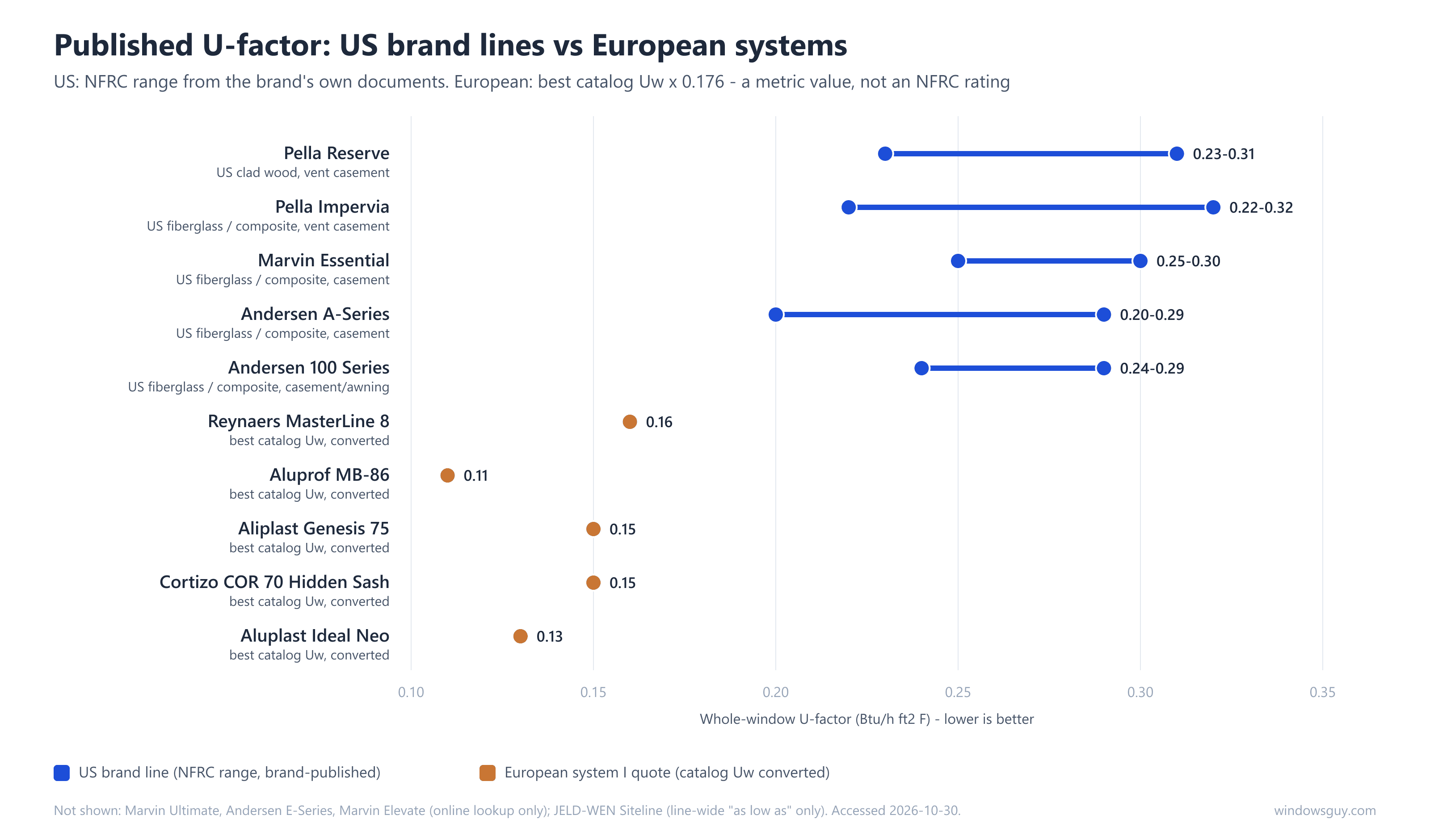
The chart sets the brands' NFRC ranges next to the best catalog Uw of the European systems I quote, converted to U-factor - a metric catalog value, not an NFRC rating of a supplied unit. Aluprof MB-86 converts to 0.11, Aluplast Ideal Neo to 0.13 and Reynaers MasterLine 8 to 0.16. Those aluminum and uPVC frames are shallower, 2.76-3.39 in (70-86 mm) against 4 9/16-5 in on the US clad lines, so depth alone says little about performance. On the wood side, the aluminum-clad timber lines I quote run from 3.21 in (81.5 mm) on Clad Hidden Sash to 4.86 in (123.5 mm) on Clad Passive, which converts from about 0.11. What I supply carries my own 10-year written warranty from Windows Guy. Brand by brand: Andersen E-Series against European aluminum-clad wood and Marvin's wood lines against European timber.
What I would specify
I would pick a different brand for each project type, and for most of them the answer is a US brand, not a European window.
Traditional replacement in standard sizes: Andersen. Double hung is on the E-Series and the A-Series, the channel includes home centers, and the warranty transfers without proration. A European window is the wrong call for a double-hung elevation; tilt-turn against double-hung explains why.
New custom build with a wood interior: Marvin Ultimate when the specification wants AAMA 2605 cladding as standard and cherry or white oak; Andersen E-Series when the millwork is walnut, maple, hickory or alder, or the exterior needs one of 50 colors; Pella Reserve when the elevation is tall casements. If the architect wants tilt-turn, I would quote Clad Hidden Sash; for a flush exterior, Clad Flush aluminum-clad wood.
Fiberglass on a mid-tier budget: Pella Impervia for an all-fiberglass window with a published triple-pane range (0.22-0.24) and lifetime material coverage for the original homeowner; Marvin Essential if the openings are tall (84 in) and narrow.
Tall casements and big units: Pella Reserve (47 x 108 in) in clad wood, Andersen A-Series (47 1/4 x 95 1/4 in) in composite.
Long ownership or a planned sale: Pella's lifetime coverage if the original owner stays; Marvin or Andersen if the house may sell, because their 20/10-year terms transfer in full while Pella's drop to 10 years for the next owner.
Cold climate or very low energy targets: Pella Lifestyle triple (0.19-0.26) or Andersen A-Series triple (0.20-0.25). Below that, I would look at Clad Passive or Timber Estate solid wood; the choosing windows guide covers the trade-offs by material.
FAQ
Is Marvin better than Pella? Not across the board. Marvin Ultimate has AAMA 2605 cladding as standard, more interior species (6 vs 3) and a fully transferable warranty; Pella Reserve publishes a larger casement (47 x 108 in vs 42 x 102 in) and lifetime coverage for the original owner of a wood window. Marvin is better for a house that may be sold; Pella is better for tall casements and owners who stay.
Which is better, Pella or Andersen? For tall clad casements and published clad-wood U-factors, Pella. For interior species (11 on the E-Series), standard colors (50), structural rating and availability through dealers and home centers, Andersen.
Marvin vs Andersen: which has the better warranty? They are nearly the same: 20 years on glass, 10 years on non-glass parts, transferable. Andersen's is not prorated; Marvin's glass coverage drops to 10 years on units of 60 sq ft and larger, but Marvin covers its AAMA 2605 cladding finish for 20 years.
Do Pella, Marvin or Andersen make tilt and turn windows? None of the lines compared here lists a tilt-turn operation; Pella Reserve lists an in-swing French casement, but it does not tilt. A tilt-turn sash swings inward and also tilts in at the top - the tilt and turn explainer shows how. Among other US makers, Kolbe lists a tilt-turn in its all-aluminum line; the Kolbe vs European tilt and turn comparison covers it.
Which of the three has the lowest U-factor? In the documents I could read, Pella Lifestyle with triple pane and a hinged glass panel (0.19-0.26) and Andersen A-Series triple pane (0.20-0.25). Marvin Ultimate, Marvin Elevate and Andersen E-Series values are published only through each brand's online NFRC lookup.
If your drawings already carry a Pella, Marvin or Andersen spec and you want a European price on the same openings, send them through the quote page and I will price the schedule line by line.