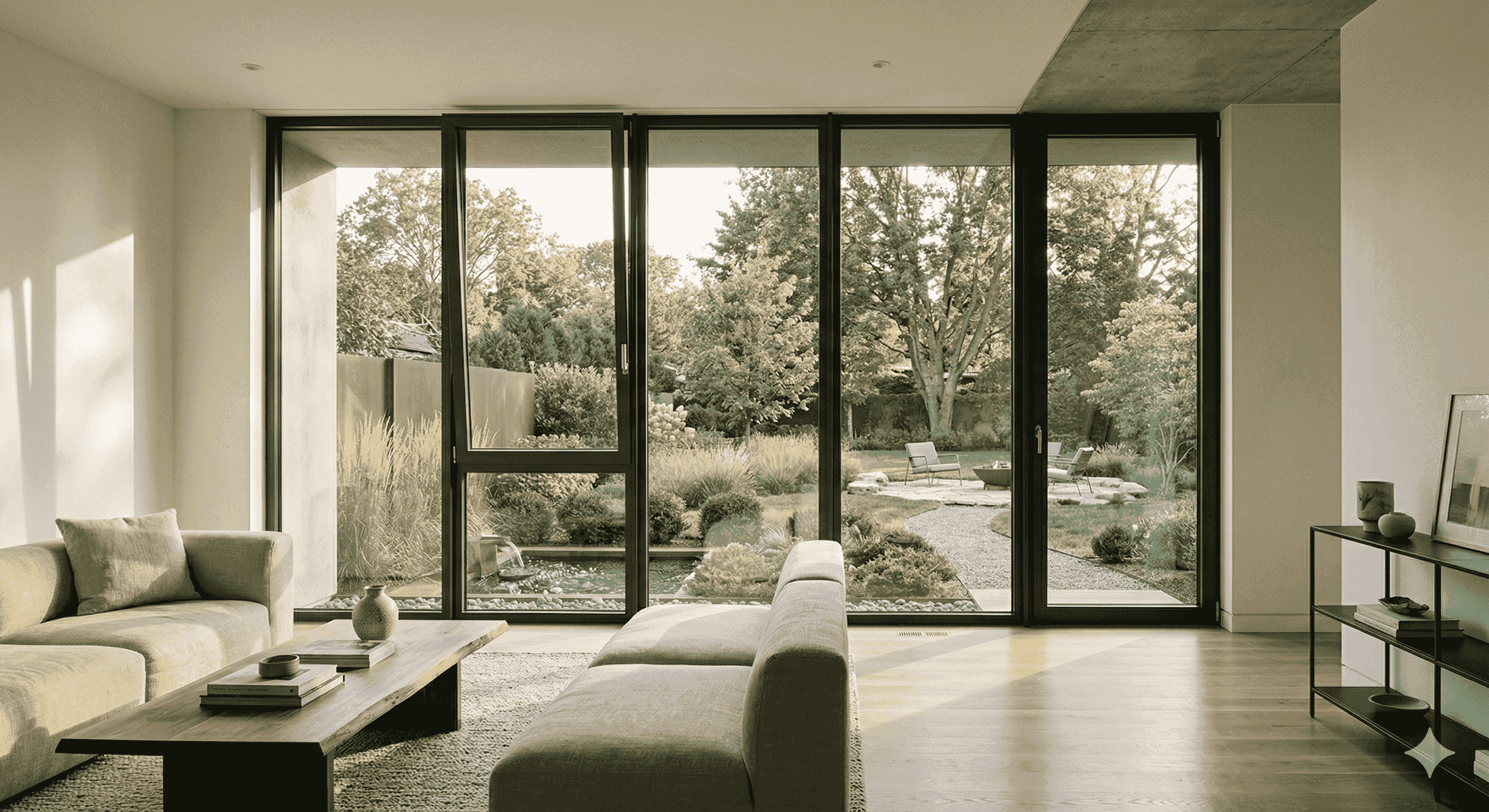
Most of the "European vs American windows" conversation online compares tilt-turn to casement. That is the wrong comparison for most US homes. Walk any street in New England, the Mid-Atlantic or the Midwest and the window you see on nine houses out of ten is a double-hung: two sashes sliding up and down in one frame. If you are replacing windows or building a traditionally styled home, double-hung is the default your architect drew and your GC has priced a hundred times.
So the question I actually get is not "tilt-turn or casement?" - it is "why would I give up double-hung for a window that opens into the room?" Here is the honest answer, including the cases where the double-hung wins.
How each one actually works
Double-hung. Two sashes in vertical tracks. The lower sash slides up, the upper sash slides down, and most modern units let both tilt inward for cleaning. The sashes are held by balances (springs or block-and-tackle hidden in the jambs) and locked by one or two cam locks at the meeting rail. The seal is a brush or fin weatherstrip that the sash slides past - by design it cannot clamp down hard, because the sash has to move along it.
Tilt-turn. One sash on a perimeter hardware system. Turn the handle 90 degrees and the sash tilts in from the top a few inches for ventilation. Turn it 180 degrees and the whole sash swings inward like a door. In both positions and when closed, the handle drives locking points around the entire perimeter that pull the sash into a continuous compression gasket. I covered the logic behind the inswing in why European windows open inward and the mechanism itself in European window hardware explained.
That one difference - sliding past a seal vs compressing a gasket - explains most of what follows.
Air sealing: the gap that decides comfort
This is where the comparison is not close. A sliding sash can only be as tight as a weatherstrip you can slide along. A compression-sealed sash is pulled shut at multiple points and stays that way.
In NFRC terms, air infiltration is reported in cfm per square foot of window area. Good new double-hungs from the premium American brands typically test around 0.1 cfm/sq ft; the code ceiling for operable windows is 0.3. Tilt-turn units from the system providers I work with test in the top European air-permeability class (Class 4 under EN 12207), and in US-style testing the same compression-sealed construction typically lands at a fraction of the double-hung figures - and the seal does not loosen with age the way a brush strip does.
Why it matters more than the U-factor on the label: air leakage is felt as a draft and as noise, and it is invisible in the U-factor number. A double-hung with a great U-factor and a mediocre seal still lets the cold in around the meeting rail every January. If comfort in a cold climate is the goal, this is the spec to look at first - I go deeper in best windows for cold climates.
Ventilation and daily use
Double-hung strengths. You can open top and bottom together for a convection loop - warm air out the top, cool air in the bottom - and you can crack it an inch on a rainy day without water getting in. Nothing projects into the room. Curtains and blinds work the way everyone expects.
Tilt-turn strengths. Tilt mode gives secure, rain-tolerant ventilation you can leave open overnight or when you are out - the opening is at the top, the sash is still locked into the frame at the bottom, and there is no way to work it further open from outside. Turn mode gives you the whole opening, which is more airflow than any double-hung can deliver from a same-size unit.
Tilt-turn trade-off. In turn mode the sash swings into the room. That means clearance in front of the window, and it means blinds and curtains need to be mounted with the swing in mind (or on the sash itself). In a kitchen with a counter in front of the window, turn mode is realistically only for cleaning. I would not pretend this is a non-issue - it is the number one thing people dislike after living with tilt-turn for a month, and it is a layout decision, not a product flaw.
Cleaning, maintenance and lifespan
Modern double-hungs tilt in for cleaning, which solved the old ladder problem. But the tilt latches, the balances and the meeting-rail lock are the parts that wear, and a double-hung that has gone soft - sash drifting down, lock that needs a shove - is a familiar sight in any 15-year-old house.
A tilt-turn sash in turn mode gives you the full exterior glass from inside, no latches to pop. The perimeter hardware is adjustable in three axes at the hinges, so a sash that has settled gets brought back into square with a hex key rather than replaced. The hardware is rated for tens of thousands of cycles and is shared across the system providers' aluminum and uPVC lines.
Egress, screens and the details the plan reviewer cares about
Egress. A double-hung only ever gives you about half its frame area as clear opening, because one sash always covers the other half. That is why bedroom double-hungs have to be tall to make the IRC 5.7 sq ft egress minimum. A tilt-turn in turn mode gives you almost the full frame - so a smaller window clears egress. The math is in tilt-turn windows and egress code.
Screens. Double-hungs carry a half or full screen outside the sash and it stays put - a genuine convenience. Tilt-turn units open inward, so the screen also sits outside, fixed or roll-down, and it stays in place in both tilt and turn modes. The detail differs from what US installers expect - see insect screens on tilt-turn windows.
Certification. Many of the tilt-turn systems I source can be delivered with NFRC labels, which most US jurisdictions will want for the energy-code submittal; a few premium aluminum systems are not in the NFRC program and I flag those early. Details in NFRC and NAFS for European windows.
Look and proportion
A double-hung reads as traditional: the meeting rail cuts the glass into two lites, and simulated divided lites (SDL grids) complete the colonial or craftsman look. That is a real aesthetic asset on a traditional facade, and no tilt-turn imitates it convincingly.
A tilt-turn reads as one pane. From outside it looks like a fixed window or a casement - clean, larger uninterrupted glass, narrower frames on the aluminum systems. On a modern, farmhouse-modern or Scandinavian-leaning design that is exactly the point. On a Georgian colonial it fights the house.
What they cost - supplied and landed
For a like-for-like comparison, hold the specification constant: same size, double glazing, standard white or a mainstream color, no grids.
Using the same per-square-foot cells my estimator runs on:
| Window type (per sq ft of unit) | Typical range |
|---|---|
| European uPVC tilt-turn, supplied ex-factory | around $26 |
| European aluminum tilt-turn, standard thermal break, supplied | around $56-62 |
| European aluminum tilt-turn, premium slim-frame, supplied | around $80 |
| Premium American double-hung (clad wood / fiberglass), installed | roughly $60-110 in the retail quotes clients forward to me |
Two things to note before you compare those lines.
First, the European numbers are the supplied price. Import duty is added on the product value - the rate depends on the frame material, and aluminum carries the higher one - plus a per-container ocean freight allocation; my estimator carries the result at a +/-10% band. Triple glazing adds about 15% on uPVC and 6% on aluminum; a nailing-flange frame for wood-frame installation adds about 8% on uPVC and 6% on aluminum. The American number is usually quoted installed, so you are not looking at the same thing until you add installation to the European side. The full landed math is in how much European windows cost.
Second, per-square-foot pricing favors bigger units. A 3 ft x 5 ft opening is 15 sq ft. That puts a uPVC tilt-turn near $400 supplied and a standard aluminum tilt-turn near $900 supplied, before duty and freight. At that size the uPVC unit lands well under a premium American double-hung, and the aluminum unit lands in the same territory - with a much better seal and a single-pane look. On small windows the American double-hung's installed price is competitive and the European advantage is performance, not dollars.
When to keep the double-hung
I would keep double-hung, without hesitation, when:
- The facade is traditional and the two-lite proportion is part of the design.
- Windows sit above counters, tubs or built-ins where an inswing sash has nowhere to go.
- The project is a like-for-like replacement in a period home and the goal is matching what is there.
- Budget is tight on many small windows and a good American double-hung with a solid air-leakage number is available locally with a local warranty.
When tilt-turn earns its place
- Cold or windy sites where drafts and noise are the complaint, not the U-factor.
- Bedrooms where egress is driving window size up beyond what the elevation wants.
- Modern or minimalist elevations that want one clean pane per opening.
- Homes where secure night ventilation matters - tilt mode is the single most-loved feature after a year.
- Large openings, where the per-square-foot economics tip clearly toward the European unit.
Plenty of projects mix them: tilt-turn on the private, weather-facing elevations and in bedrooms, and something traditional on the street face. The system providers' catalogs cover casement and fixed units that share profiles and finish with the tilt-turns, so the mix looks intentional. If you have not decided between tilt-turn and casement either, that comparison is here: tilt-turn vs casement windows. For the wider picture, start at the choosing windows hub.
Want numbers for your schedule instead of ranges? Run it through the estimator or send me the window schedule and I will price it as a DDP, all-in list.
FAQ
Is a tilt-turn window better than a double-hung? On air sealing, security, egress clear opening and long-term hardware life, yes. On traditional looks, screens that stay put, and cracking the window open in the rain, the double-hung holds its own. "Better" depends on the elevation and the room - on a modern home in a cold climate, tilt-turn; on a colonial facade, double-hung.
Can I replace a double-hung with a tilt-turn window? Yes. The rough opening is the same kind of hole; the frame depth and the mounting method differ. European frames are typically deeper and can be ordered with a nailing flange or bracket-mounted. Plan the interior swing clearance before you order - see my guide to retrofitting European windows into an existing home.
Do tilt-turn windows cost more than double-hung windows? Supplied ex-factory, a uPVC tilt-turn is usually cheaper per square foot than a premium American double-hung, and an aluminum tilt-turn lands in a similar range once duty and freight are added. The comparison only means something if you add installation to the European side and compare at the same size and glazing.
Do tilt-turn windows meet US egress requirements? In turn mode a tilt-turn gives nearly the full frame as clear opening, so a smaller unit clears the IRC 5.7 sq ft minimum than a double-hung, which only ever opens half its area. Tilt mode does not count as egress - the reviewer will look at the turn-mode dimensions.
Do tilt-turn windows have screens? Yes - they mount on the outside of the frame because the sash opens inward, and they stay in place in both tilt and turn modes. What changes is the detail your installer is used to, not whether a screen exists.