I already wrote up tilt-turn against double-hung, because double-hung is what most people picture when they think "American window." But on a lot of the production and spec-home jobs I get pulled into, the window actually on the schedule is single-hung, not double-hung - one fixed sash on top, one operable sash on the bottom, nothing else moves. It is the standard window in new-construction builder-grade work across the Sun Belt and much of the Southeast and Southwest, and it is a cheaper, simpler cousin of the double-hung. So it deserves its own comparison, not a footnote on the double-hung post.
How each one actually works
Single-hung. The top sash is fixed in the frame - caulked or clipped in place, never opens. The bottom sash rides in a vertical track on balances (usually spring or constant-force) and slides up. A single cam lock at the meeting rail pulls the sash against a weatherstrip when closed. It is the simplest, least expensive operable-window mechanism you can spec, which is exactly why production builders default to it.
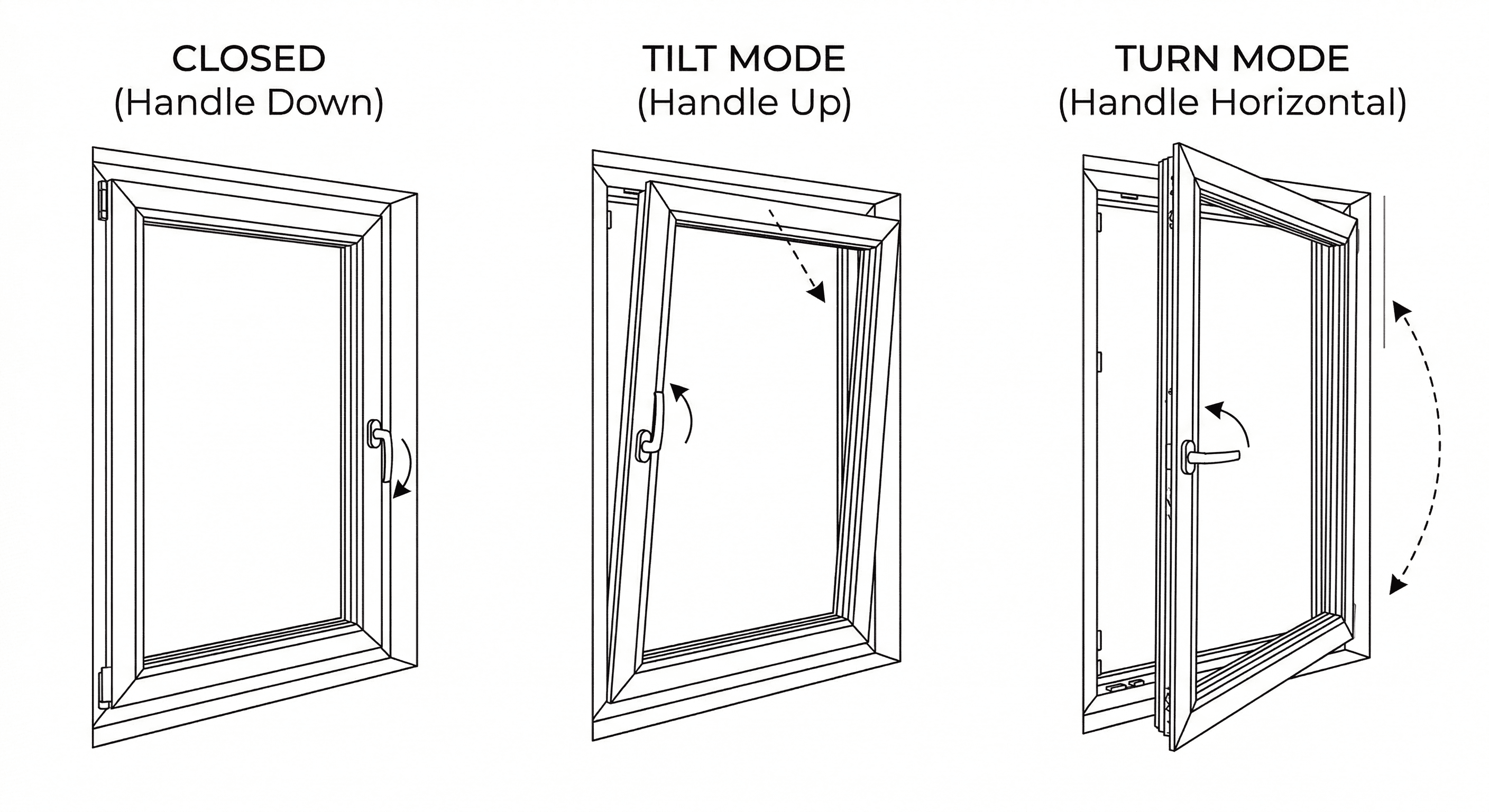
Tilt-turn. One sash, one set of perimeter hardware. Turn the handle 90 degrees and the sash tilts in from the top for secure ventilation. Turn it 180 degrees and the whole sash swings inward like a door. Closed, the handle drives locking points around the full perimeter into a continuous compression gasket - not a weatherstrip the sash slides past. I go through the mechanism itself in European window hardware explained and the reasoning behind the inswing in why European windows open inward.
Air sealing and comfort
This is the biggest functional gap between the two, bigger even than the tilt-turn/double-hung comparison, because single-hung has less sealing hardware to begin with - one lock point instead of two, and a fixed upper sash that is only as good as its caulk joint. A sliding sash against a weatherstrip loosens with age as the strip compresses and the balance wears; a compression-sealed sash does not, because the seal is pulled shut by hardware, not by friction against a strip.
Tilt-turn units from the system providers I work with test in the top European air-permeability class (Class 4 under EN 12207); in US-style testing that construction typically lands at a fraction of what a builder-grade single-hung tests at. Builder-grade single-hung is usually the cheapest window on the truck, and air sealing is often the first thing value-engineered when the sash and balance are simplified to hit a price point. If a client's complaint is "the house feels drafty" rather than "the utility bill is high," air sealing - not the U-factor on the label - is where I start. More on that distinction in best windows for cold climates.
Ventilation and daily use
Single-hung strengths. Nothing about it is unfamiliar. It opens the way every American expects a window to open, screens sit on the outside track where installers and homeowners expect them, and there is zero interior clearance to plan around. It is also, categorically, the least expensive operable window type to buy and install - which is exactly why it dominates production and entry-level new construction.
Single-hung limitation. Only the bottom sash moves, so you get roughly half the frame area as usable opening, and only from the bottom - no convection loop, no ability to vent from the top of the room where hot air collects.
Tilt-turn strengths. Tilt mode gives secure, rain-tolerant ventilation you can leave open overnight or while out - the sash stays locked into the frame at the bottom and cannot be worked further open from outside. Turn mode gives the full frame opening, more airflow than a single-hung of the same size can deliver by a wide margin, since a single-hung is capped at its one moving sash.
Tilt-turn trade-off. Turn mode swings into the room, so you need interior clearance, and blinds or curtains have to be planned around the swing. On single-hungs, nothing ever swings in - if a room genuinely has no interior clearance (over a kitchen sink run, behind a headboard), that is a real point in the single-hung's favor.
Egress and code
A single-hung's clear opening is capped at the operable bottom sash, which is why bedroom single-hungs in warm climates tend to be wide and short rather than tall - the IRC 5.7 sq ft (5.0 sq ft at grade floor) minimum has to come out of half the unit. A tilt-turn in turn mode opens to nearly the full frame, so a visually smaller window can clear the same egress requirement. I cover the actual math in tilt-turn windows and egress code.
Cleaning and hardware life
A single-hung's fixed top sash never needs cleaning access from inside - that is a genuine plus on a two-story house with a hard-to-reach exterior. The operable bottom sash on most modern units tilts in for cleaning, same as a double-hung. What wears over time is the balance and the single lock point; a single-hung that has gone soft (sash that will not stay up, lock that needs a shove) is a familiar callback on production homes once the balances age out.
A tilt-turn sash in turn mode gives full exterior glass access from inside on every pane, not just the operable one, and the perimeter hardware adjusts in three axes at the hinges with a hex key rather than needing a part swap. It is rated for tens of thousands of cycles.
What they cost - supplied and landed
Hold the spec constant for a fair read: same size, double glazing, standard white or a mainstream color, no grids.
Using the same per-square-foot cells my estimator runs on:
| Window type (per sq ft of unit) | Typical range |
|---|---|
| European uPVC tilt-turn, supplied ex-factory | around $26 |
| European aluminum tilt-turn, standard thermal break, supplied | around $56-62 |
| European aluminum tilt-turn, premium slim-frame, supplied | around $80 |
| Builder-grade American single-hung, installed | roughly $25-45 in the retail quotes clients forward to me |
Two things before you read those numbers side by side.
First, the European figures are supplied, ex-factory. Import duty is added on product value - the rate depends on the frame material, and aluminum carries the higher one - plus a per-container ocean freight allocation; my estimator carries the result at a +/-10% band. Triple glazing adds about 15% on uPVC and 6% on aluminum; a nailing-flange frame for wood-frame installation adds about 8% on uPVC and 6% on aluminum. The single-hung figure is usually quoted installed, so you are not comparing the same thing until you add installation to the European side - see the full landed math in how much European windows cost.
Second, single-hung is the genuine budget play here, and it is not close. A uPVC tilt-turn on a small opening can land in the same territory once duty and freight are added, but it is not going to beat a builder-grade single-hung on raw dollars per opening on a production job with dozens of small windows. Where tilt-turn earns its keep is performance and larger openings, not undercutting single-hung's price point.
When to keep the single-hung
I would keep single-hung, without hesitation, when:
- The project is production or spec-home volume and per-unit cost across dozens of openings is the driver.
- The facade is a standard American elevation where a single-hung's proportions are expected, not a design statement.
- Interior clearance is genuinely zero - over counters, sinks, or built-ins where any inswing sash has nowhere to go.
- The budget simply does not support a performance upgrade on every opening, and the client is not asking for one.
When tilt-turn earns its place
- Cold, hot, or coastal-adjacent sites where air sealing and comfort are the actual complaint.
- Bedrooms where egress is driving window size up beyond what the elevation wants.
- Custom or design-forward homes where a single clean pane reads better than a two-sash proportion.
- Larger openings, where the per-square-foot economics compete directly with premium American products.
- Projects where a handful of statement openings get the upgrade and the rest of the house stays standard - a common, sensible split I see on mixed-budget builds.
For the wider picture on operation types, start at the choosing windows hub, or see how tilt-turn stacks up against double-hung and casement windows if those are also on the table.
Want numbers for your actual schedule instead of ranges? Run it through the estimator or send me the window schedule and I will price it as a DDP, all-in list.
FAQ
Is a tilt-turn window better than a single-hung? On air sealing, ventilation control, egress clear opening and hardware longevity, yes, by a wider margin than the double-hung comparison, because single-hung is typically the more basic of the two American types. On raw cost per opening across a large production job, single-hung usually wins - it is built to be the economical choice.
Can I replace a single-hung with a tilt-turn window? Yes. The rough opening is the same kind of hole, though European frames are typically deeper and can be ordered with a nailing flange or bracket-mounted. The bigger planning item is interior swing clearance in turn mode, which a single-hung never needed - see my guide to retrofitting European windows into an existing home.
Why do production builders use single-hung instead of double-hung or tilt-turn? Cost and simplicity. A single-hung has one moving sash, one lock point and one balance set per unit - fewer moving parts than a double-hung and far less hardware than a tilt-turn. On a spec home with 30-plus openings, that per-unit savings adds up fast, which is why it is the default in production and entry-level new construction.
Do tilt-turn windows meet US egress requirements better than single-hung? Yes. A single-hung only ever opens its bottom sash, so the operable area is capped well below the total frame; a tilt-turn in turn mode opens to nearly the full frame, so a visually smaller unit can clear the IRC 5.7 sq ft minimum. Tilt mode alone does not count - egress is based on the turn-mode dimensions.
Do single-hung windows have worse air sealing than tilt-turn? Generally yes, and the gap is real. A single-hung seals with a weatherstrip the sash slides past and one lock point; a tilt-turn seals with a compression gasket pulled shut by hardware around the full perimeter. The single-hung's seal also loosens over time as the strip wears, where the tilt-turn's hardware stays adjustable.