
A homeowner who has lived with American wood casements asks me the same thing on almost every call: "If the window opens inward and tilts, does the wood frame really carry that?" It is a fair question. A tilt and turn sash hangs on two corners and moves in two directions, and wood is not aluminum.
Tilt and turn wood windows are laminated timber windows fitted with European tilt-and-turn hardware: one handle moves a locking bar around the whole sash, so the sash either tilts inward at the head for ventilation or swings inward on its side hinges like a door, and closes against the frame at several locking points that compress it into the gaskets. The hardware is the same family used on aluminum and uPVC windows; what changes in wood is how it is fixed into the timber, how much the sash weighs and how the frame is sealed.
If you want the two wood systems first, they are on the European wood windows page. This post is about the moving parts.
How do tilt and turn wood windows work?
The handle has three positions on standard hardware:
- Down: locked. Every locking point on the sash edge is engaged in a keeper on the frame.
- Sideways (90 degrees): turn. The sash swings inward on its side hinges, the full opening is clear and both faces of the glass can be cleaned from inside.
- Up (180 degrees): tilt. The sash leans inward at the head, held by a stay arm, while the bottom stays hinged. It is a ventilation position, not a security or weather setting - close the window when you leave or when rain is coming.
Behind the handle, a gearbox drives a continuous locking bar (the espagnolette) routed into the sash edge. The general mechanism, the multipoint locking and the gaskets are covered in European tilt-and-turn window hardware explained; the rest of this post is what is specific to a timber window.
What changes when the frame is wood instead of aluminum?
Three things: fixing, weight and sealing.
Fixing. In an aluminum frame, hinges and keepers bolt into reinforced chambers. In wood, they are screwed into solid laminated timber. That is why the frame of a European wood window is not one plank: it is glued from three or four layers, which keeps the section straight and gives the screws a dense, stable bed. The construction is explained in wood window frames explained.
Weight. A timber sash with triple glazing is heavy, and the bottom hinge carries most of it when the sash is turned open. Hardware is chosen for the sash weight and size, which is one reason I check each large sash against the system data instead of quoting a single maximum size.
Sealing. The gaskets are in the timber profile itself, and the number of sealing lines changes with the profile depth:
| Wood system | Frame depth | Sealing lines | Published reference Uw (approx. U-factor) | Opening types I quote |
|---|---|---|---|---|
| Timber Classic | 68 mm (2 11/16 in), XL 78 mm (3 1/16 in) | 2 | 0.83 W/m2K (about 0.15) | Tilt and turn, fixed |
| Timber Estate | 92 mm (3 5/8 in) | 3 | 0.77 W/m2K (about 0.14) | Tilt and turn, fixed |
| Clad Hidden Sash (aluminum-clad timber) | 81.5 / 91.5 mm (3.21 / 3.60 in) | 3 | US catalogue U-factor from 0.16 | Tilt and turn with concealed sash, fixed |
U-factors for the two wood lines are approximate conversions of the published metric reference values, not NFRC ratings; the Clad Hidden Sash figure is the US catalogue reference for a tested configuration. The value for your sizes and glass comes with the quote.
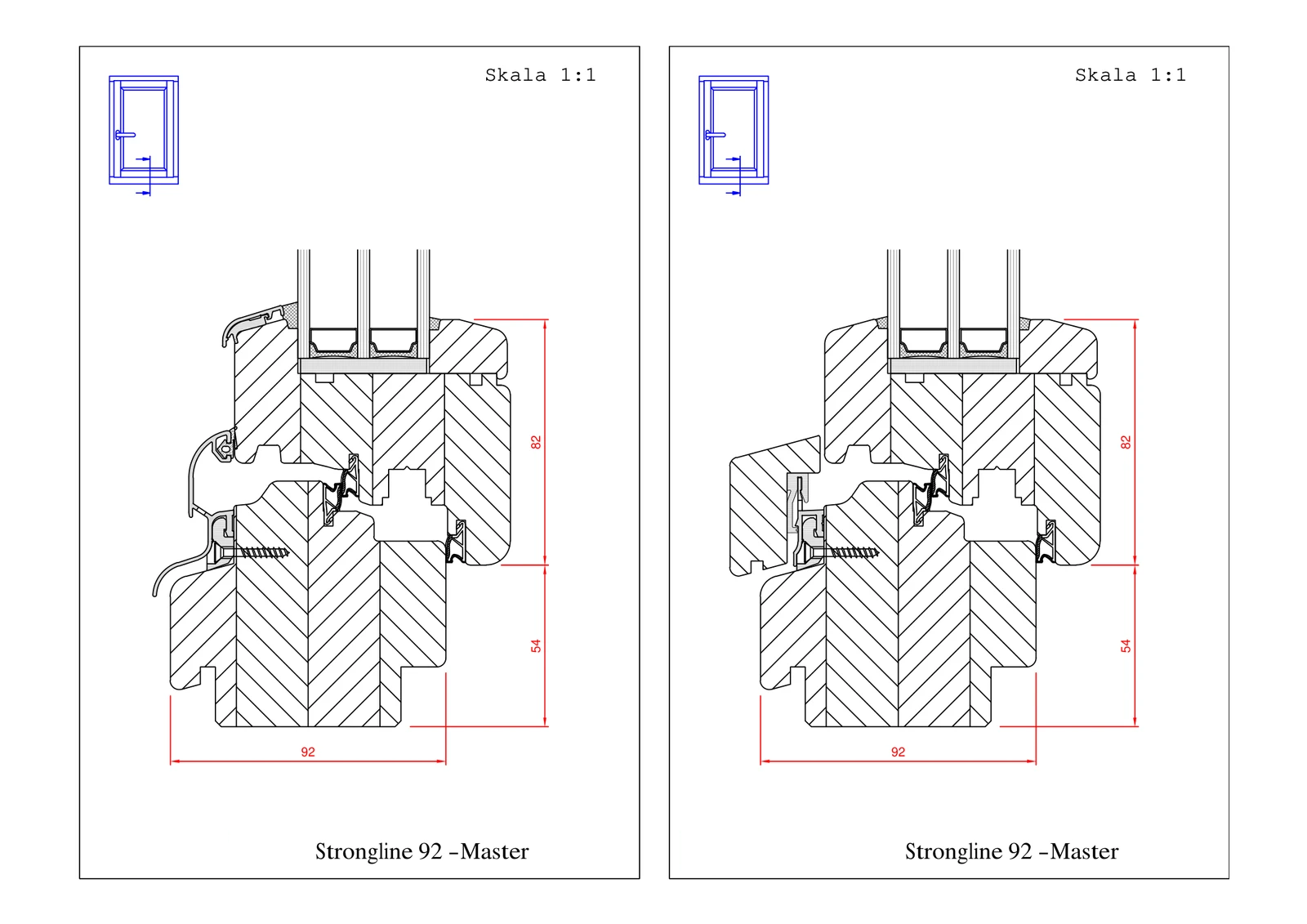 Timber Estate section: 92 mm (3 5/8 in) laminated frame and sash with three sealing lines.
Are the hinges on timber tilt and turn windows visible?
On a standard wood tilt and turn window, you see two small hinge parts on the room side: one at the top corner, where the stay arm pivots, and one at the bottom corner, which carries the sash. They are usually covered with caps, so what you notice is the handle, not the hinge.
If you want nothing showing, ask about concealed hinges. The aluminum-clad Clad Hidden Sash runs on concealed Maco Multi Power hardware with a published sash capacity of up to 331 lb (150 kg), and its catalogue reference for tilt and turn height is up to 9 ft 2 in (2,800 mm) in selected configurations. From outside, the sash sits behind the frame, so fixed and operable units read the same on the elevation. On the solid-wood lines I confirm concealed hinges per order, together with the sash size, rather than assume them.
Can I get tilt-first hardware on wood windows?
Tilt-before-turn hardware swaps the handle sequence so the first position tilts the sash and the full swing needs a further turn. It is a common choice for children's rooms because it makes an accidental full swing less likely, but it is not fall protection. Lockable handles exist too, and on any window that serves as an emergency escape opening they are the wrong choice: an egress window has to open without a key or tool, so I check handle and operation together with the opening size. It is a hardware option, not a frame option, so it is available on wood the same way it is on aluminum and uPVC; I put it on the schedule window by window so it is in the shop drawing, not remembered at the end.
Handles come from established European handle ranges in several shapes and colors, including versions with a key lock. Pick them early: the handle is the part of the window you touch every day, and it shows up in the drawing set.
One thing to keep in mind on the bedroom windows: egress is assessed in the full turn position, using the documented net clear opening of the quoted unit, not the frame size. The sash, hinges and any restrictor all affect it, so I get the opening drawing for each egress window before the size is fixed. The rules are in tilt-turn windows and US egress code.
What maintenance does tilt and turn hardware on wood windows need?
Very little, and none of it is specific to timber:
- Once a year: a drop of oil on the moving points of the hardware and a wipe of the gaskets. The full care schedule for the timber itself is in how long do wood windows last.
- After the first season: check that the sash closes evenly. New buildings settle, and European tilt-and-turn hardware typically has adjustment at the hinges and keepers, so the installer can correct a dragging sash with a hex key, without taking anything apart.
- When refinishing the exterior: mask the hardware and gaskets, never paint over them.
Inward opening also has a practical side for screens: the screen sits on the outside of the frame, out of the sash's way. The options are in insect screens for tilt-turn windows, and the reasons Europe opens inward at all are in why European windows open inward.
What I would specify
For a house with a mix of window sizes, I would make tilt and turn the default on every operable wood window and keep fixed lights fixed, rather than making every unit operable. I would use the 92 mm (3 5/8 in) Timber Estate where the sashes are large and the walls are deep enough, because the extra sealing line and the deeper section suit a heavy triple-glazed sash, and the 68 mm (2 11/16 in) Timber Classic on smaller and more traditional elevations. I would put tilt-first hardware on children's rooms, keep key-lockable handles off every window that has to serve as an escape opening, check every bedroom window against the unit drawing for egress, and choose one handle for the whole house. If the design wants no visible hinges, I would look at Clad Hidden Sash before trying to hide them on a solid-wood sash.
If you are still deciding between tilt and turn and an outward-opening casement, read tilt-turn vs casement windows; the full range of systems is on the tilt and turn windows page. When you have drawings, request a quote and I will come back with questions, then shop drawings for every position. Lead times are confirmed per order.
FAQ
Do tilt and turn wood windows use the same hardware as aluminum ones? Yes, the same European tilt-and-turn mechanism: one handle, a locking bar around the sash, several locking points and a stay arm for the tilt. The difference is the fixing - in wood, hinges and keepers are screwed into a laminated timber section - and the hardware is matched to the weight and size of the timber sash.
Are tilt and turn wooden windows strong enough for large sashes? Yes, within the limits of the hardware and the glass weight. The laminated frame gives the hinges a stable bed, and the hardware is chosen for the sash weight. I check each large sash against the system data, and for big openings I would usually specify the deeper 92 mm (3 5/8 in) frame.
Can timber tilt and turn windows have hidden hinges? Standard wood tilt and turn windows show small hinge parts at the top and bottom corners, with cover caps. A fully concealed look is the job of the aluminum-clad Clad Hidden Sash, whose concealed hardware has a published sash capacity of up to 331 lb (150 kg). On solid-wood lines, concealed hinges are confirmed per order.
Can tilt and turn wood windows be specified for a child's room? Yes. Tilt-before-turn hardware makes tilt the first handle position, which makes an accidental full swing less likely. It is not fall protection, so supervision and the operating instructions still apply. A bedroom also needs a compliant egress opening in the turn position that opens without a key or tool, checked on the drawing of the actual unit.
How do you maintain the hardware on a wood tilt and turn window? Oil the moving points once a year, wipe the gaskets, and check after the first season that the sash closes evenly. If it drags, the hinges and keepers can typically be adjusted with a hex key. When the exterior timber is refinished, mask the hardware and gaskets instead of painting over them.