
Luxury windows are windows built on a better system, not windows with a higher price tag: slimmer sightlines, larger glass, concealed hardware, heavier sashes that still move with one hand, and finishes chosen for the house instead of from a short color card. On a high-end home I judge a window by five things you can measure on a drawing. Brand prestige is not one of them.
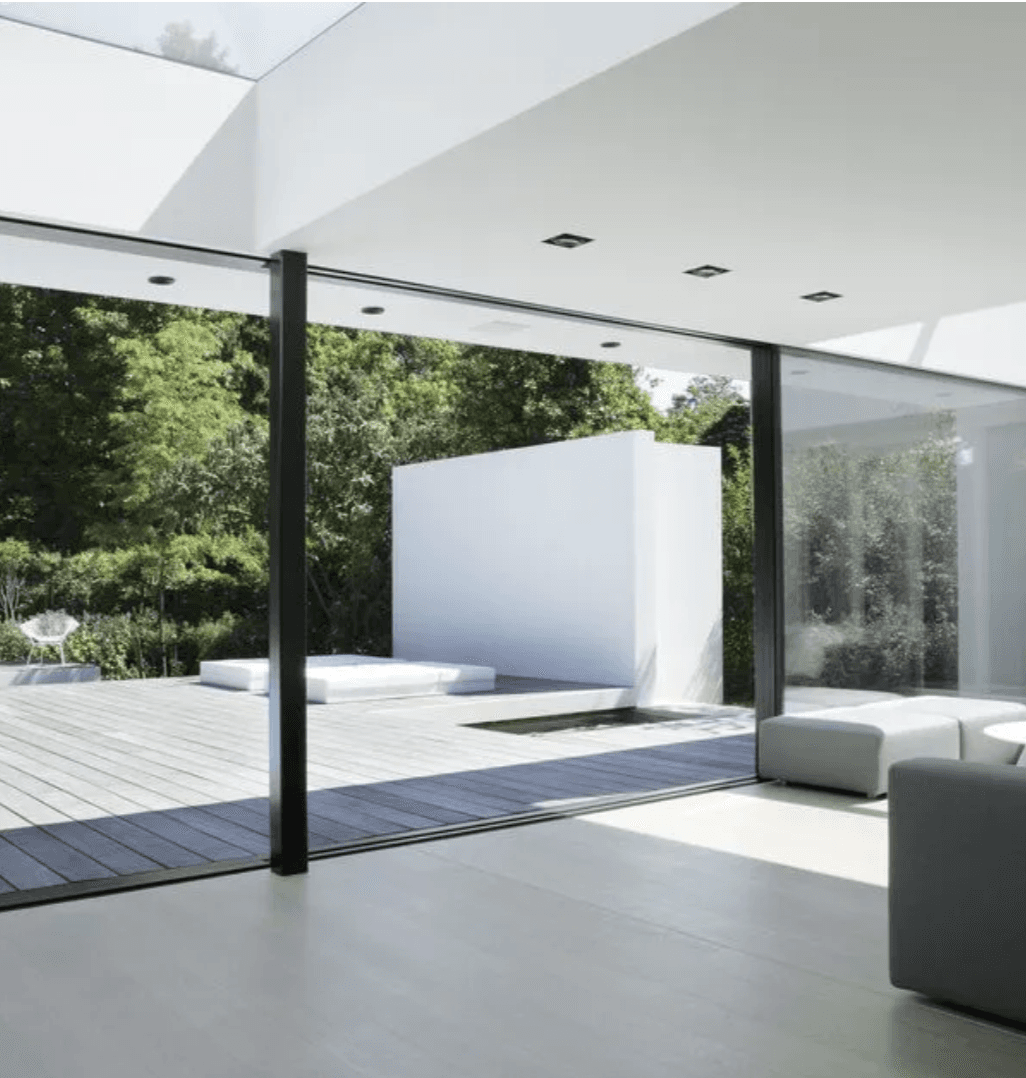
Reynaers Hi-Finity minimal sliding system, provider image.
What Makes a Window a Luxury Window?
A luxury window is defined by five measurable attributes, and each one shows up on the shop drawing before anything ships. These are the five I check on every high-end project:
- Sightline - how much frame you see. A slim frame turns the glass into the design.
- Size - how tall and wide a single sash or panel can go, and how much weight the hardware carries.
- Hardware - concealed hinges, multi-point locks and operation such as tilt and turn windows, which open inward for cleaning and tilt for secure ventilation.
- Glass - triple glazing, acoustic and laminated safety glass sized to the opening.
- Finish - any RAL color, anodized metal, a different color inside and out, or real wood on the room side.
A window that scores high on all five costs more to build, and the difference shows every time the sash opens. The rest of this guide puts numbers on each attribute.
How Slim Can the Frames Get?
The slimmest European systems I quote reach a 35 mm (1.38 in) interlock on sliding doors and about 80-87 mm (3.15-3.43 in) of visible frame on operable windows with a hidden sash. The values below come from the system providers' published data.
| System | Type | Published sightline |
|---|---|---|
| Reynaers Hi-Finity | Minimal sliding door | 1.38 in (35 mm) interlock, no visible external beads |
| Reynaers SlimLine 38 | Slim casement, steel-look aluminum | 2.22 in (56.5 mm), burglarproof edition |
| Reynaers MasterLine 8 Hidden Vent | Hidden-sash window | 3.15 in (80 mm) |
| Reynaers MasterLine 10 Hidden Vent | Hidden-sash window | 3.43 in (87 mm) |
The hidden-sash systems matter most on a modern facade. The opening sash sits behind the frame, so from outside an operable window looks the same as the fixed glass next to it. Aliplast Max Light Invisible is another hidden-sash option. I cover that family in hidden sash windows, and the sliding side in frameless sliding glass doors.
How Big Can High-End Windows and Doors Go?
High-end European systems take sliding panels up to 13 ft 1 in (4,000 mm) tall and MasterLine 8 window sashes up to 9 ft 2 in (2,800 mm) tall. The weight the hardware carries is what makes those sizes usable, and the table lists the published limits.
| System | Published size limit | Published weight limit |
|---|---|---|
| Reynaers Hi-Finity sliding | Panel height to 13 ft 1 in (4,000 mm) | 1,653 lbs (750 kg) motorized |
| Aluprof Skyline sliding | Leaf up to 13 ft 1 in (4 m) high | 1,543 lbs (700 kg) base; 2,645 lbs (1,200 kg) Type R with concealed motor |
| Reynaers MasterLine 8 window | Sash height to 9 ft 2 in (2,800 mm) | 441 lbs (200 kg) window sash |
| Cortizo Millennium Plus Pivot | Leaf 6 ft 11 in x 9 ft 10 in (2,100 x 3,000 mm) | 353 lbs (160 kg) |
These are system limits, not a promise for every opening. Glass type, wind load and the transport route set the real maximum for your project, and I confirm each size on the shop drawing. Entrance doors on a pivot are their own topic, covered in pivot doors for luxury projects.
What Hardware Separates High-End Windows?
High-end window hardware is concealed, multi-point and sized to the sash weight. You see a handle and glass, not hinges, and the sash locks at several points around the perimeter instead of one latch.
Concealed hinges sit inside the frame rebate. On the Clad Hidden Sash aluminum-clad wood window, the concealed hardware carries a published sash capacity of up to 331 lbs (150 kg). Multi-point locking pulls the sash evenly onto the seals, which is where air and water tightness come from. Security editions add tested burglar resistance classes: MasterLine 8 lists RC2 and RC3 variants, and Hi-Finity lists RC2.
The detail most buyers notice first is how a heavy sash moves, which is why I size the hardware set to the actual sash weight on the shop drawing. For the parts and how they work, see European window hardware explained.
Which Glass and Finishes Do Luxury Projects Use?
Luxury projects use triple glazing for comfort, laminated glass for safety and sound, and a finish chosen per face of the frame. These are the options I specify most often on high-end homes:
- Triple glazing - MasterLine 8 Functional takes glazing up to 2.83 in (72 mm), enough for triple glass with acoustic or laminated panes.
- Acoustic glass - MasterLine 8 Hidden Vent lists sound insulation up to 49 dB, useful on a city lot or near a road.
- Any RAL color - powder coat in the full RAL palette on aluminum.
- Anodized finishes - a hard metallic surface in natural, bronze or black tones.
- Dual-color frames - one color outside to match the facade, another inside to match the room.
Aluminum-clad wood takes the finish idea one step further: a powder-coated RAL exterior with a stained, lacquered or painted wood interior. The full palette is in European window colors and finishes.
Which Frame Material Fits a Luxury Home?
Every one of the five material families I source can be a luxury window. The right one depends on the design, not on a ranking, and the table shows what each family does best.
| Material | What it does best on a high-end home | Example |
|---|---|---|
| Aluminum | Slimmest frames, largest glass, any RAL color | Hi-Finity, MasterLine 8 |
| Wood | Real timber inside and out, traditional or classic design | Timber Estate |
| Aluminum-clad wood | Wood interior with a low-maintenance aluminum exterior | Clad Hidden Sash, see the aluclad window guide |
| uPVC | Strong thermal value at a lower budget, white, RAL colors or woodgrain foils | Aluplast Ideal Neo |
| Real steel | Thin steel profiles with a thermal break, Jansen Janisol | Steel windows and doors |
Real steel is not the same product as steel-look aluminum. Both appear on high-end homes, and I quote real steel from drawings only.
How Much Do Luxury Windows Cost?
Luxury windows are priced per project from the drawings, because size, glass, hardware and finish change the number more than the material does. I do not publish a per-window figure for high-end assemblies, and I would not trust one that ignores those four inputs.
For a first budget on standard aluminum, uPVC or aluminum-clad wood units, use the window cost estimator. For how the price builds up, read what drives European window prices, and for ways to bring it down without losing the look, see how to lower window costs in high-end homes. Solid wood and real steel always need a quote from drawings.
How Do You Buy Luxury Windows and Doors from Europe?
You buy high-end European windows and doors from a fabricator who builds them on a system provider's platform, and I coordinate that chain for projects in the US and Canada. The process I run has four steps:
- Drawings - you send the architectural drawings or a window schedule.
- System selection - I match each opening to a system by sightline, size, operation and finish.
- Quote and shop drawings - you review the quote, then sign off the shop drawings before production.
- Production and delivery - the units are built, packed and shipped to the site; installation is done by your local team.
Lead times are confirmed per order. To start, send your drawings for a quote.
FAQ
What are luxury windows? Luxury windows are high-end windows with slim sightlines, large glass, concealed multi-point hardware and project-specific finishes. The difference is measurable on the shop drawing, not only in the brand name.
Are European windows considered luxury windows? Many European systems sit in the high-end category because of inward-opening tilt and turn operation, slim aluminum profiles and full RAL color choice. A basic European window is not automatically a luxury window; the system and configuration decide.
What is the most expensive part of a high-end window? Size and glass usually move the price most. A tall sash with triple, laminated or acoustic glass needs stronger hardware and a heavier frame, and all three add cost.
Do luxury windows come with NFRC ratings? Not automatically. European systems publish EN test data, and a US rating applies only to the tested assembly. I confirm the documentation your project needs before the order.