
A thermally broken steel window or door has an inside steel half and an outside steel half joined by insulating bars, so heat cannot conduct straight through the metal. Without the break, steel loses heat quickly. With it, a steel frame can work in a cold climate when the glass and size are right.
This post explains how the break works, which U-factors the system provider Jansen publishes for its Janisol steel systems, and how they compare with thermally broken aluminum. It is about real steel, the kind I quote from drawings on my steel quoting page, not steel-look aluminum. One caution up front: Jansen's values are European test values, not a US rating.
What Does Thermally Broken Mean in a Steel Window?
A thermally broken steel frame is a steel frame split in two, with a non-metal bar holding the halves together. A steel frame window is the same idea as the aluminum version, which I explain in thermally broken aluminum windows explained. The thermal break works the same way in both metals. The thermally broken steel glossary entry has the short definition.
The need is bigger in steel because steel conducts heat very well. A plain steel frame is a cold bridge from the room to the outdoors. The break is what keeps the inside face warm.
How Does the Thermal Break Work in a Steel Profile?
Jansen describes the spacer bars in its Janisol door and window systems as glass-fibre reinforced plastic. They connect the inside and outside steel profiles into one structural frame. The lift-and-slide system adds a glass-fibre reinforced plastic threshold profile. The Arte 2.0 sheet describes steel half profiles with the same type of plastic between them.
The depth of the frame changes how much room the break has. These are the section depths per Jansen documentation:
- Janisol HI door and fixed glazing. 3.15 in (80 mm).
- Janisol HI window sash. 3.54 in (90 mm).
- Janisol Arte 2.0. 2.36 in (60 mm).
- Janisol lift-and-slide. Leaf 3.15 in (80 mm), frame 7.28 in (185 mm).
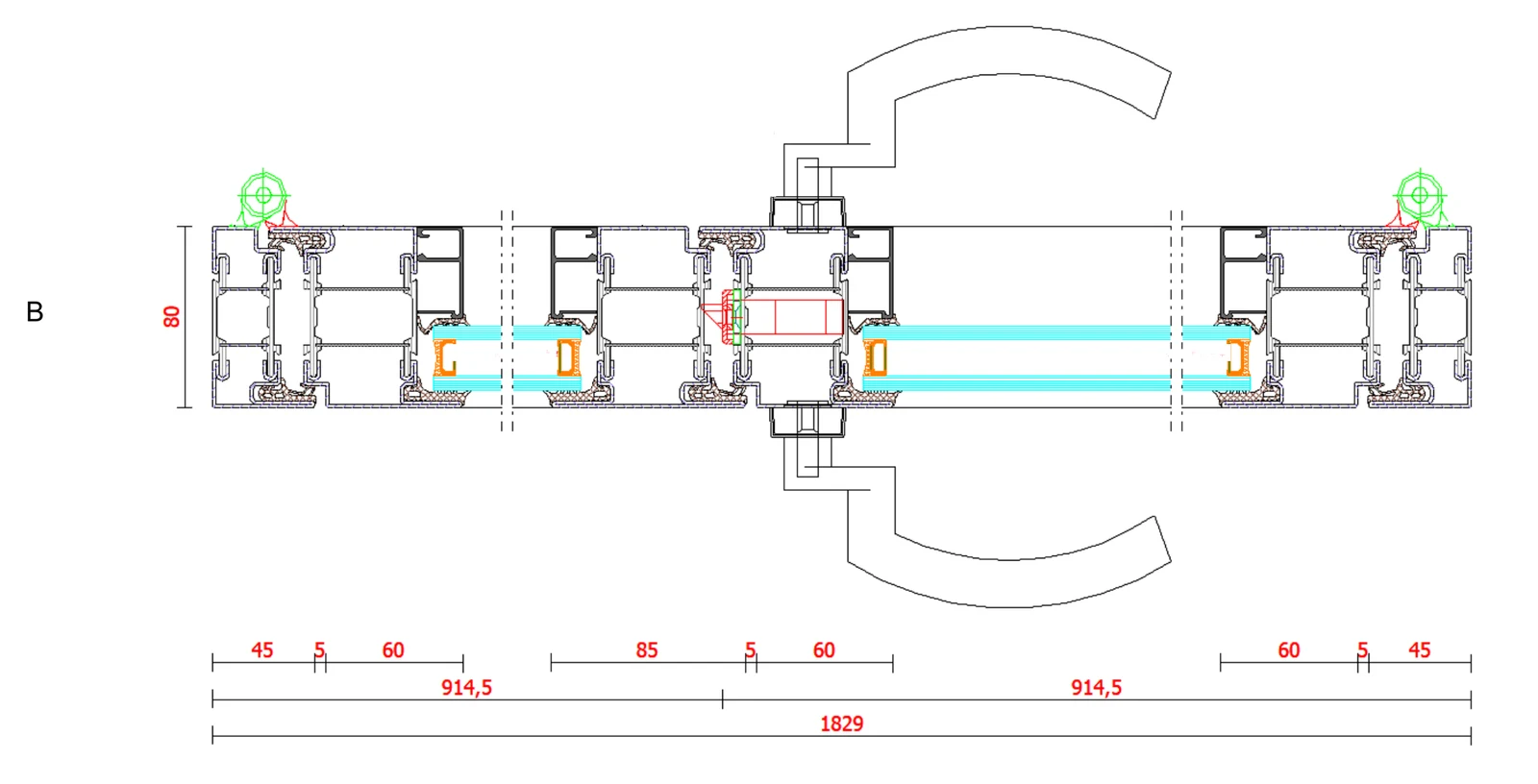
Horizontal section, 3.15 in deep. The insulating bars sit inside the profile chambers and are small at this scale. Redrawn from a quoted configuration. Profile geometry is Jansen's.
What U-Factors Do Thermally Broken Steel Systems Reach?
Jansen publishes frame and whole-unit values for Janisol HI and a frame value for Arte 2.0. For the lift-and-slide it publishes a frame value only, in its safety and security brochure. I list them below with a Btu conversion that is my arithmetic (1 W/m2K = 0.1761 Btu/h-ft2-F, rounded to two decimals).
| System | Quantity | W/m2K (Jansen) | Btu/h-ft2-F | Note |
|---|---|---|---|---|
| Janisol HI door and window frame | Uf, from | 0.74 | about 0.13 | Jansen HI brochure (10.2020) |
| Janisol HI door | Ud | around 1.0 | about 0.18 | Triple glazing |
| Janisol HI fixed glazing | Uw | around 0.69 | about 0.12 | Triple glazing |
| Janisol HI opening window | Uw | around 0.8 | about 0.14 | Triple glazing |
| Janisol Arte 2.0 frame | Uf, from | 1.9 | about 0.33 | Frame only |
| Janisol lift-and-slide frame | Uf, over | 1.7 | about 0.30 | Frame only, Jansen safety and security brochure |
These are Jansen-published European test conditions (EN ISO 10077), triple glazing where noted. They are not NFRC ratings and not a US rating. The whole-unit value for your size and glass is confirmed in the quote.
Frame, Door or Window: Which U-Factor Number Am I Reading?
Uf is the frame alone, Ud is the whole door and Uw is the whole window. Glass-only values (Ug) are a fourth number. The whole-unit value depends on size and glazing, so a frame value alone does not tell you how a window performs.
My reference quotes use double glazing with a Ug of 1.1 W/m2K (about 0.19). The whole-door result is therefore higher than Jansen's triple-glazed Ud of around 1.0. If you need the conversion to US units, what counts as a good U-factor walks through it, and NFRC and NAFS covers the rating path your reviewer may want.
How Does Thermally Broken Steel Compare With Thermally Broken Aluminum?
On published best-case values, Janisol HI is in the same range as the better thermally broken aluminum. The right-hand column below is a different product, steel-look aluminum, taken from the SlimLine 38 system data on this site. If you want the full picture of that side, see how the aluminum version works and the steel versus steel-look comparison.
| Best published whole-window value, triple glazing | Janisol HI (real steel) | SlimLine 38 (aluminum, different product) |
|---|---|---|
| Opening window | Uw around 0.8 (about 0.14) | Classic HI tier: Uw 0.90 (about 0.16) |
| Best published | Fixed glazing Uw around 0.69 (about 0.12) | HI+ tier: Uw 0.74 (about 0.13) |
The thermal numbers are close, so the choice rests on three non-thermal points:
- Weight. A quoted 72 x 96 in Janisol HI double door is about 552 lb for the pair. I compare weight on the exact unit, since it depends on size and glazing.
- Face. Janisol Arte 2.0 reaches a fixed face from 0.98 in (25 mm) and a vent face of 0.79 in. The best SlimLine 38 sightline I list is 2.22 in.
- Finish care. Steel needs its coating kept intact, so ask about the coating system and touch-up for the exact build.
I do not put any price in this comparison.
Will Thermally Broken Steel Windows Get Condensation?
It depends on the build, and a break alone does not guarantee a dry frame. The break raises the interior surface temperature of the frame. Whether it stays above the dew point depends on the frame, glazing, spacer, indoor humidity and how freely room air reaches the frame.
I do not have a published surface-temperature figure for these systems. For a cold climate, ask for an interior-surface-temperature or condensation analysis of the exact build-up. That is why I request one per project instead of quoting a number.
Which Glass Goes in a Thermally Broken Steel Window?
Janisol HI takes triple glazing, with infill up to 2.24 in (57 mm) in doors and 2.64 in (67 mm) in windows. Arte 2.0 takes glass from 0.8 to 1.85 in (20 to 47 mm). The lift-and-slide takes infill of 1.0 to 2.24 in (25 to 57 mm) per Jansen documentation. My reference quotes all use double glazing.
Triple glazing is possible within the depth range and worth discussing for cold climates. For Arte 2.0, double glazing is typical with higher frame values, and Janisol HI is the better fit when the climate needs the lower numbers.
Which Thermally Broken Steel System Fits Which Opening?
Janisol HI fits doors and casement windows, Arte 2.0 slim and arched work, and the lift-and-slide wide sliding openings. Here is what each one covers:
- Janisol HI. Doors, casement windows and fixed glazing in one family. The door side is covered in the steel French doors guide.
- Janisol Arte 2.0. Slim faces, arches and small formats.
- Janisol lift-and-slide. Wide sliding openings. The one I quoted, 234 x 96 in, weighs about 1,955 lb.
The whole range is on the steel systems catalog.
What Should I Ask for in a Quote?
Ask for these six items in writing:
- Which system, and why it suits the opening.
- The whole-unit U-factor for your exact size and glass, and the test standard behind it.
- Double or triple glazing.
- A condensation analysis if the climate is cold.
- Coating specification and touch-up guidance.
- The documents your permit needs, and what exists. European values are not NFRC.
Also ask for the weight of each unit, so handling and anchoring are planned early. Send me your drawings and I will come back with these answered for your project. More on the range is in steel windows and doors for US projects.
FAQ
Does a thermal break make a steel window as efficient as triple-glazed aluminum? On Jansen's published best-case values, Janisol HI is in the same range as the better thermally broken aluminum. The result depends on size and glass.
Are thermally broken steel windows rated by NFRC? I do not have an NFRC rating to cite. Jansen's values are European test data, and I document what exists for the assembly per project.
Do thermally broken steel doors have the same break as the windows? The Janisol HI family uses the same type of glass-fibre reinforced insulating bars in its doors and windows.
Can steel windows rust? Steel is powder coated, and the coating needs to stay intact, so touch up scratches. I make no service-life claim.
Is there a thermally broken steel lift-and-slide? Yes. Jansen's Janisol lift-and-slide uses glass-fibre reinforced insulating bars. Jansen lists a frame Uf of over 1.7 W/m2K (about 0.30) for it, and I have not verified a whole-unit Uw for the assembly I quoted.
Have a steel project in mind? Send me the drawings.
Kai, your window guy!
Technical references: Janisol HI door, Janisol HI windows, Janisol Arte 2.0, Janisol lift-and-slide.