
A window has a fixed frame, one or more movable sashes that carry the glass, and the dividers, seals and hardware that join them; a European drawing and a US catalog use mostly the same words for these parts, with five differences - rebate vs rabbet, glazing bar vs muntin, fanlight vs transom window, espagnolette vs multipoint lock, gasket vs weatherstripping.
When a shop drawing for European windows lands on a US job, this is the list I keep next to it. Nearly all of the words are the same on both sides of the Atlantic. The five that differ are the ones that cause a wrong assumption on a call with a framer or a plan reviewer.
What are the main parts of a window?
The main parts of a window are the frame, the sash, the glass unit, the glazing bead and the seals. This table covers each part and where it sits.
| Part | What it is |
|---|---|
| Frame | The fixed part anchored into the wall opening. It has a head (top), jambs (sides) and a sill (bottom). |
| Sash | The framework that holds the glass. It is movable on an operable window and fixed (non-operating) on some fixed windows. |
| Glass unit | The sealed insulating glass unit (IGU) set in the sash or frame. |
| Glazing bead | The strip that holds the glass in its recess. |
| Gasket | The compressible seal between sash and frame, or between glass and profile. |
| Drip cap | A horizontal molding at the head that diverts water from the top casing so it drips beyond the outside of the frame (definition as in the Knebel Windows glossary). |
The glass unit is where most of the energy numbers come from: the low-E coating, the argon fill, the warm-edge spacer and the number of panes (triple glazing is the third pane).
What is the difference between a window frame and a sash?
The frame is the fixed part anchored into the wall opening, and the sash is the part that opens and carries the glass. A direct-glazed fixed window has only a frame, with the glass set straight into it, while other fixed windows hold the glass in a non-operating sash. On an operable window the visible band you see from the room is the frame plus the sash.
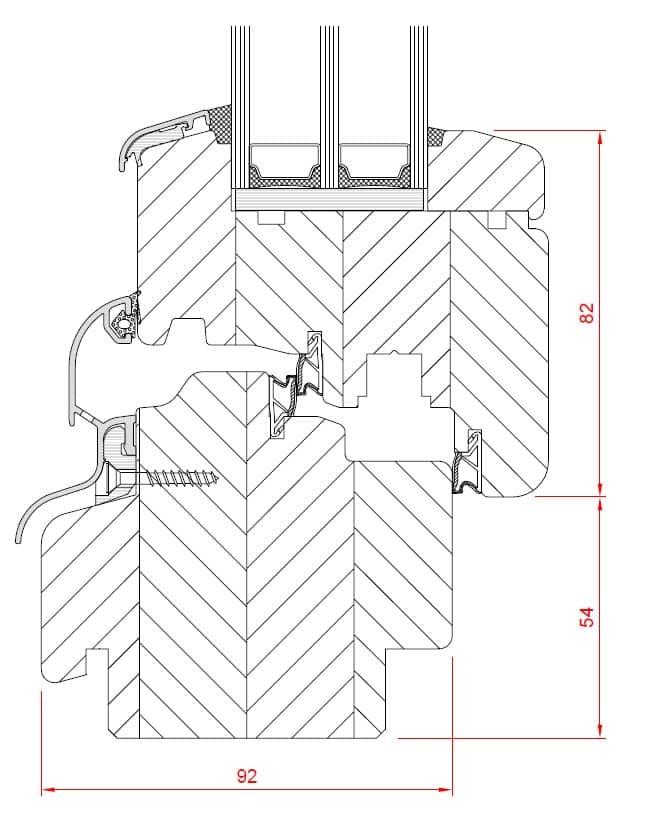
A section drawing like this one shows both parts at once. I walk through reading one in the wood frame, sash and sightline guide. One naming trap: in US and UK usage, a "sash window" or "hung sash" means a window with sashes that slide vertically. In this post, "sash" means the framework that carries the glass, which is movable on an operable window.
What is the difference between a mullion, a transom and a muntin?
A mullion divides separate window units, a transom is a horizontal bar or the window above a door, and a muntin divides a single sash into smaller panes. This table sets the three side by side.
| Term | What it is | Direction | Usage note |
|---|---|---|---|
| Mullion | The element dividing units of a window or screen | Vertical | Often confused with a transom |
| Transom | A horizontal crosspiece, including the one separating a door from the window above it | Horizontal | The window above is a "transom window" in the US, a "fanlight" in Britain |
| Muntin | A strip of wood or metal that separates and holds panes of glass in a sash | Either | "Glazing bar" in Britain; in the US the word "mullion" is also confused with it |
So I say mullion for vertical and transom for horizontal. A mullion can be a separate profile between two units or part of a sash. A grille is a decorative piece that mimics muntins without dividing the glass.
What do Europeans call the parts of a window that Americans name differently?
Five terms differ, and the table below lists each with its US equivalent. The words are usage, not a standard, so use the table to translate a drawing and not to settle a dispute.
| European term | US term | Note |
|---|---|---|
| Rebate | Rabbet | The recess cut into the sash where the glass sits |
| Glazing bar | Muntin | Divides a sash into panes |
| Fanlight | Transom window | The window above a door |
| Espagnolette | Multipoint lock (locking bar) | The locking bar driven by one handle; see the multipoint lock entry |
| Gasket | Weatherstripping | Same job; on the systems I quote the gasket sits in a groove in the profile |
| Sash | Sash | Same word on both sides |
What parts does a European tilt-and-turn window have that a typical US window does not?
A tilt-and-turn window has a concealed locking bar, a perimeter compression gasket and a gear box that a typical single-latch US window lacks. This list covers the parts you will see named on the drawing.
- Espagnolette. A continuous locking bar around the sash with 4-8 or more locking points, driven by one handle. See how the hardware works.
- Mushroom cams and strike plates. The cams on the bar engage strike plates in the frame and pull the sash into the gasket.
- Hinges. Corner hinges carry the weight of the sash.
- Handle and gear box. The gear box turns the handle rotation into tilt or turn movement. The handle positions are in the diagram below.
- Adjustment points. Hinges and strikes adjust sash height, lateral position and compression depth.
- Frame construction. Aluminum profiles use a continuous polyamide thermal break and uPVC profiles use multi-chamber sections, with the gaskets in the profile.
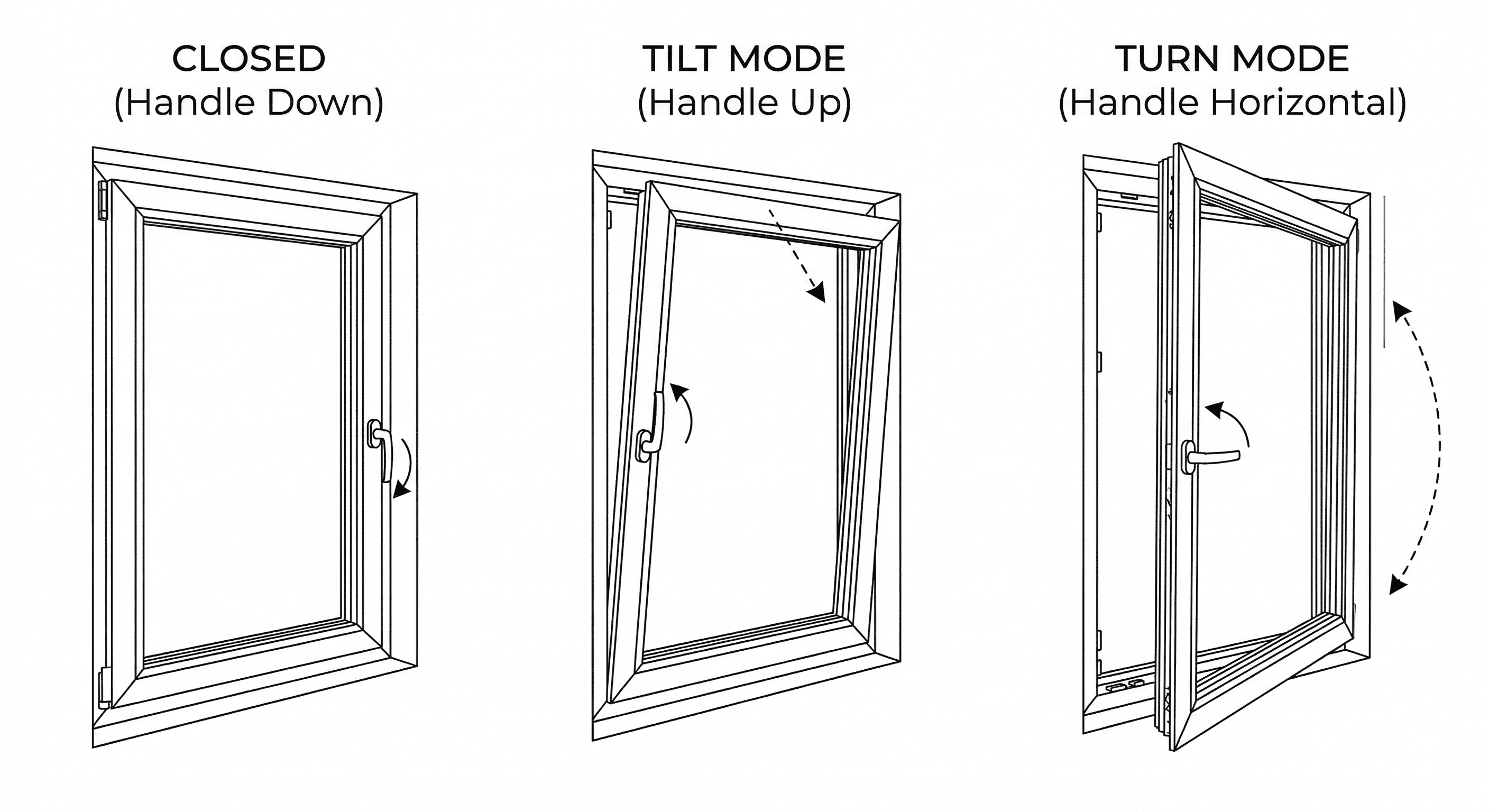
Tilt means the top of the sash tilts inward for ventilation, and turn means the sash swings inward like a door. Tilt mode is a ventilation position, which matters for the question of tilt-and-turn egress.
How do I read these parts on a shop drawing or a quote?
Read a drawing by locating four things: the frame and sash depth, the side the glazing bead is on, which sash opens, and where the mullions and transoms sit. Follow these steps in order.
- Check the frame depth, measured front to back through the wall, against the face width you see from the room. They are different numbers.
- Find the glazing bead. On the wood systems I quote it sits on the interior side, so a glass unit can be replaced from inside.
- Mark which sash opens and which are fixed, and whether a fixed unit has a fixed sash or the glass set straight into the frame.
- Locate every mullion and transom, because they decide where your opening is divided.
- Convert the units. A drawing in millimeters needs imperial values for your framer: 54 mm is 2-1/8 in and 82 mm is 3-1/4 in. See reading a European quote in US units.
Then compare the drawing with your framing. The rough opening sizes guide and the rough opening and nailing fin entries cover the wall side of the same detail.
For the window itself, read how a tilt-and-turn window works, then run your sizes through the estimator or request a quote and I will send drawings you can read with this list.
FAQ
What is a window sash? A sash is the framework that holds the glass of a window. It is movable on an operable window. A direct-glazed fixed window has no sash, only a frame with the glass set into it, while a fixed sash is a non-operating one.
What is the difference between a mullion and a muntin? A mullion divides separate window units and runs vertically, while a muntin divides a single sash into smaller panes. In the US the two words are often confused.
What is a window transom? A transom is a horizontal bar between glazed units, or the window above a door. The window above a door is called a transom window in the US and a fanlight in Britain.
What is a rebate in a window? Rebate is the British and European word for the recess in the sash where the glass sits. The American word for the same joint is rabbet.
What do I call the locking bar on a European window? The locking bar is the espagnolette. A US spec describes the assembly as a multipoint lock.