
If you're planning to import windows and doors from Europe for a U.S. project, the hard part is almost never finding a factory. The hard part is making sure the product is right for the opening, compliant for the jurisdiction, priced clearly enough to budget against, and delivered without breaking your schedule. That is where most U.S. buyers get exposed - not at the factory door, but in the gaps between sourcing, engineering, customs, and the jobsite.
To import windows from Europe to the US, you need five things in place: a window schedule matched to the right European system, US compliance data where the permit asks for it (NFRC, NAFS), a landed DDP price rather than a factory price, approved shop drawings, and one party who owns freight, customs and delivery. Plan on roughly 9 to 16 weeks from approved drawings to your site.
European systems can offer real advantages: lower U-factors, slimmer sightlines, larger operable units, multi-point locking hardware, and finish options most domestic packages do not match. But importing them is not a retail purchase. For a custom residence or architect-driven build, it is a procurement and coordination exercise that touches design, engineering, freight, customs, and installation - in that order.
Here is how I run that process for U.S. projects without creating risk.

The One-Minute Version
- Define project inputs first - frame material, performance targets, opening types, sightlines, glazing, finish, and budget range.
- Match those inputs to the right European system, not to a brand you have heard of.
- Confirm the package can support NFRC and NAFS discussions for your jurisdiction before you commit.
- Build a landed cost, not a factory cost - the factory invoice is one line in the budget.
- Freeze shop drawings on time - approval delays move freight slots by weeks.
- One accountable party handles freight, customs, and site delivery - not three different vendors.
| Import step | Who owns it | Typical time |
|---|---|---|
| Window schedule and system selection | You and your architect, with me | Budget estimate the same or next working day |
| Landed (DDP) price | Me | Line-item quote, often on 2-3 systems |
| Shop drawings | Me and the fabricator; you approve | 2-3 working days after review, plus your review time |
| Production, freight, customs, delivery | Fabricator and me (DDP) | Roughly 9-16 weeks from approved drawings for uPVC and aluminum, by material and coast; wood and aluminum-clad wood confirmed per order |
| Installation | Your installer | Local schedule |
Start with the project, not the factory
The first step is not requesting quotes from ten manufacturers. It is defining what the project actually needs in writing. That means frame material (aluminum, PVC, wood, or aluclad), thermal targets, opening configurations, sightline priorities, glass build-up, hardware expectations, finish color or wood species, and a realistic budget range. If those inputs are vague, every quote that comes back will be vague too - and revisions will multiply until someone loses patience or money.
A builder cares about schedule and field coordination. An architect cares about frame depth, mullion conditions, and corner details. A homeowner usually starts with aesthetics but still needs to meet coastal, mountain, or energy requirements. All three perspectives have to be aligned before procurement starts. Otherwise the imported package becomes expensive for the wrong reasons.
In practice, the cleanest imports start with a complete window and door schedule tied to current plans and elevations. From there, I can identify which European systems are actually suitable instead of forcing a preferred brand into openings it does not fit. If you want a structured way to evaluate suppliers first, my guide on evaluating a European window supplier for the U.S. covers the operational questions to ask.
Match systems to the project, not the other way around
One of the biggest mistakes in this category is assuming European system providers are interchangeable. They are not. Some are strong in passive-house-grade tilt-turn packages. Others are better at large aluminum lift-and-slide doors, specialty geometries, or aluclad systems. Some are flexible on custom colors and details. Others are stronger on lead-time discipline.
Concretely: Reynaers and Aluprof are strong on aluminum systems where slim sightlines and large openings matter - profiles like the Aluprof MB-79N CSF for thermally broken windows or the MB-77HS for large lift-and-slide doors are common picks on architect-driven projects. Aliplast covers a broader range including economy aluminum where budget pressure is real. uPVC systems are often the right answer when a low U-factor matters more than sightlines; wood and aluminum-clad wood systems are the choice when the brief calls for a timber interior - see wood windows and aluminum-clad wood windows.
That matters because the best source for one project may be the wrong source for the next. A modern home in California, a high-altitude build in Colorado, and a contemporary residence in the Northeast may all need different systems, even if they look similar on a mood board. If you are still weighing material categories, the aluminum vs PVC developer guide walks through how each performs in real projects. If you are looking at Polish fabricators specifically - I'm based in Wroclaw - windows from Poland covers what changes on that route.
The right questions to ask a system provider are operational, not marketing. Can they produce to the exact configuration required? Do they have the certifications and testing documentation for U.S. use? Can they issue clean shop drawings? Are their lead times realistic? Do they understand U.S. project context - delivery sequencing, jobsite expectations, freight planning?
Compliance is where many imports go sideways
For U.S. buyers, compliance is not a side issue. It is central.
Imported windows and doors should be reviewed against the project's specific code and performance requirements. That can include structural performance (NAFS), air infiltration, water resistance, thermal performance (NFRC ratings), impact requirements in coastal jurisdictions, and labeling expectations. The right package for one jurisdiction may not work in another.
A common mistake is assuming that strong European testing - CE marking under EN 14351-1 - automatically satisfies U.S. approval pathways. It often does not. EN 14351-1 establishes performance characteristics for the EU market. U.S. acceptance often relies on NFRC-rated U-factor and SHGC values, plus AAMA/NAFS structural data when reviewers ask for it. Some configurations have this documentation ready; others do not - and that is where buyers and design teams get tripped up.
If your project is in California, Title 24 adds energy-specific requirements - I cover the zones, the NFRC question and wildfire glazing in European windows in California. ASHRAE 90.1 and the IECC drive most commercial and residential energy compliance elsewhere. For the detailed pathway, my breakdown of NFRC and NAFS certified European windows covers what reviewers usually ask for and what gets rejected.
The reason direct factory buying often becomes messy is not product quality. It is translation. A factory knows its own product; it does not always know how a U.S. architect, builder, or building department needs the information organized. The package that gets approved is the one delivered in the format the reviewer expects.

Build a landed cost, not a factory cost
The factory quote is one line in the budget. To import European windows commercially, you need to plan for production cost, packing and crating (including oversized units), inland transport in Europe to the port, export handling and documentation, ocean freight (typically FCL for mid-sized projects, LCL only for very small ones), marine insurance, U.S. customs clearance and broker fees, duties where applicable (the HTS classification of the actual product decides the treatment, confirmed with the customs broker), port and terminal handling charges, final-mile delivery (sometimes with crane or liftgate requirements), and a realistic contingency for schedule movement.
For background on tariff exposure on European fenestration, see my 2026 window tariffs cost guide; for what a landed price looks like next to the factory number, my estimator shows both for your schedule, and how much European windows cost has the per-square-foot ranges. Buyers often discover that a "cheaper" factory quote is actually more expensive once freight, duties, and missing scope are added back. The reverse is also common: a quote that looked high included details others left out. The question is never "who is cheapest at the factory" - it is "who gave the clearest landed project price."
If keeping landed cost under control is the priority on a specific project, the playbook in lowering window costs in high-end homes is a good reference.
Shop drawings drive the timeline
Once the system and supplier are selected, the process moves into detailing. This is where dimensions, handing, mullion conditions, thresholds, hardware, glazing, finishes, and install interfaces are locked in. If approvals drag, production drags - and the container slides by weeks.
Good shop drawings do more than confirm sizes. They show how the package will behave on the building: frame build-up, opening clearances, sill conditions, recessed tracks, extension profiles, and coordination with waterproofing, cladding, and shading. A threshold decision affects floor build-up. A frame depth decision changes trim alignment. A glazing composition change affects weight and crane planning.
The buyers who stay on schedule are the ones who treat shop drawing review as a construction milestone, not an admin task. Decisions get frozen, signed, and not reopened.
Freight, customs, and delivery need a single owner
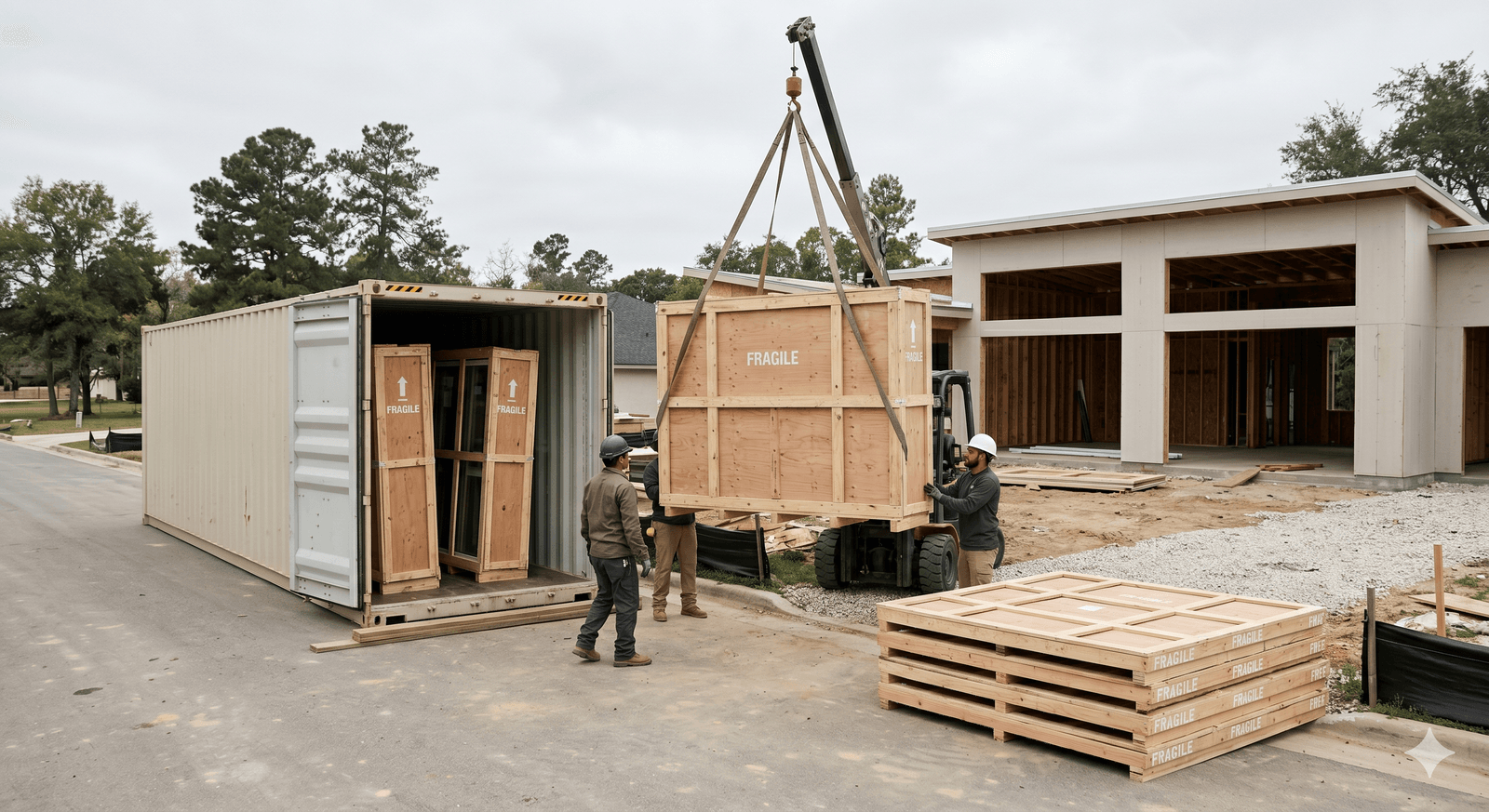
By the time the container moves, the critical work should already be done. Ocean freight is predictable when the order is packed correctly, documented properly, and shipped on a realistic timeline. Customs is predictable when the paperwork is complete and the description matches what is in the box. Delivery is predictable when site access, unloading, and sequencing have been addressed before the container arrives at the port.
Problems come from fragmentation. One party quotes, another manufactures, a third books freight, a fourth clears customs, and the builder is left chasing updates while the framing crew waits. Nobody owns the chain end-to-end, so every gap creates delay.
This is why many U.S. buyers prefer a single-point-of-contact approach - one accountable party managing pricing, technical review, shipping, customs, and site delivery as one workstream. If you want a DDP (Delivered Duty Paid) model specifically, my DDP import guide covers exactly what that looks like in practice.
Common pitfalls
The most expensive errors are predictable. Ordering before the schedule and elevations are stable, so revisions multiply and revisions cost. Comparing non-equivalent quotes - one supplier excludes freight, another includes it, one assumes double glazing, another quoted triple. Without a like-for-like basis the cheapest quote is not really cheapest. Underestimating compliance review, because EN 14351 numbers do not automatically become NFRC numbers. Waiting too long to approve shop drawings - a two-week delay in approvals is a two-week delay in production, and freight slots do not wait. Treating installation as an afterthought, even though European systems only perform as rated with the right tolerances, flashing approach, and seal transitions. And buying too early or too late: place the order roughly 9 to 16 weeks before the windows need to be on site, plus however long your shop-drawing review takes, depending on material and coast.
What a good import process looks like
A good process is straightforward. The project team defines the right performance and design inputs. Suitable systems are compared across multiple system providers, not just one familiar name. Pricing is built on a like-for-like landed basis. Compliance is checked against the actual jurisdiction. Shop drawings are reviewed carefully and approved on time. Production is tracked. Freight and customs are coordinated under one plan. Delivery reaches the site with the paperwork, timing, and packaging aligned to the build. That is how importing becomes a controlled procurement exercise instead of a gamble.
FAQs
Do European windows automatically meet U.S. code if they have CE marking? Not automatically. CE marking confirms compliance with EN 14351-1 for the EU market. U.S. acceptance often relies on NFRC values for U-factor and SHGC, plus AAMA/NAFS structural data when a reviewer asks for it. Some configurations carry both; many do not by default. Confirm before committing.
What is a realistic lead time for imported European windows? Plan for roughly 9 to 16 weeks from approved shop drawings to site delivery for uPVC and aluminum, depending on material and coast - the phases are in European window lead times. Custom colors, wood and aluminum-clad wood are scheduled and confirmed per order.
Are duties always charged on European windows? Confirm the actual products, origin and entry date with the responsible importer and customs broker. The European window import cost guide explains what to include in a project-specific DDP comparison.
Who handles customs clearance? Either the buyer (DAP - Delivered at Place) or the supplier (DDP - Delivered Duty Paid). DDP is simpler for U.S. buyers because the seller's side handles brokerage and pays the duty. DAP transfers more admin and risk to the buyer. Every quote I send is DDP.
Can I install European windows with a regular U.S. framing crew? Yes, but the crew needs clear installation instructions, the right bracket and flashing approach, and ideally a short brief from the supplier. The systems are not difficult to install - they are just different from American windows, and the differences matter for warranty. My bracket-mounted installation guide walks through this.
Ready to talk about your import?
Send me your window schedule - even an early draft - and I will come back with a landed budget estimate the same or next working day, or run it through the estimator first for a quick range. No obligation, no factory hand-off, no chasing five different vendors. One person owns your project from pricing through site delivery.
Kai, your window guy!